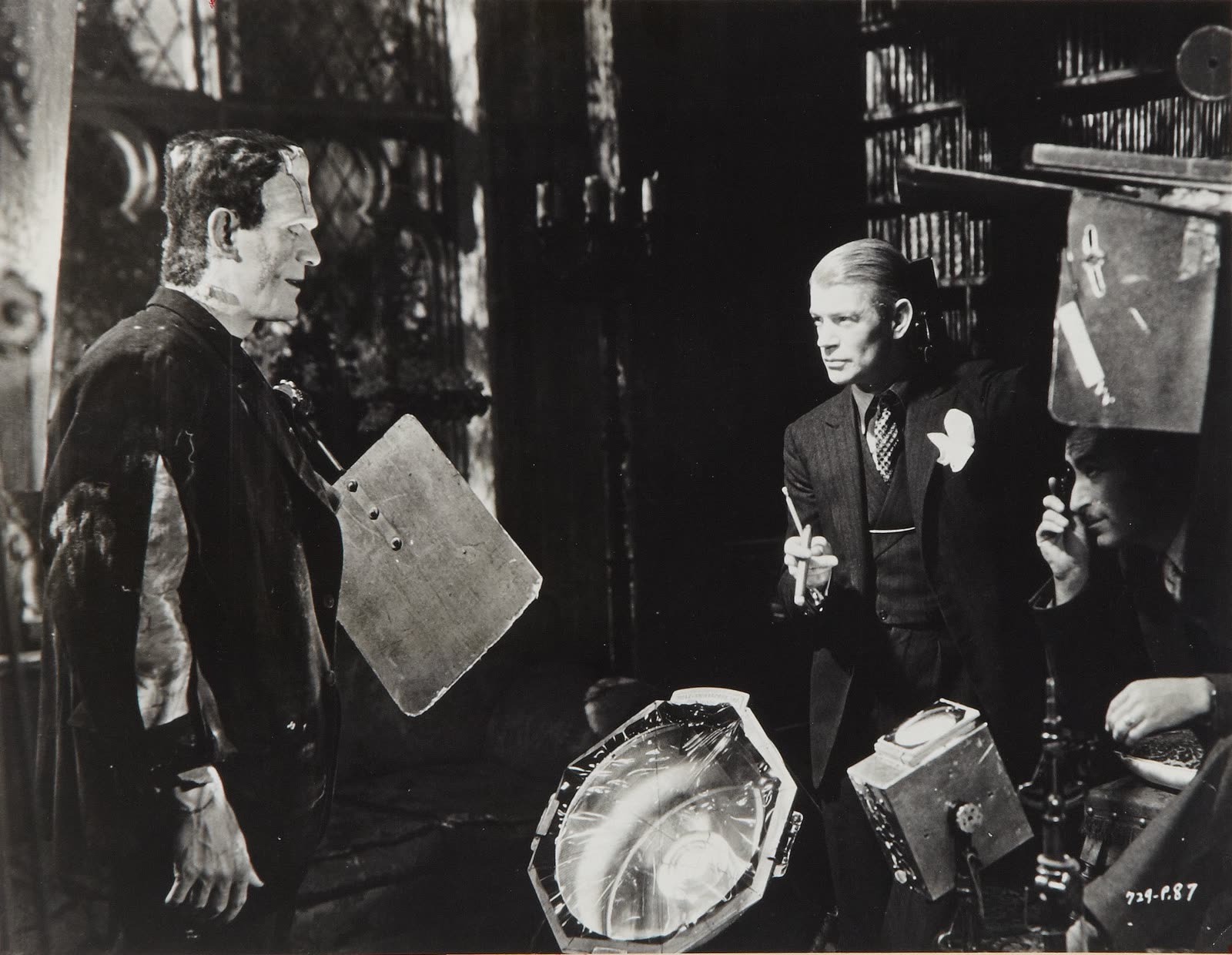
James Whale is still introduced as if the explanation were already finished once someone says "the director of Frankenstein and Bride of Frankenstein."[2][3][5] The label is not wrong, but it is too narrow for the films themselves. Whale did not simply make famous monster pictures. He made social worlds in which monstrosity, wit, ceremony, and embarrassment kept bleeding into one another. That is why his best work still feels alive. The horror is vivid, but the real signature lies in how completely he understands that ordinary life is already theatrical.
That theatrical instinct came with unusual force because Whale never treated the stage and the screen as enemies.[2][3] He arrived in film through theatre, carried a stage director's sense of entrances, tableaux, and eccentric supporting figures, and then used camera placement, cutting, and décor to make those theatrical elements newly mobile. His frames often feel architectural, but never dead. A staircase, laboratory, storm corridor, riverboat deck, drawing room, or dining table becomes a pressure chamber for social performance. People do not merely stand inside these spaces. They try to inhabit rank, flirtation, normalcy, professionalism, or authority inside them, and Whale keeps noticing how effortful that performance is.
*Image context: the lead image uses an archival set photograph from *Bride of Frankenstein, showing Whale with Boris Karloff and cinematographer John J. Mescall.[1] It fits this article because Whale's cinema is not just about creatures or stars in isolation. It is about constructed atmospheres, about the collective labor that turns gesture, costume, light, and décor into a social spectacle with teeth.
He brought class self-invention and stage intelligence into Hollywood form
Senses of Cinema and TCM both stress that Whale's background mattered beyond biography.[2][3] He was not born into the drawing-room assurance that some of his films later satirize so well. He came out of the English Black Country, built himself through theatre, and learned early that class could be performed, defended, and exposed.[2][3] That helps explain why so many Whale films are fascinated by people entering a room and immediately having to negotiate status. The negotiation may be comic, elegant, hostile, or macabre, yet it is almost always visible.
This is one reason Whale's movies feel more worldly than the shorthand term "horror" suggests.[2][4][5] Even before the monster appears, the scene is often already crowded with affectation, vanity, brittle manners, and social misrecognition. Whale likes hosts who overplay hospitality, guests who cannot quite relax into their role, and authority figures whose confidence is one sharp angle away from absurdity. He stages these interactions with a theatre director's pleasure in timing and with a filmmaker's pleasure in visual punctuation. A cut can turn deference into mockery; a doorway can turn elegance into entrapment.
The result is that even his grotesques are rarely sealed off from the rest of the cast as pure Others.[2][3] They emerge from the same world of posture and performance, only with the tensions exaggerated. Whale understood that the so-called normal social body already contains stiffness, masquerade, and ritual. His monsters do not crash into a sane universe from outside. They expose how unstable the universe already was.
In the horror films, the monster matters because everyone is already acting
BFI's essay on The Old Dark House is especially good at showing how Whale's sensibility works once the material turns taboo, funny, and claustrophobic.[4] That film is full of storm-battered arrivals, grotesque family ceremony, suppressed desire, drunkenness, and social comedy so barbed that the horror almost seems to grow out of bad manners. Whale does not treat the house as a neutral spooky location. He turns it into a stage where every gesture carries too much style and too much strain. The camp edge is not an afterthought. It is part of the method.
That same method becomes even clearer in Bride of Frankenstein.[5] TCM's account emphasizes Whale's reluctance to make a sequel until he found a way to approach it with dark farce and a freer, more flamboyant tone. That tonal decision explains why the film still feels so strange and modern. Whale is not trying to preserve solemn gothic purity. He is letting comedy, perversity, spectacle, and pathos coexist in the same constructed world. Ernest Thesiger's Pretorius, Elsa Lanchester's Bride, the miniature homunculi, the laboratory pageantry, the interruptions to heterosexual domesticity: all of it plays like a society of performers who cannot keep their masks from becoming revelations.[2][5]
This is where Whale's monsters become more than icons.[2][4][5] Karloff's creature is moving not only because of makeup or pathos, but because Whale places him in a universe where supposedly civilized behavior already looks contingent and unstable. The monster's loneliness has force because the normal world around him is full of brittle ceremonies that are not much less artificial than a laboratory creation scene. Whale keeps shifting the viewer's attention from the abnormal body to the theatricality of the social order judging that body.
Seen this way, the queer and camp afterlives of Whale's films do not feel like retrospective overlays imposed from outside.[2][4][5] They grow from the films' own textures. Whale repeatedly stages normalcy as something assembled through costume, ritual, architecture, and performance, then lets oddity and desire disturb that assembly from within. The effect is mischievous, but it is also analytical. He makes social order look handmade.
Show Boat proves the method was larger than horror
If Whale had only made the great Universal horror films, his place in cinema history would already be secure. Show Boat matters because it proves the same directorial intelligence could move into a different register without losing its shape.[2][6] Criterion's essay on the 1936 film is clear that Whale was not an accidental hire. His mixture of visual daring and delicate handling of dramatic situations made him a natural choice for a story that needed pageantry, intimacy, ensemble control, and shifting tones all at once.[6]
What carries over from the horror films is not monsters but staging.[2][6] Whale remains absorbed by thresholds, ensembles, and the friction between public show and private cost. On the riverboat, people are always entering a role before others, stepping into spectacle, or discovering that spectacle has social consequences. The camera responds by organizing bodies across decks, backstage spaces, and performance areas with the same precision Whale had brought to laboratories and uncanny mansions. He still thinks in terms of constructed social worlds; he simply changes the music.
That reach is crucial for understanding why Whale lasts.[2][3][6] He was not a specialist locked inside one spooky niche. He was a director of social performance whose horror films happened to provide the sharpest laboratory for his ideas. Show Boat reveals the continuity: Whale cares about how people occupy roles, how décor turns feeling public, and how spectacle can hold both delight and discomfort in the same frame.
Why Whale still feels modern
Whale's durability comes from this double gift.[2][4][5][6] He knows how to build images that readers of film history can recognize in an instant, but he also knows how to fill those images with unstable human weather. The famous sets, lightning, veils, bolts, shadows, and processions endure because they are not empty surfaces. They are social arrangements under pressure.
That is why the best way to describe Whale is not simply as a horror master, even though he certainly was one.[2][3][5] He was a director of worldly artificiality. He understood that people build themselves through costume, class aspiration, flirtation, etiquette, labor, and performance, and he found cinema forms equal to that understanding. His monsters remain unforgettable because they arrive in films that already know civilization can be just as staged, just as fragile, and just as strange.
Sources
- Wikimedia Commons, "File:Karloff-whale-mescall-bride opt2.jpg" - archival set photograph metadata and file page.
- David Lugowski, "Whale, James," Senses of Cinema.
- Turner Classic Movies, "Behind the Scenes with director James Whale."
- Joseph McBride, "Why there's more going on in The Old Dark House than you might think," BFI.
- Jay Steinberg, "Bride of Frankenstein," Turner Classic Movies.
- Gary Giddins, "Show Boat: Rollin' on the River," The Criterion Collection.