Spoiler note: this essay discusses the ending of I Know Where I'm Going!, including the Corryvreckan sequence and Joan Webster's final change of course.
The title I Know Where I'm Going! sounds like a declaration of freedom, but Powell and Pressburger treat it more like a diagnosis.[1][2][4] Joan Webster arrives in the film not as a fool, a dreamer, or a helpless romantic. She is efficient, punctual, socially fluent, and proud of her own decisiveness.[2][4] She has known what she wants since childhood, the ACMI note says, and what she now wants is to marry wealth on a remote Hebridean island.[4] Her certainty is real. So is the film's suspicion that certainty of this kind may only be another form of captivity.
That is why the movie feels so strange and so enduring. On paper it is a romantic interruption story: Joan heads north to marry the industrial magnate Sir Robert Bellinger, weather blocks the last stretch of travel, and on Mull she meets Torquil MacNeil, the local laird who becomes the human face of everything her plan had excluded.[1][2][3] Yet the film's real subject is not simply whether Joan chooses one man over another. It is whether a life can be built as a line of appointments, purchases, and destinations without anything unplanned being allowed to make a claim on it. Powell and Pressburger do not answer that question with abstract speeches. They answer it with mist, ferry delays, island custom, and finally the whirlpool.
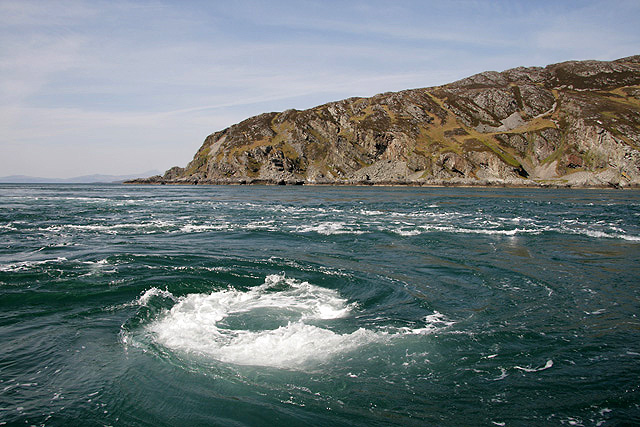
Image context: the cover now uses a real photograph of the Corryvreckan whirlpool rather than a film still.[5] That choice fits the post-publish image rule and also sharpens the article's argument: the water is the film's most physical answer to Joan's fantasy that life can be routed by intention, money, and schedule alone.
Joan's certainty is a money rhythm before it is a love story
The film's opening movement makes Joan's ambition feel almost aerodynamic.[2][4] She does not drift toward marriage; she organizes herself toward it. The BFI's seventieth-anniversary feature is especially helpful here because it describes the film as part of Pressburger's "crusade against materialism."[2] That phrase gets to the center of Joan's character. She has translated value into destination. Marrying Bellinger means arriving at the correct station in life, and because she experiences that arrival as rational, she can mistake calculation for self-knowledge.
The movie never reduces her to greed alone.[2][4] Joan is brisk because she has been trained to be brisk. She belongs to a Britain in which class confidence, financial aspiration, and wartime discipline have fused into a whole temperament. She knows how to order dinner, manage luggage, instruct staff, and convert every obstacle into a scheduling problem.[2] The title therefore carries an edge from the start. Joan knows where she is going in the sense that accountants, fathers, and timetables know: by fixing a target, pricing the route, and refusing emotional leakage.
What Powell and Pressburger expose is the poverty inside that fluency. Joan can price transport, but she cannot price weather. She can name her destination, but she cannot command passage to it. The farther north she travels, the less the world cares about the authority of her plan.
Mull changes the scale of reality
BFI's British-islands list describes the film's Hebridean setting as a "satellite world of capricious weather, myth, curses and tradition."[3] That is more than atmosphere. It is the movie's counter-system. Joan begins in a social order where intention moves forward in straight lines: city to train, train to boat, boat to husband, husband to status. Mull bends every line. Fog thickens. Boats do not leave when money wants them to leave. Local knowledge matters more than metropolitan impatience. The island is not picturesque resistance to modern life; it is a practical reminder that the world contains conditions outside the reach of will.
This is why the film's treatment of place feels richer than a simple city-versus-country fable.[1][2][3] Torquil is not some pure pastoral corrective. He is himself tied to history, war, family burden, and damaged inheritance.[2] The BFI feature notes that the long wartime presence of soldiers has scarred local life and wrecked an ancestral house.[2] The island is not timeless. It has absorbed pressure of its own. But it still retains something Joan lacks: an understanding that value may come from belonging, memory, risk, and obligation rather than from acquisition alone.
Powell and Pressburger make that lesson physical. Wind on the shoreline, blocked crossings, steep roads, ceilidh rooms, and old stories do not sit around the romance as local color.[1][2][3] They change what kind of perception is possible. Joan's language of efficiency starts sounding thinner because the island requires attunement rather than command. She has to listen, wait, and notice. That is the film's first real conversion.
The title becomes ironic only because it first had to be true
One of the film's great achievements is that Joan's self-assurance never turns ridiculous.[2][4] If she were merely vain, the story would be easy. Instead, she remains recognizably admirable almost all the way through. She is smart, capable, and not wrong to want a life larger than the one assigned to her. What the film challenges is narrower and more unsettling: the belief that desire becomes legitimate simply because it has become organized.
That is why Torquil matters less as an alternative groom than as an alternative relation to uncertainty.[1][3] He does not out-plan Joan. He inhabits a world where planning has to negotiate with sea, weather, ancestry, and accident. Around him, the film starts loosening Joan's devotion to the straight line. Schedules give way to delays, delays to conversations, conversations to exposure. She learns that not all lost time is loss.
The romance works because it emerges from that wider correction. Joan does not discover an inner self that had been waiting intact beneath ambition. She discovers that the self she had called intact was built on exclusion. She had excluded weather, history, community, desire, and the possibility that being stopped might itself be a form of knowledge. The film's comedy and enchantment come from watching that exclusion fail.
The whirlpool is the image of a life no ledger can master
Everything culminates in Corryvreckan, the whirlpool that turns the film's abstract argument into bodily peril.[2][3] Up to that point, Joan's lesson has been inconvenient. At the whirlpool it becomes absolute. No timetable can negotiate with that water. No social poise can civilize it. The sea stops being scenic obstruction and becomes judgment on the fantasy that life can be perfectly routed from one profitable point to another.
The power of the ending lies in the fact that the film does not convert Joan into passivity.[1][2] Surrender here is not collapse. It is the abandonment of a false mastery. By the time she changes course, the title means something different from what it meant at the start. She no longer "knows where she is going" as a purchaser of outcomes. She knows it as someone who has allowed the world to enlarge the terms of the question.
That is the reason I Know Where I'm Going! still feels modern.[1][2][3][4] Its target is not ambition itself. It is the colder fantasy that a life becomes meaningful once every step in it has been correctly optimized. Powell and Pressburger answer with weather, with island time, with a community that has not converted all experience into exchange, and with a heroine who has to learn that direction without openness is only another name for confinement. The film's romance remains intoxicating because the correction is so exact. Joan does not lose herself in mist. She loses the smaller, costlier version of herself that mist was needed to expose.
Sources
- BFI, "I Know Where I'm Going!" re-release page, with synopsis, credits, restoration note, and the still used for this article image.
- Nathalie Morris, "Raise a gin and Dubonnet to Powell and Pressburger's I Know Where I'm Going! at 70," BFI.
- BFI, "10 great films set on British islands" - entry on I Know Where I'm Going!.
- ACMI, "I know where i'm going" collection item.
- Walter Baxter, Wikimedia Commons file page for the photographed Corryvreckan whirlpool used as the article image.