It is tempting to treat A Hard Day's Night as a miracle of timing and leave the matter there.[1][2][3][4] The Beatles arrived on film just as Beatlemania was turning from British uproar into international weather, and Richard Lester happened to catch them before the machine hardened into heritage. All true. But the film still feels alive because Lester did something more exact than mere capture. He turned pop speed into form. Running feet, compartment doors, stairwells, studio corridors, flashbulbs, press-conference volleys, and song-length editing units give the picture its pulse. The result is a movie in which fame is never abstract background noise. It is a pressure system that keeps bodies moving and images snapping into new shapes.[1][2][4]
Criterion's overview gets to the center quickly when it says the film reconceived the movie musical and exerted an incalculable influence on the music video.[1] Bruce Eder's older Criterion essay sharpens the mechanism: Lester's commercial work made him a master of the two-minute film, and A Hard Day's Night is effectively broken into self-contained bursts of that length.[2] BFI, meanwhile, describes the film as a mix of faux cinema vérité and kitchen-sink surrealism, while Maha Albadrawi's recent BFI essay argues that it helped establish the modern pop-star persona by blurring public and private, reality and fantasy.[3][4] Those accounts point to the same craft fact. The picture is loose only on the surface. Underneath, it is a machine for converting Beatlemania into rhythm, blockage, release, and recurrence.
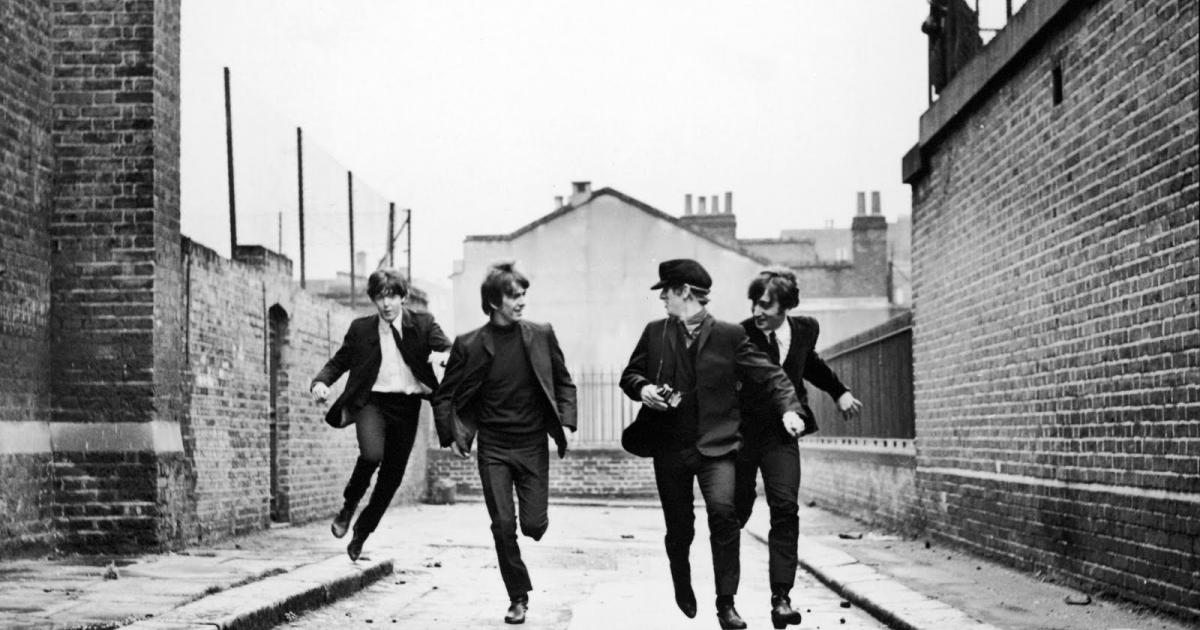
Image context: the lead image uses a black-and-white running still from the film rather than a poster or a later portrait. That choice fits this essay because the movie's great subject is not Beatles iconography in a static sense. It is motion under pressure. The band are always escaping fans, authority, schedules, handlers, or enclosed spaces, and Lester's style keeps treating movement itself as the most truthful portrait of sudden stardom.[1][4]
Running is the film's first and last instrument
The movie announces its method before anyone has time to settle into plot.[1][2][4] The Beatles run, the camera runs with them, fans spill after them, and the title song arrives not as decorative overture but as propulsion. From the start, Lester refuses the solemn entrance usually granted to major stars. The band do not emerge as statues or as carefully unveiled idols. They burst into the frame as a problem of traffic. Their celebrity already has a bodily cost: they cannot stand still for long without someone else trying to fix, sell, package, or corner them.[3][4]
That opening sprint establishes the film's deepest formal argument. Beatlemania is not shown chiefly through big crowd tableaux; it is shown through interrupted passage.[2][3][4] The train compartment is too cramped. The station exit is too exposed. The hotel is full of blocked doors and handlers. The television studio is a maze. Even leisure comes as a stolen interval. Eder is especially useful here because he notes that the film's seeming spontaneity is a cinematic illusion built through tight cutting and staging, with the group's escape from the train serving as the rare truly unstaged event caught in the movie's flow.[2] The point is not raw documentary authenticity. The point is that Lester makes engineered movement feel like the most natural condition of Beatles life.
This is also why the adult world in the film never has to become truly sinister to feel oppressive.[2][3] Businessmen, managers, producers, press figures, and assorted respectable nuisances all try to immobilize the band in one way or another: sit properly, answer properly, wait here, go there, wear this, sell that. The pressure is comic, yet the spatial logic is exact. Adults keep making rooms smaller. The Beatles keep trying to turn those rooms back into pathways. Every corridor corner is therefore a minor political event. It asks whether energy can slip past management before management catches up.[3][4]
The songs work because they are structural detonations, not decorative breaks
BFI is right to note that the songs are not woven into story in the conventional musical sense.[3] They remain songs: rehearsed, performed, or suddenly cut loose as songs. That separation is not a weakness. It is the whole trick. Because the film has already been broken into compact modules of motion and gag timing, the music does not need to pretend to arise naturally from dialogue. It arrives as a formal intensification of energy the movie has already built.[1][2] A Lester sequence is already thinking in pop lengths. When a number begins, it feels less like genre obligation than like the frame finding its most efficient voltage.
The clearest example is "Can't Buy Me Love."[1][2][4] After train compartments, hallways, dressing rooms, and perpetual supervision, the song explodes into open air. The field sequence gives the Beatles room to leap, kick, sprawl, and sprint with no narrative duty except exuberance. Albadrawi points out that the slow-motion jumping there echoes already-circulating Beatles imagery, and that observation matters because Lester is not simply filming a song performance.[4] He is feeding pop iconography back into cinema and then redistributing it through editing. The bodies are suddenly freer than before, but the freedom is still shaped shot by shot, bounce by bounce, landing by landing.
That is why the movie remains a foundational text for later music video grammar without becoming reducible to it.[1][4] The numbers do not exist as detachable inserts pasted onto a weak comedy. They reorganize the surrounding film. A song burst can suspend adult interference, widen space, or briefly turn group identity into pure kinetic pattern. Then the film snaps shut again, back into trains, staircases, makeup rooms, and studio pressure. Each musical release therefore has contour because enclosure has contour. Lester understands that liberation only reads on screen when the viewer has recently felt the walls.
Corridors, control rooms, and press gags turn fame into architecture
About halfway through, George wanders into the television studio's marketing office, and the film quietly explains its own intelligence.[3][4] The scene is funny because George undercuts an ad man's fake expertise with serene mockery. It is sharper than that too. Albadrawi reads the moment as a critique of trend manufacture and the commodification of youth culture, and she is right.[4] George is being asked to become a marketable version of himself written by someone else. The office is therefore not just a comic detour. It is a laboratory in which the movie stages the conversion of living personality into managed image.
The film keeps returning to that conversion by visual means.[3][4] Press conferences reduce speech to ricochet. Contact sheets and photographs turn faces into reproducible tokens. Television monitors multiply the band into screens within screens. Fans, managers, and media people all want access to "the Beatles," but the movie repeatedly shows how unstable that category already is. The four men at the center can play themselves only by slightly performing themselves, and Lester's style never lets the viewer forget the gap between flesh-and-blood motion and flat public avatar.[4]
This is where the corridors matter as much as the jokes. Corridors are spaces of transit, but they are also spaces of supervision. People are always being ushered, delayed, redirected, announced, or prepared for display. The Beatles are funniest when they resist that funneling by acting like boys on the loose rather than product on a schedule.[2][3] Yet the film does not pretend there is a stable private realm waiting outside the machine. Even their escape attempts feed the machine. Their irreverence is the commodity and their refusal is part of the show. That paradox gives the film its modern aftertaste. It knows pop authenticity is already inseparable from performance, and it keeps the knowledge playful instead of grim.[4]
The looseness is heavily engineered
One reason the movie still surprises viewers is that it looks tossed off while being highly controlled.[1][2][3] Eder states the case directly: only two scenes were improvised, and the realism is a masterpiece of illusion, natural lighting, and tight cutting.[2] BFI's page similarly stresses that Lester shot on the hoof for a fast release schedule while mixing visual trickery with deadpan press-conference wit.[3] Those conditions could have produced disposable exploitation. Instead they forced precision. Lester had to make speed legible, not merely frantic. He had to place the Beatles inside frames loose enough to preserve their banter and exact enough to keep the film from dissolving into formless access.
That precision is why A Hard Day's Night remains more than a beloved period artifact.[1][2][4] It certainly preserves a historical instant: the month when the Beatles had conquered America, the moment before their image calcified, the stage when fame still looked funny from the inside.[1][4] But preservation alone would not make the picture so rewatchable. The film lasts because its form is perfectly matched to its subject. Pop celebrity arrives as acceleration, fragmentation, repetition, circulation, and leakage between public script and private impulse. Lester finds cinematic equivalents for every one of those conditions. The songs burst because the edits were already singing. The jokes land because the spaces are already under pressure. The running never stops because stopping would mean surrendering to someone else's frame.
That is the deeper craft achievement.[1][2][3][4] A Hard Day's Night does not merely put the Beatles on camera at the right historical second. It invents a film language elastic enough to hold their speed, cheek, and commercial overexposure without flattening them into brand wallpaper. Running feet, corridor turns, and song bursts are not side pleasures around the movie's core. They are the core. Beatlemania becomes cinema when Lester makes movement itself do the explanatory work.
Sources
- The Criterion Collection, "A Hard Day's Night" film page.
- Bruce Eder, "A Hard Day's Night," The Criterion Collection.
- BFI, "A Hard Day's Night (1964)" film page.
- Maha Albadrawi, "A Hard Day's Night at 60: how The Beatles made the movies pop," BFI.