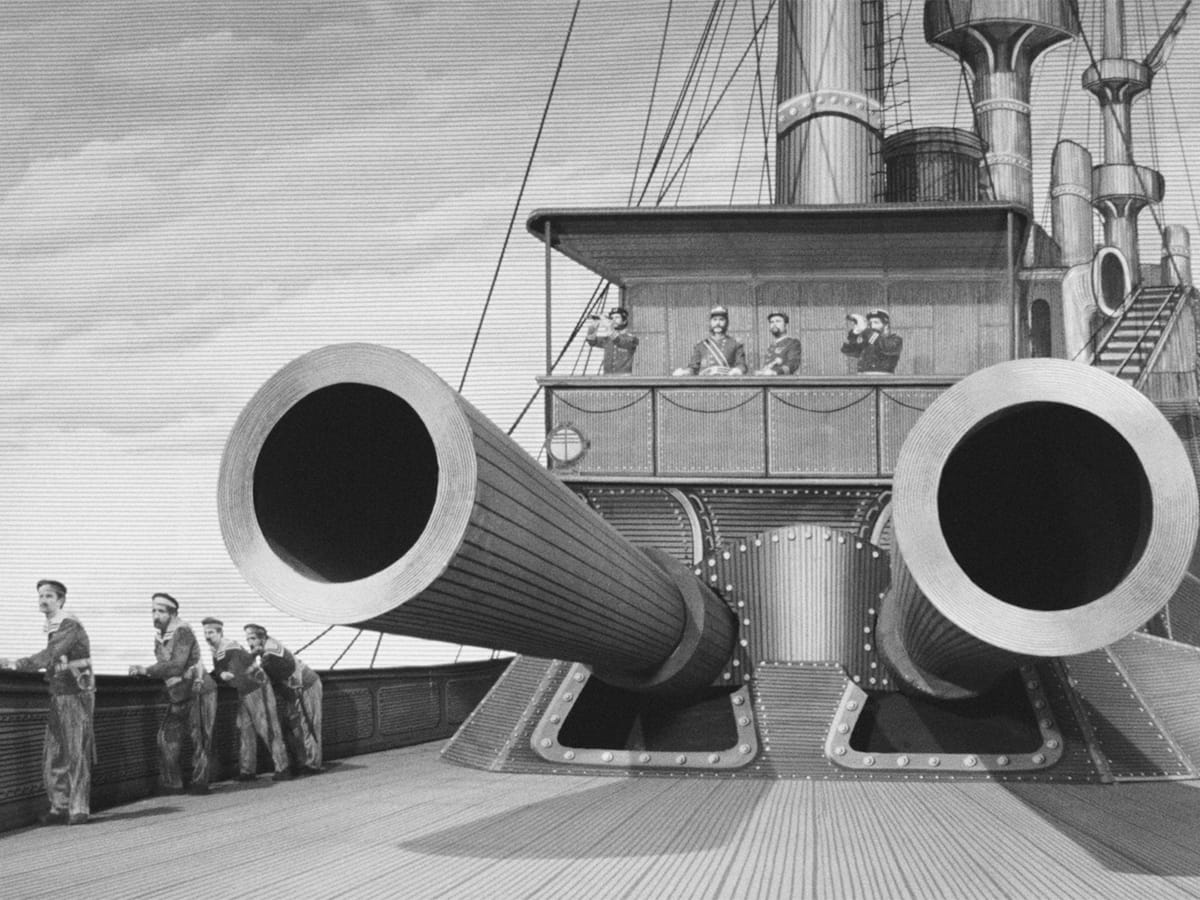
Look at the sky behind the warship. It is not empty gray but a field of close horizontal strokes. Those strokes descend into the smokestacks, run along the enormous gun barrels, cross the deck, and reappear in the sailors' striped clothes. The men are photographic; much of the world around them is built, painted, matted, modeled, or animated. Yet the changes of material do not feel like breaks because every material submits to the same visual law.
That is the central special effect in Karel Zeman's Invention for Destruction (Vynález zkázy, 1958). The film does not make its seams invisible. It makes them rhyme.
Freely adapted chiefly from Jules Verne's 1896 novel Facing the Flag, the Czechoslovak production follows an engineer, his idealistic inventor mentor, and the pirate industrialist who wants their explosive technology. Zeman based its appearance on the nineteenth-century line engravings associated with Verne illustrators Édouard Riou and Léon Benett. He did not use those images merely as concept art for a conventionally realistic film. He treated their hatching as an instruction that scenery, clothing, water, smoke, machines, and photographed bodies would all have to follow.[1][2][3]
The result is often described as a combination of live action and animation. That is accurate but incomplete. Live sets, painted backgrounds, matte work, miniatures, stop-motion, and cel animation are not attractions taking turns. They are coordinated departments inside one moving print.[2][3][5]
Version note: this essay refers to the restored Czech presentation, not the dubbed and retitled American release, The Fabulous World of Jules Verne. The restoration led by the Czech Film Foundation, Karel Zeman Museum, and Czech Television returned material missing from the other available negatives, including a shot of a clock bearing a Napoleonic eagle. Second Run presents the 4K restoration in the original 1.37:1 ratio; institutional listings vary slightly between 82 and 83 minutes.[1][4][5]
The seam is the subject
Most effects filmmaking asks unlike materials to impersonate one another. A miniature should seem full-sized; a painted extension should pass for architecture; a matte edge should disappear. Zeman sets himself a stranger problem. His photographed actors must remain visibly human, and his illustrated world must remain visibly handmade, but neither can look as though it belongs to a different movie.
The solution begins with consistency rather than concealment. In the warship image above, the cannons are not persuasive because they mimic the exact weight and finish of naval artillery. They are persuasive because their concentric rings, ruled barrels, and black openings agree with the deck and sky. The frame offers plenty of depth—the guns project toward us, sailors stand at several distances, stacks rise behind them—but surface treatment keeps pulling those volumes back toward a printed page.
Black and white is essential to that agreement. Color would immediately sort skin, cloth, wood, ink, paint, and model work into different material families. Monochrome lets tone and line do the sorting instead. The compact 1.37:1 frame helps too: Zeman can pack it like an illustrated plate, using rigging, pipes, railings, and borders to bind one plane to the next.[3][4]
This is not a primitive stop on the road to seamless digital compositing. It is a complete alternative idea of compositing. The viewer sees the trick and accepts the world at the same time.
Photograph the actor as if he has already been printed
The hardest object to place inside an engraving is a face. It changes shape continuously, reflects light softly, and carries more tonal information than a drawn background. If Zeman had covered every performer in graphic marks, the people would have become cartoons. If he had left them in ordinary photographic space, they would have floated above the design.
He splits the difference. Faces and hands are usually allowed to remain the clearest photographic facts in the frame. Jackets, trousers, uniforms, upholstery, walls, and floors take on stripes, checks, crosshatching, or strong outlined edges. Simon Hart can turn his head and register alarm as a live actor while the ruled pattern of his coat affiliates his body with the room. The face moves freely; the costume negotiates passage into the page.
Blocking reinforces the bargain. Performers frequently arrange themselves in readable profiles or shallow groups, their gestures crisp enough to survive a busy field of lines. Doorways, portholes, railings, windows, and machinery give them internal frames. Instead of asking the eye to locate a naturalistic person inside undifferentiated spectacle, Zeman keeps making little stages within the larger picture.
The official restoration press kit makes the collaboration visible even in its compact credits: Zeman directed and cowrote the screenplay, Jiří Tarantík led the camera work, Zdeněk Liška composed the music, and a substantial cast carried the live-action layer. Its biography of Zeman also recalls that the technically limited Kudlov studio crew learned on the job and gradually became a coordinated creative team.[2] The unified look is an auteur signature made through collective craft.
Different tricks, one weather
Senses of Cinema identifies etching lines painted onto sets or superimposed over the sea, then names double exposure, painted and cutout animation, stop-motion, puppets, miniatures, models, and matte paintings among the film's methods. The BFI's film record condenses the result to a groundbreaking combination of live action, animation, and design.[3][5] The remarkable thing is not the length of the inventory. It is how rarely the film pauses to announce that one method has yielded to another.
Consider the sea. It does not need to simulate every optical behavior of water. Undulating marks give it the directional energy of an engraving that has learned to breathe. Balloons and aircraft cross skies whose regular hatching makes motion unusually legible. Engine pistons cycle inside the same drafted universe as a diver, a fish, or a plume of ink. The degree of photographic reality changes from shot to shot, but the graphic weather holds.[3]
Zeman therefore solves a common composite-image problem in reverse. Rather than pushing an animated element toward realism until it can hide beside an actor, he asks the photographed environment and performer to come partway toward illustration. A model may keep its model-like precision. A painted wave may remain a painted wave. Because both carry the right lines, their difference becomes expressive texture instead of technical failure.
The transitions also create humor. A machine can be imposing and toy-like at once; an underwater creature can be dangerous without losing the cheerful absurdity of a marginal drawing. The film preserves the pleasure of recognizing how something was made while keeping the adventure in motion. Wonder does not depend on ignorance.
That pleasure also places Zeman in an older effects tradition. A 1989 Museum of Modern Art memorial program called him a successor to Georges Méliès and singled out Invention for Destruction as the film in which he combined live action, animation, and Verne illustration most expansively.[6] Like Méliès, he makes the mechanism part of the invitation: cinema is marvelous because a viewer can feel a human hand arranging the impossible.
Depth arrives in printed layers
An engraving can suggest immense distance on a flat sheet through scale, overlap, density, and atmospheric thinning. Zeman imports that logic into cinema. His deep spaces often behave less like continuous rooms than like stacked plates: a sharply patterned foreground, a band of live action, a miniature or matte construction, then a ruled sky.
Matte paintings, miniatures, models, and superimposition make those layers interact, but Zeman does not erase their planar character.[3] A circular window can hold a distant harbor like an illustration mounted inside the set. A submarine can travel through a lateral seascape whose depth is measured by overlapping silhouettes. A volcano lair can feel enormous because tiny figures, receding architectural bands, smoke, and black apertures establish scale, not because every cubic meter has been built.
This rationing of depth is what lets a crowded image stay readable. The hatching supplies surface abundance; bold silhouettes supply hierarchy. In the warship still, the black mouths of the cannons register first, the human figures second, the vertical machinery third, and the fine-lined sky last. The eye receives spectacle in an order even though almost no part of the frame is visually empty.
Zeman's brisk cutting adds another layer of control. A dense frame does not have to bear every narrative task. One shot establishes the graphic mass of a machine; another isolates the person operating or fearing it; a third releases the invention into motion. The film can make the page restless without dissolving its design into blur.
An antiwar story built from delightful machines
The craft has a productive moral tension. Invention for Destruction warns about scientific ingenuity captured by people seeking domination, but its images are intoxicated with invention. Submarines, airships, cannons, diving suits, optical devices, laboratories, and mechanical interiors are threats and toys at once. Zeman does not solve that contradiction because the film needs it.
If the machines were only ugly, Professor Roch's faith in discovery would look foolish from the start. If they were only marvelous, Artigas's weapon would have no moral weight. The engraved style allows both responses to coexist. It recalls an era when technological progress could be pictured with painstaking optimism, while the story—made in the shadow of modern mass destruction—shows how quickly that optimism can be conscripted.[1][2][5]
Even the composite method participates in the argument. Every invention on-screen is visibly the work of inventors behind the screen. The audience is invited to admire technique without pretending technique is innocent. Craft can build an impossible sea voyage; the same disciplined intelligence, inside the story, can build a doomsday weapon. What matters is not whether invention stops, but who directs it and toward what end.
Restoration had to protect the drawing
The film's dense linework makes restoration unusually revealing. The Karel Zeman Museum reports that the digital project cleaned 117,288 frames and removed more than six million instances of damage or dirt over six months. The team scanned the source material at twice the resolution of the intended master, then graded the black-and-white image against a reference print and period information.[1]
Those details matter because a scratch and an intentional hatch can resemble each other when reduced to a thin pale or dark stroke. Cleaning cannot mean sanding the image into modern smoothness. The task is to remove accidental marks while preserving the very busyness that makes the separate layers cohere. The reference print gives restoration a historical target rather than a generic idea of clarity.
The restored film confirms the audacity of Zeman's choice. He did not make actors disappear into drawings or drawings pass as ordinary reality. He found the narrower, more magical interval where both could remain themselves. Sets have weight. Faces have warmth. Mattes have flatness. Models have scale. Animation has impossible freedom. They hold together because all of them appear to have passed through one hand.
That is why Invention for Destruction still looks unlike almost anything else. Its world does not share one substance. It shares one handwriting.
Sources
- Karel Zeman Museum, “Invention for Destruction” — official film history, Riou and Benett influence, awards, restoration partners, recovered material, frame cleaning, grading, and sound-restoration process.
- Karel Zeman Museum, Czech Film Foundation, and Czech Television, Invention for Destruction restoration press kit — official credits, visual concept, “paper look,” antiwar framing, studio history, and restoration provenance.
- Wheeler Winston Dixon, “Dreams of Jules Verne: Karel Zeman's Invention of Destruction,” Senses of Cinema (June 2015) — critical account of painted and superimposed etching lines, double exposures, animation forms, puppets, miniatures, models, and matte paintings.
- Second Run, “Invention for Destruction” — distributor's 4K restoration record, including the original 1.37:1 presentation, runtime, alternate U.S. version, effects documentaries, and restoration feature.
- British Film Institute, “Invention for Destruction” — institutional film record covering the 1958 Czech feature, 83-minute listing, hybrid live-action/animation design, cast, music, story, and antiwar dimension.
- Museum of Modern Art, “The Baron of Magic: Karel Zeman” (September 1989) — institutional memorial-program record connecting Zeman to Méliès and describing the film's fusion of live action, animation, and Verne illustration.
- The Criterion Collection, official archival still from Invention for Destruction — image source for the warship frame used above.