For millions of French viewers, Med Hondo was a voice before he was a face. Sidney Poitier, Danny Glover, Morgan Freeman, Muhammad Ali, and Eddie Murphy appeared on-screen; Hondo spoke from their bodies in French.[2] Dubbing was not a glamorous detour from directing. It helped make the directing materially possible: Hondo said that eighteen months of dubbing Black American performers financed Soleil Ô. He paired that fact with the industry's racial contradiction—he was denied white roles even as white performers could be hired to dub Black actors.[7]
That split career has often been presented as an irony: one of African cinema's great directors was more widely heard through Hollywood stars than seen through his own work. It is more revealing as a formal clue. Hondo spent decades at the joint where a voice meets an image—and his films keep worrying that joint until it becomes political. Narrators multiply. Songs contradict the scene beneath them. A chorus interrupts an individual story. Dance carries an argument that dialogue cannot contain. Sound does not certify what the camera shows; it talks back.
Dubbing need not be treated as the secret origin of this method. Hondo's theater practice, migrant experience, political commitments, and engagement with African oral forms are just as important.[2][5] But the professional overlap clarifies what is distinctive in his cinema. In the dubbing booth, he made a voice inhabit an image produced elsewhere. As a director, he asked who had produced the image, whose language it demanded, and what other voices could break its authority.[7]
A living made inside other people's pictures
Hondo arrived in France in the 1950s and worked as a cook, dockworker, factory worker, and waiter while studying theater. Black actors, he found, were routinely confined to thin, paternalist, or folkloric parts. He helped build Black theater companies, including Shango and Griot-Shango, that staged writers such as Aimé Césaire, René Depestre, Daniel Boukman, Guy Menga, and Kateb Yacine. He learned filmmaking without attending film school, watching sets and studying movies on his own.[1][2]
Theater gave him more than actors and texts. It offered a model of collective address: one body can speak, a group can answer, and an audience can be made conscious of the room it occupies. Harvard Film Archive connects Hondo's storytelling to the West African griot tradition and to his wish to dismantle the inherited psychology of Hollywood drama.[5] His movies do not simply replace a white protagonist with a Black one inside the same machine. They keep changing who may speak, how long a scene may hold the floor, and whether a character remains one stable person.
The material conditions were inseparable from that aesthetic freedom. In a 1970 interview, Hondo described assembling a team on a participation basis, filming only when people were free, bargaining with laboratories, and shooting Soleil Ô in fragments over roughly a year. Post-synchronization work for radio dramas helped him pay the film's outstanding bills.[1] Criterion's production history adds that he bought 16 mm stock whenever acting income allowed and drew performers from theater, film sets, friendships, and the dubbing world.[3]
Scarcity did not make the film small. It made conventional continuity one option among many—and Hondo had better uses for the gaps.
Soleil Ô refuses the single narrator
Soleil Ô (1970) follows an African migrant who reaches Paris expecting opportunity and meets employment discrimination, exploitative housing, sexual objectification, and daily racism. That description makes it sound like a social-realist descent attached to one hero. The film is much less obedient. It moves through animation, street observation, satire, direct address, staged tableaux, abrupt inserts, songs, and arguments. Robert Liensol plays the central migrant, but he also appears in other roles; several performers share the voice-over. Identity becomes a relay rather than a sealed container.[2][3]
The opening announces the method. An animated colonial encounter is driven by energetic percussion, then punctured by sarcastic laughter and a collective African voice. Live-action figures look directly into the lens and answer the colonial fiction that African history began with European arrival. The soundtrack does not sit behind these images as atmosphere. It changes their grammatical subject: not a specimen being described, but a people speaking back to the system that named them.[3]
Hondo keeps sound and image from settling into agreement. A scene with a sociologist, which could have played as one self-contained exchange, is broken apart and distributed across other episodes. Bureaucratic language about migrant labor is repeatedly interrupted by the lives it claims to explain: job searches, demonstrations, cramped housing, street encounters, and collective debate.[3] The expert's voice loses its right to organize reality uninterrupted.
The same principle shapes the “Apollo” sequence. Georges Anderson's song considers the spectacle of the moon landing against war and hunger while Hondo shows Black migrants walking, shopping, talking, riding bicycles, and occupying ordinary Parisian space. The people in the frame have been rendered socially invisible; the song makes that invisibility impossible to accept as neutral. Image and music do not deliver one slogan in unison. Their friction asks why technological triumph can coexist with a society unable—or unwilling—to recognize lives directly before it.[3]
This is what it means for the soundtrack to talk back. It need not contradict every visible fact. It contests the hierarchy that decides which facts are foreground, which are noise, and who is permitted to connect the present to colonial history.
One ship, four centuries, many rhythms
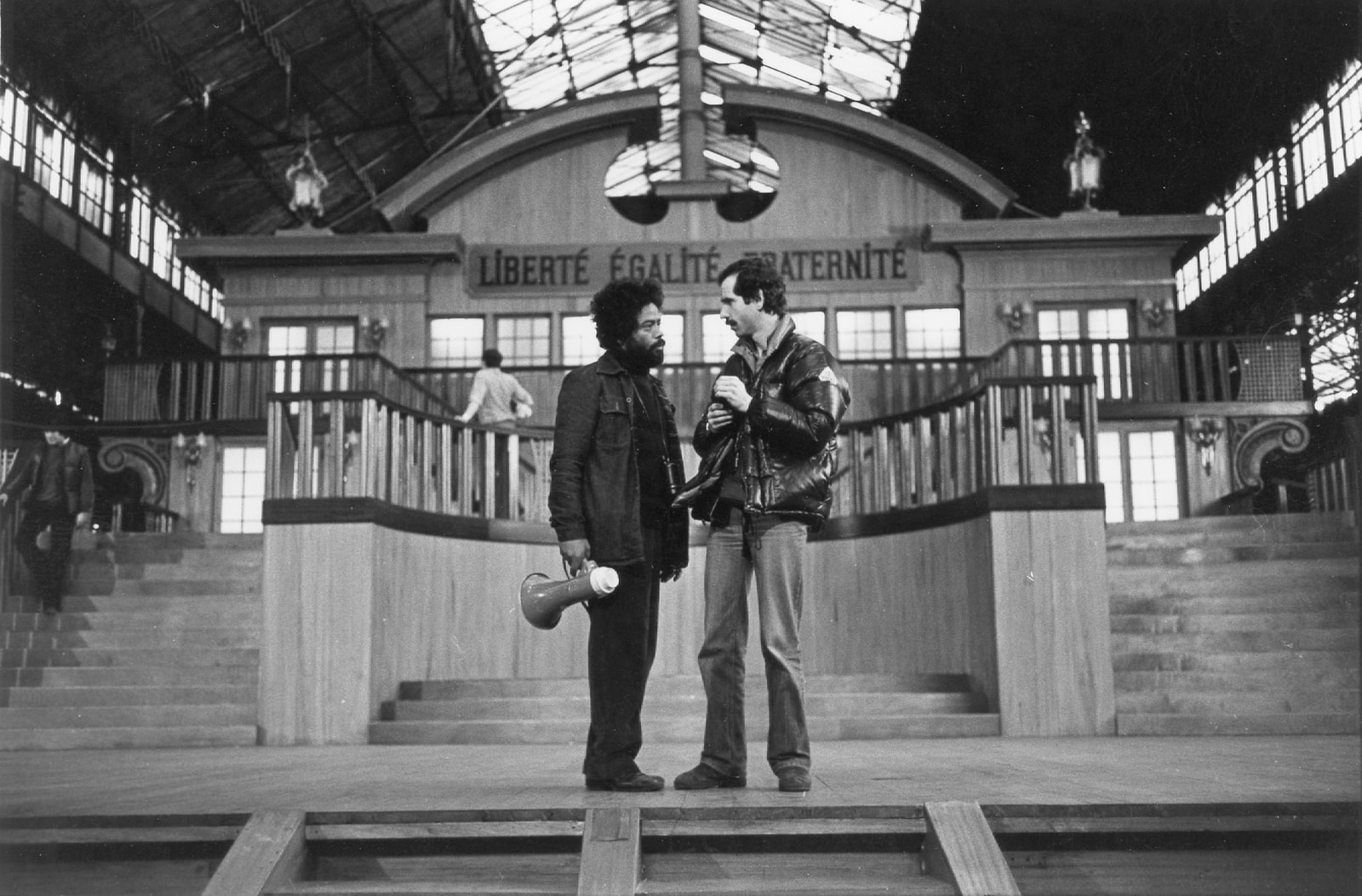
Nine years later, West Indies turned the same argument into a musical built on an audacious physical constraint. Hondo constructed a vast wooden slave ship inside an abandoned Citroën factory in Paris and used it as the film's principal stage. Across roughly two hours, the set holds four centuries of enslavement, Caribbean colonial rule, resistance, political betrayal, and migration to France.[2][4]
The production photograph above catches Hondo inside that feat of coordination.[2][8] A director working on one set might seem to have accepted confinement. Hondo instead makes the ship a historical instrument. The camera can travel from the elevated seats of political, religious, and commercial power to the crowded hold below; it can cross decades within a shot because the hierarchy has not disappeared when the costume changes.[4]
Music makes those continuities audible without making them uniform. A minuet on the upper deck, protest dances below, Parisian swing, and chains beaten into rhythm give different groups distinct relationships to time and power.[4] The numbers do not pause the history for entertainment. They show history being enforced, endured, mocked, remembered, and resisted through bodies moving together.
Hondo said that he wanted to free musical comedy from its American trademark and recover each people's right to its own musical thought.[4] West Indies does not reject Hollywood scale or pleasure; it seizes both and changes their labor. Spectacle is no longer a solvent that makes conflict go down easily. The set keeps rulers and ruled in one vertical field, while the score keeps their incompatible accounts of history sounding at once.
Talking back can also mean refusing speech
Hondo never reduced political sound to loudness. In Watani: A World Without Evil (1998), his first experiment with video, he de-emphasized speech and let crosscut images, graffiti, hip-hop, and lyrics connect an unemployed African sanitation worker to a French banker pulled toward a racist movement. The film's montage argues that their fates occupy one social system even when its institutions teach them to see separate worlds.[2]
That restraint matters. A conventional message film often assigns one character the correct explanation and lets the camera ratify it. Hondo could use a monologue, a chorus, a musical ensemble, a direct look, or a stretch in which speech gives way to rhythm. No device receives permanent moral authority. Form remains accountable to the historical problem in front of it.
The through line is not volume but counter-authority. In Soleil Ô, several voices prevent one migrant from becoming a tidy case study. In West Indies, song and dance make centuries coexist on one constructed deck. In Watani, reduced dialogue allows montage and music to expose a relation the characters may not yet be able to name. Each film denies the dominant image a final word.
The restoration had to recover an argument
The restoration of Soleil Ô makes the stakes unusually concrete. Cineteca di Bologna restored the film at L’Immagine Ritrovata in collaboration with Hondo, with funding from the Hobson/Lucas Family Foundation and The Film Foundation’s World Cinema Project. The work drew on a 16 mm reversal print and duplicate negatives Hondo had deposited at Ciné-Archives, with a vintage Harvard Film Archive print as a reference. For sound, the restorers digitized the original 16 mm magnetic tracks and preserved the particular dynamics of the percussion and chants; missing material had to be recovered from a 35 mm soundtrack.[6]
Those details are not technical aftercare to a primarily visual masterpiece. If the percussion were flattened, the voices cleaned into false uniformity, or the music treated as detachable accompaniment, the film's political architecture would change. Restoration had to preserve the distances among word, body, rhythm, and frame because those distances are where Hondo directs.
His career leaves a productive reversal. The dubbing industry asked him to make images created elsewhere speak fluently to French audiences. His own cinema refused fluency whenever fluency meant submission to somebody else's grammar. It let a voice leave one body and join a chorus; it let a song expose what a street scene had been trained not to notice; it let a musical inherit the scale of Hollywood while rejecting Hollywood's ownership of the form.
Med Hondo made the soundtrack talk back because he understood that an image is never merely visible. It arrives already named, narrated, distributed, and authorized. His films reopen that arrangement. Then another voice enters—and the picture has to answer.
Sources
- Guy Hennebelle, “Entretien avec Med Hondo,” Cinéma, no. 147 (June 1970), republished by Sabzian — primary interview on Hondo's migration, theater work, self-education, the financing and production of Soleil Ô, post-synchronization labor, and directorial aims.
- Aboubakar Sanogo, “By Any Means Necessary: Med Hondo,” Film Comment (May–June 2020) — career profile covering theater, acting and dubbing, filmography, censorship, formal range, Soleil Ô, West Indies, Watani, and the on-set photograph used above.
- Aboubakar Sanogo, “Soleil Ô: ‘I Bring You Greetings from Africa,’” The Criterion Collection (October 1, 2020) — production history and close formal account of the film's polyvocal narration, contrapuntal sound, digressive structure, “Apollo” sequence, and African oral forms.
- Philip Concannon, “The African musical masterpiece you've never seen,” BFI (November 26, 2019) — production and reception history of West Indies, its ship set, four-century structure, moving camera, dance forms, and Hondo's conception of musical cinema.
- Harvard Film Archive, “African Perspectives: Med Hondo” (April 28–30, 2000) — institutional retrospective on Hondo's theater beginnings, griot-informed storytelling, migrant themes, formal challenge to Hollywood dramaturgy, and major films.
- The Film Foundation's World Cinema Project, “Soleil Ô” — institutional film and restoration record detailing source elements, 4K scan, image references, original magnetic tracks, audio repair, and preservation of percussion and chants.
- Mark Reid and Sylvie Blum, “Med Hondo, interview: Working abroad,” Jump Cut, no. 31 (March 1986) — primary interview on dubbing income, racialized voice casting, the financing of Soleil Ô, and control of film production and distribution.
- Harvard Film Archive, “Med Hondo and the Indocile Image” — institutional gallery source for the high-resolution production photograph captioned “Med Hondo on the set of West Indies.”