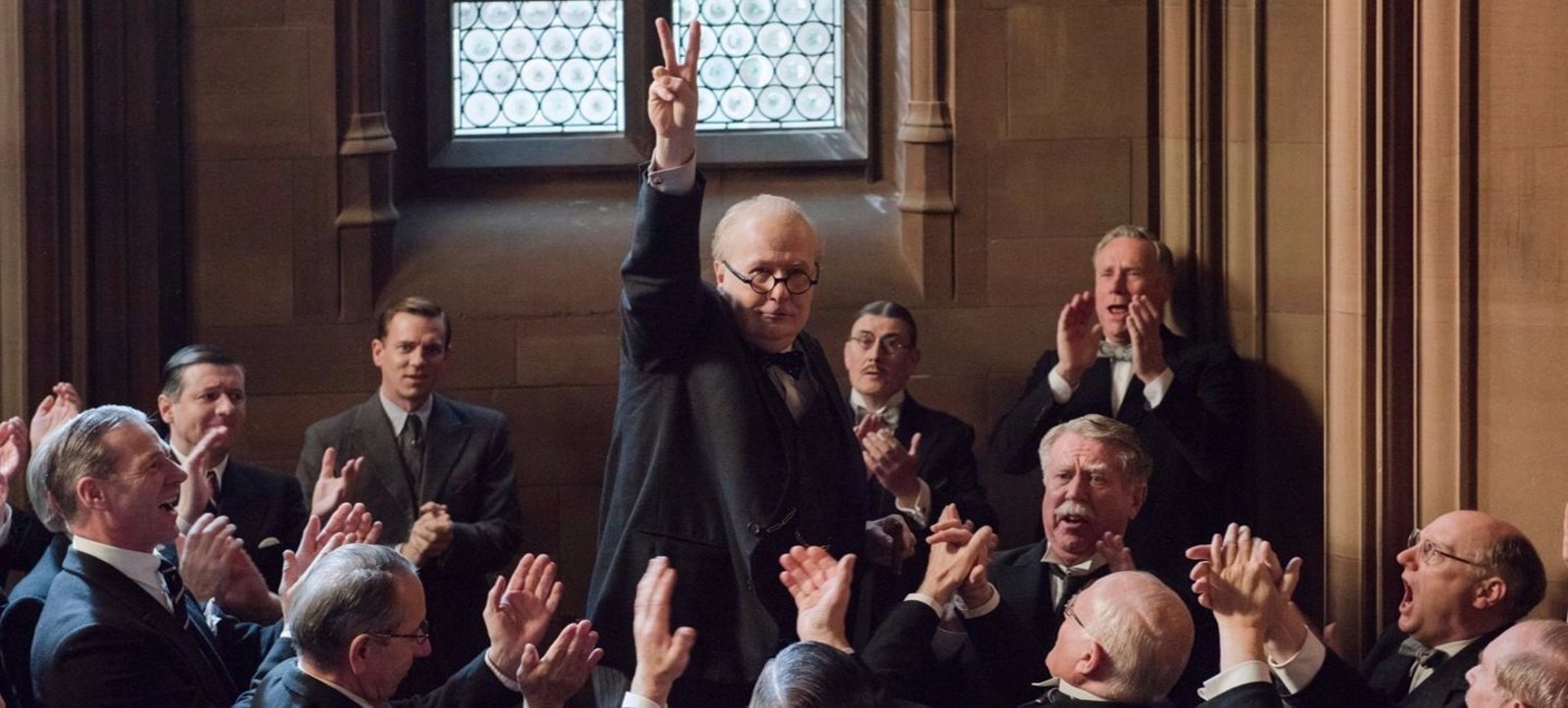


A makeup test can look astonishing in a still photograph and still fail a movie. A screen face is not a sculpture. It has to speak, blink, sweat, catch light, survive a close-up, match footage shot days later, and remain comfortable enough for an actor to think about the scene rather than the material attached to their skin. The real achievement is therefore not transformation by itself. It is transformation that stays movable.
The two BAFTA conversations below make that principle unusually clear. The first brings the hair and makeup teams from Blade Runner 2049 and Darkest Hour into the same room.[1] One film invents a rain-soaked future; the other reconstructs recognizable public figures in 1940. The second video gathers artists from Dune, The Eyes of Tammy Faye, Cruella, Cyrano, and House of Gucci.[2] Across both sessions, spectacular prosthetics share the frame with less obvious work: choosing a shade of pink that will survive Roger Deakins's lighting, giving a wig believable age, deciding which historical figure needs exact resemblance, or removing a star's familiar iconography without erasing the actor underneath.
Watch for the points where no department can finish the job alone. Hair changes what prosthetics can do around the forehead. Costume changes whether a body suit reads as anatomy or padding. Lighting changes color. Visual effects may replace contact lenses. Scheduling turns a design choice into a continuity problem. These are not complications around the art. They are the medium in which the art exists.
First viewing: design the face with the camera
The 2018 BAFTA session begins with two apparently opposite assignments. Blade Runner 2049 needs faces that belong to a world no one has seen; Darkest Hour needs faces that viewers may think they already know. The useful surprise is how similar the design process becomes once the artists stop talking about “looks” and start talking about production.[1]
Around 5:00, Donald Mowat and Kerry Warn explain that Blade Runner 2049 was not designed in a calm sequence from concept to test to finished shoot. The production began with late-story material, forcing the team to establish appearances before it had the chronological experience of watching those characters change.[1] “Future” was not a usable instruction. The artists had to turn it into decisions that could be photographed now.
The discussion of Joi's pink appearance, beginning around 6:00, is a miniature lesson in why color never belongs to one department. Concept art supplied an idea of pink, but skin tone, wig color, blood, reflection, and Deakins's lighting determined which pink the camera would actually record.[1] A bubble-gum reference becomes less a color swatch than a meeting point among makeup, hair, cinematography, and visual effects. Even a flamboyant choice has to be engineered relationally.
That same section keeps returning to contingency. Ana de Armas required multiple wigs because Joi changes appearance, although director Denis Villeneuve was wary of wigs. Jared Leto arrived with hair restrictions from another production, while hand-painted contact lenses and an abandoned bald-cap test had to be judged against the danger of caricature.[1] The rejected bald design is as instructive as the finished lenses. More alteration did not produce more truth. Once the work began announcing itself as an effect, it pulled the character away from the film.
At roughly 16:00, the conversation turns to Darkest Hour. Ivana Primorac describes historical resemblance as a responsibility, but not as a wax-museum contest. Hair and makeup also carry information that dialogue may not supply: whether someone is exhausted, ill, frightened, privileged, or shaped by wartime scarcity.[1] Around 19:45, she makes the actor-facing purpose explicit. A changed hairline, eyebrow, or silhouette can help an actor enter a role; removing it at the end of the day can help the person leave the role behind.
Gary Oldman's Churchill is the session's most visible transformation, yet director Joe Wright's account of the tests is built around restraint. Early versions were too mask-like; lighter versions did not create enough resemblance. The design developed until it found what Wright called a “sweet spot” between Churchill's appearance and access to Oldman's performance.[3] The design history explains why the result works: anger, wit, fatigue, and hesitation can still travel through the face.
The audience question around 23:30 adds an industrial boundary often missing from celebratory making-of footage. A historical drama cannot reconstruct every cabinet member with equal intensity. The team had to decide where resemblance mattered most, balancing public recognition, screen time, budget, application time, and what would best help each actor.[1] Accuracy is therefore not one dial turned to maximum. It is allocated attention.
Second viewing: build a system the actor can inhabit
The 2022 session widens the field. Its five films move from science fiction and biography to punk fantasy, period musical, and fashion-world crime drama. The range of solutions is just as broad: full-body prosthetics, nearly invisible age work, expressive wigs, digital eye color, and deliberate decisions to do less.[2]
The Dune section, from about 1:00, could have been presented as a victory lap for the Baron Harkonnen prosthetics. Instead, Love Larson and Eva von Bahr insist that the design was not “all about the prosthetics.” Their Baron had to fit the Harkonnen family, Patrice Vermette's production design, Jacqueline West's costumes, the other bodies in the scene, and Villeneuve's larger world.[2] That statement changes the unit of analysis. The object is not the appliance on Stellan Skarsgård. The object is the character as produced by every visible system at once.
The Fremen eyes offer the inverse lesson around 4:00. Applying blue contact lenses to the cast would have created a physical on-set effect, but it would also have multiplied fittings, discomfort, and continuity demands. The production instead added most of the color in postproduction, while the makeup team designed surrounding tones with that future intervention in mind.[2] “Practical” and “digital” are not moral categories here. They are tools assigned according to which path protects time, bodies, and the image.
From roughly 6:00, The Eyes of Tammy Faye team describes a different risk: turning a heavily mediated real person into a late-night caricature. Research and repeated viewing established the public looks, but the daily question was whether the design had reached the line without crossing it.[2][4] Three prosthetic stages let Jessica Chastain and Andrew Garfield age across decades while maintaining continuity. Application expanded from about two and a half hours to roughly four when hair, makeup, body work, and costume were counted together.[2][4] Those numbers matter less as endurance trivia than as evidence of coordination. A face that photographs beautifully but consumes the performer's usable day, breaks between setups, or cannot be reproduced is not a finished design.
The quieter examples sharpen the same point. Around 10:00, Nadia Stacey explains that Cruella treats hair and makeup as instruments of disguise: Estella and Cruella use visual identity rather than merely possessing it.[2][5] The huge one-night looks work because they belong to a story about pop-up personas. In the Cyrano section near 16:00, Alessandro Bertolazzi rejects both glossy period-painting imitation and flat documentary naturalism; Siân Miller describes a modern, boyish haircut for Peter Dinklage and the substantial design hidden inside “less is more.”[2] Minimal appearance is not the absence of craft. It is craft refusing to demand applause.
Finally, the House of Gucci discussion, beginning around 19:00, defines transformation as subtraction. The team first had to remove the visual shorthand of Lady Gaga, a performer whose hair and makeup history was already culturally familiar.[2][6] A fine bald cap concealed her own hair beneath wigs; hidden tensioning altered the apparent age and weight of the face; texture and over-processing helped the hair belong to particular decades. Yet the most revealing detail comes near 22:00, when Frederic Aspiras describes watching Gaga rehearse in the mirror and adjusting the design according to whether a scene would be played as hurt, soft, furious, or controlled.[2][6] Makeup is responding to performance before the camera rolls, not sealing it inside a predetermined shell.
The moving-set test
Together, the videos suggest a better way to evaluate movie makeup. Do not begin with “How unrecognizable is the star?” Begin with what the design lets the film do. Can the actor's smallest intention cross the prosthetic? Does the hair move like it belongs to this person and this weather? Does the color survive the cinematography? Can the look be repeated after lunch, after a location move, or three weeks later? Does it cooperate with costume, visual effects, and the time available?
Calling the face a moving set is not a metaphor for scale. It is a reminder that screen identity is constructed space. Skin, hair, silhouette, light, and movement give a performance somewhere to happen. The best work may be spectacular or nearly invisible, historically exact or openly stylized. Its common achievement is availability: the design changes what we see while leaving the actor free to change what we feel.
Sources
- BAFTA Guru, “The Hair & Make Up Design of Blade Runner 2049 and Darkest Hour,” YouTube video — a 2018 craft conversation with Donald Mowat, Kerry Warn, and Ivana Primorac.
- BAFTA, “Cyrano, Cruella, Dune, The Eyes of Tammy Faye, House of Gucci | BAFTA Film Sessions 2022,” YouTube video — nominee interviews on prosthetics, hair, research, continuity, and performance.
- Focus Features, “How Joe Wright Brought Winston Churchill to Life in Darkest Hour,” December 4, 2017 — on the makeup tests, preserving Gary Oldman's performance, and the official still used as this article's lead image.
- Hugh Hart, “The Eyes of Tammy Faye Oscar-Nominated Hair & Makeup Team on Helping Chastain Channel Faye,” The Credits, Motion Picture Association, March 15, 2022 — on research, collaboration, and the film's three prosthetic stages.
- Patrick Cremona, “Hair and make up artist Nadia Stacey on creating Cruella's look,” Radio Times, May 27, 2021 — an interview on visual identity, references, and the freedom of an origin story.
- Lauren Valenti, “Inside Lady Gaga's Decade-Spanning Beauty Transformation for House of Gucci,” Vogue, November 24, 2021 — Sarah Tanno and Frederic Aspiras on research, wigs, texture, and charting Patrizia Reggiani across three decades.