

Production design is often praised only after it has disappeared into the finished film. A room seems inevitable, a street seems inhabited, a fantasy city seems to continue beyond the frame. By then, thousands of provisional decisions have hardened into one visible world. The achievement is not simply that the world looks good. It is that actors, lenses, light, props, construction, visual effects, schedules, and money have all been persuaded to behave as if they belong to the same idea.
That persuasion begins with translation. A script describes action and feeling in words; the production designer has to turn those words into choices other people can build, find, dress, light, move through, and photograph. The Art Directors Guild describes the designer as responsible for a production's overall look, atmosphere, and emotion, while also collaborating across cinematography, visual effects, lighting, props, set dressing, stunts, and other departments.[3] A private inspiration is therefore not enough. The vision must become a shared language.
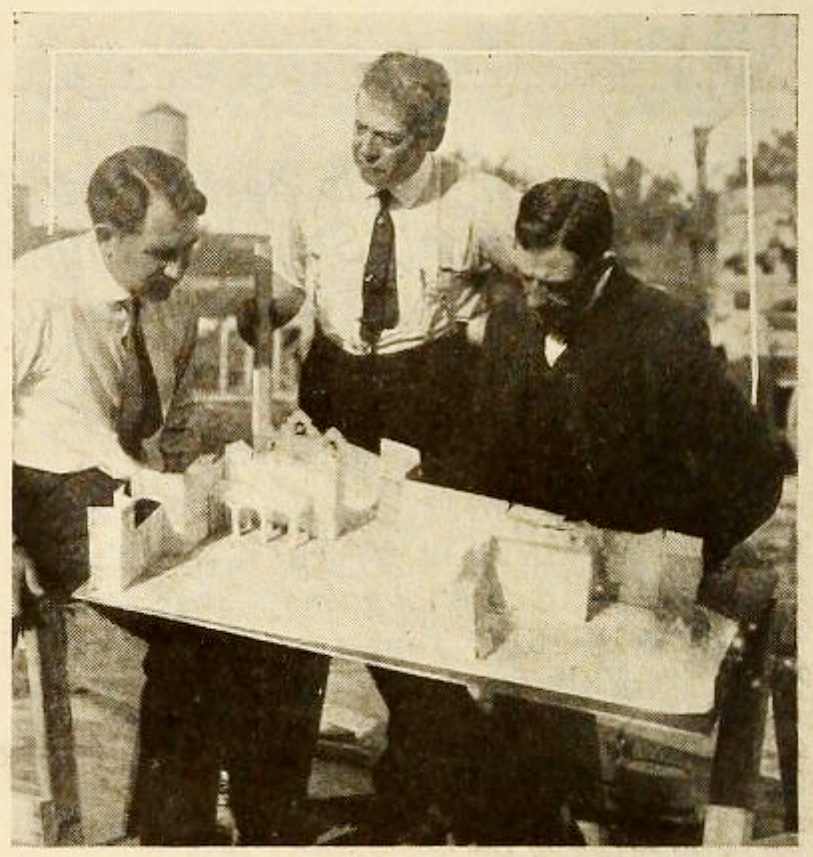
The cover photograph catches an early version of that language in 1915. Frank Powell, set designer J. Alan Turner, and technical director William Bach bend over a model used to plan a full-scale Mexican village for The Witch on Fox's Fort Lee backlot.[6] The model is not a tiny finished movie. It is an interface: a way to make scale, routes, facades, and relationships discussable before carpenters commit them to lumber and the camera turns them into geography.
The two videos below follow the same problem at different resolutions. BAFTA's compact masterclass with Maria Djurkovic shows a designer moving from an initial brief toward palette, research, location, dressing, and props. The BFI Film Academy Lab with Gini Godwin slows down the managerial machinery: script breakdown, budget, mood boards, leadership, and collaboration.[1][2] Together they show why production design is neither decoration nor solitary world-building. It is the craft of keeping an idea legible while it passes through many hands.
Maria Djurkovic: turn atmosphere into decisions
Djurkovic's fourteen-minute masterclass is a useful first watch because it moves quickly from intention to evidence. Using Tinker Tailor Soldier Spy as a central case, she begins with the briefing relationship, reaches colour palette around 2:00, turns to development and location research, and later arrives at set dressing and props.[1] The sequence matters: atmosphere is not applied at the end. It becomes a chain of constraints early enough to shape what the production seeks.
Watch what happens when a word such as “drab,” “secretive,” or “period” is no longer allowed to remain vague. It has to become a range of colours, a quality of surface, a kind of furniture, a level of wear, a location search, and a rule for what should be excluded. A palette is valuable not because it makes every frame match a swatch. It lets the costume, camera, locations, construction, graphics, and dressing teams argue from common ground. When a proposed object is beautiful but belongs to the wrong visual system, the team has a reason to reject it beyond taste.
Djurkovic's discussion of location work, beginning around 5:43, also corrects the notion that designers either discover a ready-made world or manufacture one from nothing.[1] A location is raw material. Its proportions, entrances, windows, existing finishes, surrounding streets, and practical access may solve some story problems while creating others. The production can retain, suppress, repaint, extend, re-dress, or reframe what is there. Design resides in that selection as much as in an original drawing.
The passage on an Istanbul hotel around 9:19 is especially useful as a viewing prompt.[1] Do not look only for the most conspicuous object. Look for the agreement among objects: how furniture, lamps, curtains, wall colour, paper, and wear imply the same institution and the same passage of time. Set decoration converts the designer's broad visual rule into accumulated life. Props then bring that rule within an actor's reach. A file, glass, telephone, or door handle is small, but performance may depend on its weight, position, period, and readiness to be used.
This is why a successful scheme cannot be judged as a portfolio of empty rooms. It has to survive occupation. The Academy Museum's exhibition on production designer Sarah Greenwood and set decorator Katie Spencer describes their collaboration as the creation of environments that convey time, place, and character.[4] Those three dimensions meet only when space becomes actionable: a character knows where to wait, what to touch, what signals status, and which route through the room produces the scene's tension.
Gini Godwin: make the vision assignable
The second video widens the frame from a case study to the operating system of a production. Recorded for a 2023 BFI Film Academy Lab, it places production designer Gini Godwin in conversation with production designer and art creative Jackie du Bled; the Independent Cinema Office identifies Blue Story, Boxing Day, and Then Barbara Met Alan among Godwin's credits.[5] The long format is valuable because it leaves the unglamorous connective tissue intact.
Godwin defines the role near 3:19 and, shortly afterward, frames design as an extension of character.[2] That is more exacting than making a character's home “expressive.” Space has to disclose information at the rate the film needs. One room might reveal income immediately but conceal grief until the camera notices a protected object. Another might advertise control through order, then betray precarity through a repair at the edge of frame. Design does not supply a psychological caption. It distributes evidence.
The most practically revealing stretch begins around 17:51, when the discussion enters preproduction, and reaches the master breakdown near 21:17.[2] A breakdown takes the script's flowing experience and separates it into demands: sets and locations, periods, day or night, dressing, action props, graphics, vehicles, weather, effects, special construction, and continuity. That transformation can sound bureaucratic, but it is where imagination becomes assignable. Someone must research the sign, source the chair, draw the wall, clear the artwork, age the floor, and make sure the object returns for the matching shot.
The Art Directors Guild's Production Design Initiative names research, script interpretation and breakdowns, design-document organization, distribution, and communication among the discipline's foundational skills.[7] The list explains why beautiful concept art cannot carry a production by itself. An image may persuade a director; a usable design package must also tell an art director, buyer, draughtsperson, model maker, construction crew, decorator, prop team, and effects unit what part of the promise belongs to them.
Budget enters Godwin's conversation around 27:04, not as an interruption of creativity but as one of its materials.[2] Money determines how many environments can be built, how completely, in which order, and for how long. The designer's harder task is not to spread compromise evenly. It is to preserve the story's hierarchy. A corridor crossed once may need only the angle the shot can see; a kitchen where actors cook, collide, and return across the film needs working depth, durable surfaces, controllable access, and continuity. Equal expenditure would be less intelligent than deliberate emphasis.
Near the end, the lab returns to vision, collaboration, and mood boards.[2] A mood board is most useful when treated as a conversation starter, not a verdict. It can align colour, texture, scale, and emotional temperature, but every collaborator reads reference differently. The designer's leadership lies in explaining what matters in an image—its compression, institutional chill, worn abundance, or geometry—so the team does not merely copy its furniture.
From model to photographed world
The 1915 set model and the two contemporary masterclasses belong to one continuous history of making the invisible discussable. The tools have expanded from tabletop models and drawings to digital models, location databases, shared breakdowns, virtual scouting, and visual-effects workflows. The communication problem remains: how can one spatial idea retain its dramatic purpose while specialists translate it into different materials?
The answer is not exhaustive realism. A film set is built for encounters: actor with doorway, lens with depth, light with surface, prop with hand, sound with wall, schedule with weather. The Guild's definition includes the obligation to ensure that sets are well photographed and contribute to the whole production.[3] That phrase sets a useful boundary. The room does not have to pass as ordinary architecture from every position. It has to tell the truth the movie asks for from the positions the movie can occupy.
This is not permission for careless fakery. Camera-specific construction demands greater foresight, because the team must know which absences will never be exposed and which details will carry disproportionate weight. A wall can stop beyond frame; a sightline cannot fail during a camera move. A facade may have no building behind it; a door an actor slams must behave convincingly. A digital extension may create the horizon; the foreground still has to give bodies contact, shadow, and scale.
Seen together, Djurkovic and Godwin turn production design from a gallery of impressive outcomes into a sequence of translations: read the character, research the world, establish rules, test them against locations, break the script into work, rank that work by story and budget, then keep explaining the design until it can be built and photographed. The image on screen may feel effortless. The real craft is the shared language underneath it—the agreement that allows a model, a spreadsheet, a paint sample, a prop, and a camera angle to describe the same world.
Sources
- BAFTA Guru, “Maria Djurkovic: Production Design Mini Masterclass,” YouTube video — briefing, palette, development, location research, dressing, props, and practical advice.
- Independent Cinema Office, “BFI Film Academy Lab - Production Design with Gini Godwin,” YouTube video — role definition, character, preproduction, script breakdown, budget, mood boards, and collaboration.
- Art Directors Guild, “Who Are Art Directors” — the production designer's responsibility for overall look, atmosphere, emotion, collaboration, and photographable sets.
- Academy Museum of Motion Pictures, “Barbie to Anna Karenina: The Cinematic Worlds of Sarah Greenwood and Katie Spencer” — exhibition overview of production-design and set-decoration process, collaboration, and story environments.
- Independent Cinema Office, “BFI Film Academy Lab: Production Design with Gini Godwin,” February 22, 2023 — event provenance, speakers, credits, and educational context.
- Fox Film Corporation, “Director Frank Powell examining set model for The Witch,” Motion Picture News, July 31, 1915, via Wikimedia Commons — subject identification, model purpose, publication history, and public-domain source image.
- Art Directors Guild, “Production Design Initiative” — professional preparation in research, script breakdowns, design-document organization, distribution, and communication.