Spoiler note: this essay discusses the film's two-part structure, the birthday-night sequence, the wake, and the final playground scene in Ikiru.
Akira Kurosawa's Ikiru is often introduced through its diagnosis, and with reason.[1][2][3] The film begins with an x-ray and the knowledge that Kanji Watanabe, a longtime municipal bureaucrat, is dying of stomach cancer.[1][3] But the movie's force does not come from the diagnosis alone. It comes from the way Kurosawa places mortality inside procedure. Before Watanabe learns he is ill, he is already spiritually entombed at his desk, stamping papers whose whole purpose seems to be that they can be stamped again.[3] When a group of neighborhood women arrives with a petition to turn a foul cesspool into a children's playground, the request is shunted from office to office until the city's structure reveals itself as an engine for postponement.[3] Kurosawa's great move is to make that municipal drift the real moral landscape of the film.
Criterion's film page rightly emphasizes the picture's radically conceived two-part structure, while the BFI description stresses that the narrative later shifts onto Watanabe's colleagues so the question becomes not only how one man dies but what his life meant in public.[1][2] That formal choice matters because Ikiru is not finally a private weepie about making peace with death. It is a civic drama about whether a man who has spent decades forwarding responsibility can, in the little time left, reverse the current.
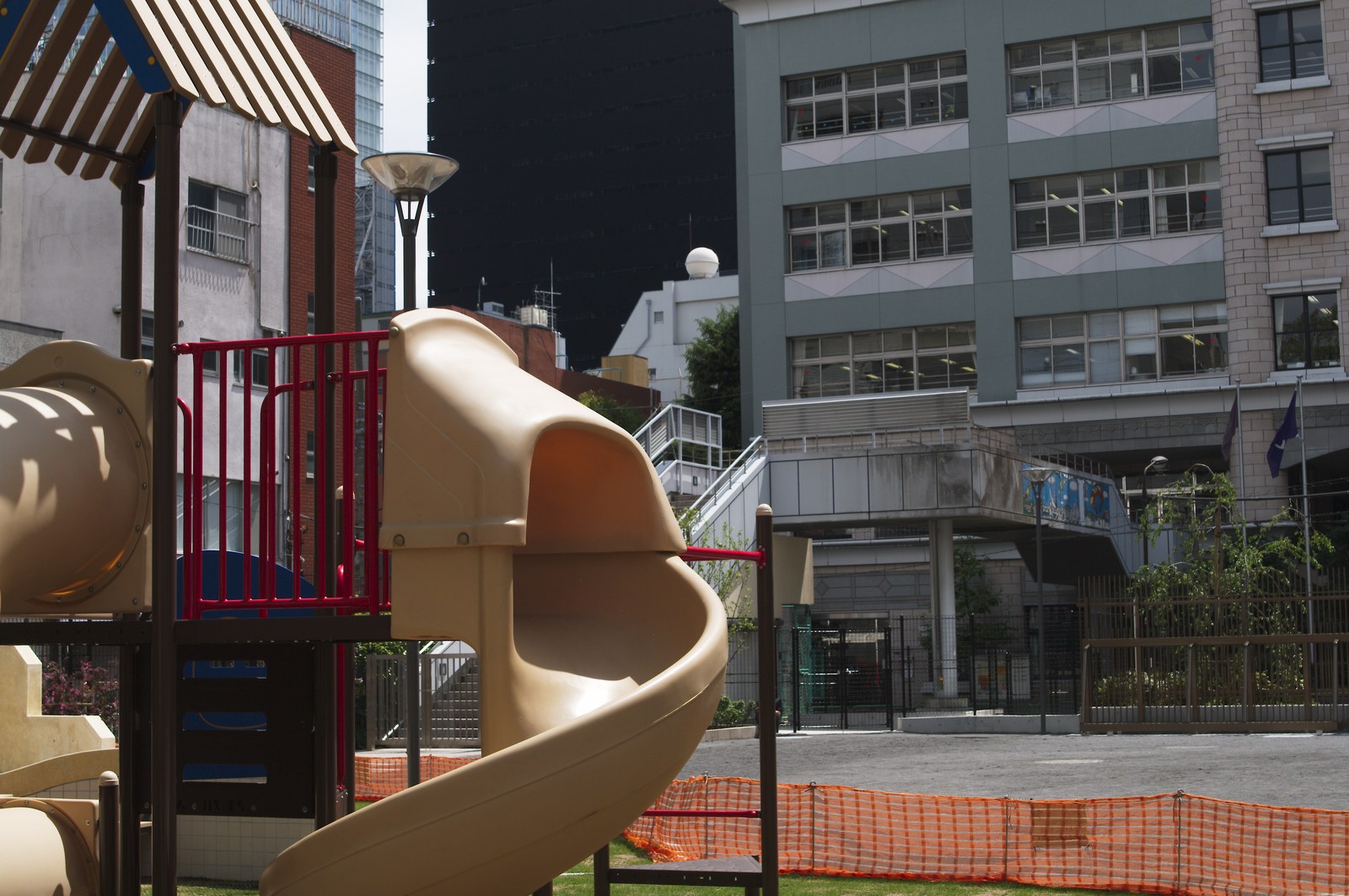
Image context: the cover now uses a real Tokyo neighborhood playground rather than a film still. That choice fits the article's QA direction and the film's argument: Kurosawa keeps translating emotion into civic movement—stairs, queues, streets, offices, and eventually a playground built out of bureaucratic resistance.[3][6]
The playground petition is the film's moral map
Alexander Sesonske's Criterion essay gives the petition sequence the weight it deserves.[3] The women do not merely supply a plot device; they expose the shape of a whole administrative culture. Moved heedlessly from one desk to another, they end where they began, angrier and no closer to action.[3] Sesonske points to Kurosawa's repeated wipes as a way of turning bureaucracy into rhythm. The visual device matters because each wipe feels like a shove sideways rather than a step forward. Paper moves. People move. Responsibility does not.
This is where Ikiru becomes sharper than a generic "life is short" classic.[2][3] Watanabe's problem is not only that he has wasted his time. It is that he has helped sustain a machine designed to keep everyone's time from turning into consequence. BFI calls the film a deeply compassionate study of a civil servant whose search for meaning finally prompts viewers to consider their own contribution to the common good.[2] The phrase "common good" can sound grand. Kurosawa keeps it concrete. It means drains, mud, signatures, mothers, children, and a patch of land nobody powerful cares about until somebody refuses to let the matter die.
That is why the early office scenes feel so claustrophobic despite their bustle.[3] Watanabe is surrounded by subordinates, files, and routine, yet the room has the dead air of a tomb. Kurosawa does not depict bureaucracy as loud villainy. He depicts it as the steady conversion of need into circulation. The petition gives the movie its first full diagram of that conversion, and once we have seen it, every later gesture of Watanabe's awakening has a public measure.
The birthday night clarifies the difference between pleasure and purpose
The middle stretch in which Watanabe tries nightlife, companionship, and late freedom is sometimes remembered simply as a sad old-man excursion. The film is doing something more exact.[3][4][5] Geoffrey O'Brien's Criterion piece on "The Gondola Song" is especially useful because it stays close to the cabaret scene's peculiar tonal pressure.[4] Watanabe, in his overcoat and newly purchased hat, requests an old song from the nineteen teens, and the room's mood changes around him.[4] What had been boisterous modern entertainment suddenly becomes a suspended interval in which everyone has to register a man singing from very near the edge of death.
The song matters because it keeps the film from mistaking appetite for renewal.[3][4] Watanabe can drink, wander, and spend money, but none of that becomes a real answer. Sesonske's essay traces the transition more carefully: the birthday revelry and the young worker Toyo Odagiri's vitality do not save Watanabe by themselves; they prepare him to recognize that joy only becomes durable when attached to work that leaves a mark.[3] Pico Iyer's later Criterion essay also catches the postwar texture around these scenes, where imported songs and borrowed lightness drift through a society still learning what modern freedom might feel like.[5]
One of the film's most beautiful bridges arrives when the voices singing "Happy Birthday" continue across Watanabe's return to the office and his search for the old playground petition.[3] That carry-over is crucial. The film does not let private feeling remain private. Celebration leaks back into paperwork, and paperwork is suddenly capable of motion. The birthday sequence therefore does not function as a sentimental detour. It tests several false exits from despair and then sends Watanabe back toward the one thing that can make his remaining time answerable to other people.
The second half turns awakening into public evidence
Criterion's page notes the film's two-part design, and BFI stresses the shift toward Watanabe's colleagues after his death.[1][2] Kurosawa's structural gamble is to deny us the most obvious version of catharsis. Instead of staying beside Watanabe in a straight line until the end, the movie fractures into recollection at the wake. Family members, coworkers, superiors, and policemen all try to narrate what happened, and in doing so they expose their own limits.[2][3] Some are hypocritical, some obtuse, some briefly honest. What matters is that Watanabe's change can only be measured after the fact, through the resistant institution he disturbed.
Sesonske observes that the most sincere interruption at the wake comes from the women connected to the playground.[3] That detail is the film's final moral correction. Prestige, rank, and office talk do not get the last word. The people who suffered the original delay are the ones who can testify most clearly to what Watanabe actually did. Kurosawa refuses slushy sanctification. He stages remembrance as argument, uncertainty, drunken self-protection, and only occasional recognition.[2][3]
Then the film gives us its image of proof: Watanabe on the swing in softly falling snow, singing to himself.[3] It is one of the most famous shots in world cinema, but its greatness depends on everything around it. The swing is not beautiful because it is sad. It is beautiful because the movie has worked so hard to define what public action looks like in an ordinary city. The playground is there. The petition has become a place. One dying man has managed, briefly, to reverse a system whose normal function is delay.
That is why Ikiru endures.[1][2][3][4][5] It does not merely tell us that life is short. It asks what kind of form a life can take once private panic has been forced through public work. The x-ray, the stamped files, the old song in the cabaret, the drifting birthday chorus, the evasions at the wake, and the snowy swing all belong to one design. Kurosawa turns paperwork into civic grace by showing that even a small administrative victory can become a final act of human style.
Sources
- The Criterion Collection, "Ikiru (1952)" film page.
- BFI, "Ikiru (1952)".
- Alexander Sesonske, "Ikiru," The Criterion Collection.
- Geoffrey O'Brien, "To the Tune of Mortality: 'The Gondola Song' in Ikiru," The Criterion Collection.
- Pico Iyer, "Ikiru Many Autumns Later," The Criterion Collection.
- Ryo FUKAsawa, "Hōrin Park - During the opening, Sotokanda 3, Chiyoda, Tokyo," Wikimedia Commons.