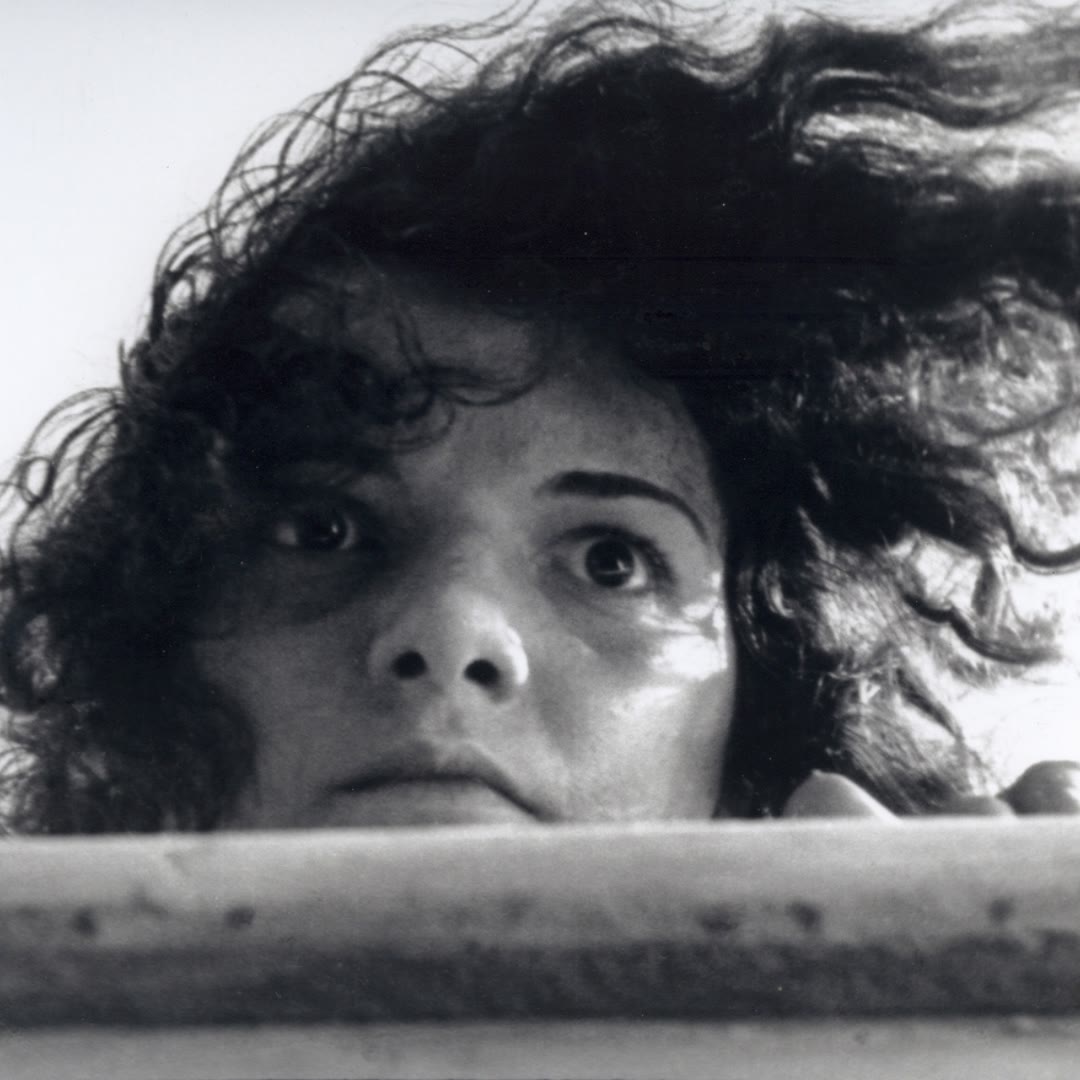
Nothing in Limite is freer than the camera. Nothing is less free than the people it photographs.
Three bodies sit in a rowboat on an open sea, yet openness has ceased to mean possibility. They do not command the horizon; they endure it. In the lead still, one woman's face rises just above the gunwale, close enough for wind, hair, skin, and painted wood to become a single field of pressure. The frame offers almost no comfortable distance from which to interpret her. It gives exposure instead.[1][7]
Mário Peixoto's 1931 Brazilian silent film builds its deepest effect from that contradiction. Its castaways are stalled, but cinematographer Edgar Brasil's lens climbs, drops, tilts, runs beside feet, isolates faces, and turns ordinary things into violent changes of scale. Flashbacks leave the boat without delivering anyone from it. Close-ups bring the body nearer while making a whole person harder to possess. The craft is not ornamental avant-gardism laid over a story of confinement. Camera mobility is how confinement becomes felt.[2][3][5]
Version note: this essay refers to the 2010 restoration assembled from surviving materials by Cinemateca Brasileira and Cineteca di Bologna/L'Immagine Ritrovata with the World Cinema Project, Arquivo Mário Peixoto, Saulo Pereira de Mello, and Walter Salles. One section was already missing when the long preservation effort began, so the film available now is both a restoration of Peixoto and Brasil's work and a record of what could not be recovered.[4][8]
The boat is a zero point, not a destination
The premise can be stated in a sentence: a man and two women drift at sea while the film enters the lives that brought them there.[6][8] Limite does not treat the boat as a suspense problem to be solved, however. There is no practical geography beyond water, horizon, wood, and bodies. Instead, the boat becomes the film's zero point: the fixed condition against which every other movement is measured.
Peixoto repeatedly refuses the ordinary establishing-shot bargain. A conventional wide view would tell us where everyone sits and let closer images clarify their individual states. Limite reverses that hierarchy. A face, a hand, a length of rope, the boat's rim, or light shivering on water can arrive with more authority than the group. Wider views do not restore mastery. They reveal how little the human figures command the space around them.[1]
This is why the sea feels both immense and airless. The horizon should guarantee depth, but the boat scenes keep pressing foreground matter toward the lens. A head can be cropped by the frame; a body can become a diagonal; the gunwale can divide the image more decisively than the line between water and sky. Space exists, but usable space has vanished.
The flashbacks appear to answer that stasis with roads, trains, buildings, shorelines, and walking bodies. They give the camera new routes. They do not provide the characters with a road out. Each remembered life contains another boundary: prison, marriage, grief, economic routine, social command. Movement therefore accumulates without becoming progress. The more places the film can visit, the more precisely the boat reads as a condition rather than merely a location.[1][6]
The first image was already a restraint
Peixoto traced the project to the cover of the French magazine Vu that he encountered in Paris in 1929: a woman's face encircled by a man's handcuffed hands. The image did not simply supply a poster-like emblem. It offered a visual grammar in which intimacy and restraint occupy the same small area. Peixoto's scenario grew from that encounter, and the handcuff image became a recurring motif within the finished film.[2]
That origin matters because Limite rarely lets a close-up mean access without qualification. Eyes are available to inspection, but looking does not dissolve the barrier around a person. Hands touch objects without necessarily controlling them. Hair, cloth, wire, rope, and wood keep crossing bodies or dividing the frame. The film makes nearness tactile, then withholds the promise that nearness will become knowledge.
The technique is clearest when Peixoto and Brasil fragment the body. A shoe moving along a road, fingers working at a task, a face tipped into a difficult angle: these are not neutral inserts placed between dramatic scenes. Each fragment temporarily becomes the scale of the world. Montage does not assemble a stable person from useful details. It keeps testing how much of a person an image can hold before the frame itself becomes another limit.[1][3]
This distinguishes Limite from a film that uses eccentric angles only to announce modernity. An upended or low camera is not automatically expressive. Here, orientation changes because the relationship between body and world has changed. A road can stop serving as a route and become a rough surface beside a foot. A wheel can stop serving a vehicle and become rotation without arrival. The angle is not a flourish added to the object; it is the instant when the object stops behaving as expected.
Mobility had to be engineered
The camera's freedom was not an abstract aesthetic wish. It came from a small production in Mangaratiba working out how to put heavy, fragile equipment where the scenario demanded. Research assembled by Universidade Federal Fluminense describes a portable Kynamo acquired for difficult or rapidly moving views and an Ernemann on a tripod as the principal camera. A later preservation study identifies four cameras used across the production, including brief work with a Mitchell NC and a Debrie Parvo L, while emphasizing that the compact Kynamo could go where the Ernemann could not.[2][4]
That division of labor is more revealing than a legend about one magic machine. The film's visual grammar depends on switching between kinds of support. A tripod can make a pose severe and a horizon immovable. A portable camera can chase train wheels, pass close to footprints, approach a contorted face, or move over a water tap. One apparatus establishes weight; another breaks from it.[2]
Brasil also built or adapted physical supports rather than accepting a clean choice between fixed tripod and uncontrolled handholding. The UFF formal study describes articulated devices and human-pulled boards used to obtain unusual frames and movements. Alexandre Vasques's archival research finds production photographs of a wooden platform roughly four metres high, constructed so the Ernemann and its operators could look down on a woman walking along a dirt road.[3][4] The result on screen may feel like vision detaching itself from ordinary bodily limits, but that detachment rested on carpentry, hauling, balance, rehearsal, and several people keeping a camera safe.
This is the craft paradox in material form. The image can seem disembodied only because unseen bodies are working intensely around it. A camera gliding away from a performer does not abolish labor. It moves labor outside the frame.
The production's film stock added another constraint. The UFF study describes Limite as black-and-white 35 mm work made primarily in daylight, with a large sunshade visible in production photographs and no night scenes in the finished film.[3] Vasques's closer technical history identifies slow panchromatic negative stock and the exposure demands of the Mangaratiba sun.[4] Brasil had to preserve detail across pale sky, reflective water, white clothing, dark hair, and shadowed faces without the monitoring tools a cinematographer would expect now.
The brightness is therefore not empty abundance. It is something measured, shaded, and risked. When a face seems to emerge from glare or a dark shape hardens against the coast, the image carries the negotiation between a sensitive strip of film and a landscape that will not lower its intensity for the camera.
The camera can leave a person without betraying her
One of Limite's most radical habits is to begin near human action and then allow the camera's attention to migrate. A gesture points toward an object; the object leads toward a texture; a line in the landscape pulls the frame elsewhere. The film does not always return on the schedule that narrative clarity would prefer.[1][2]
That movement could easily become a display of directorial superiority: the camera is free, the character is trapped, and the viewer is invited to admire the difference. Peixoto and Brasil avoid that smugness because the departures do not produce a commanding overview. The lens may leave a face, but it does not rise into perfect knowledge. It finds wheels, wire, mud, roofs, footsteps, water, or an emptied road—more pieces of the same resistant world.
The effect is less like abandoning a person than discovering that her condition has spread. Confinement is no longer located only in a prison wall or a boat. It can reside in repetition, in work, in an object that outlasts touch, or in a path whose direction offers no release. The mobile camera does not escape on the character's behalf. It tests the environment and returns with bad news.
This is also why the film's most intimate views resist sentimentality. The close-up does not isolate a face from circumstance; it lets circumstance reach the face. Wind pushes hair across it. Brightness erases parts of it. An awkward tilt makes gravity newly visible. The lead still is powerful not because it gives us a transparent portrait of suffering, but because a human expression has to share the frame with the material facts of being exposed on a small boat.[1][7]
Montage converts routes into pressure
Peixoto completed a scenario before production, but the finished film behaves less like an illustrated script than a system of visual returns. The rowboat, the Vu-cover-derived handcuff motif, staring eyes, roads, thresholds, and forms of rotation recur with altered force. A repeated element is never quite a label. It is a pressure carried from one part of the film into another.[1][2]
The flashback structure makes this possible. In a conventional explanatory flashback, the past supplies causes and the present receives them. Limite permits a more unstable traffic. The present boat scenes make every remembered movement look already exhausted, while remembered images change the boat from an accident at sea into the visual sum of several failed freedoms. Cause and metaphor keep exchanging places.
Editing can therefore make two spaces touch without pretending they form a continuous route. A cut from bodily effort to indifferent matter does not necessarily say that one caused the other. It makes the viewer feel an imbalance of scale. Human intention lasts for a gesture; water, road, machinery, and weather continue. The montage is forceful because it does not need to turn every juxtaposition into a riddle with one answer.
UNESCO's Memory of the World record places Limite in direct contact with Soviet cinema, German expressionist cinema, and Griffith's American narrative cinema.[5] That mixed inheritance helps explain why the film feels rigorous without feeling doctrinaire. It can cut for collision, move for sensation, hold for duration, and return for memory. Technique is not asked to prove one theory of cinema. It is asked to discover how many formal freedoms can coexist inside a film about lives that have run out of them.
Restoration is part of what the image now means
The surviving Limite cannot be discussed responsibly as though it traveled untouched from 1931. Its early public life was extremely small. The Cinemateca do MAM Rio dates the first public presentation to May 17, 1931; UFF records another public screening in January 1932, no commercial distribution, and only scarce later circulation.[2][7] By the late 1950s, the surviving nitrate print had deteriorated enough to stop normal projection. It was later seized during Brazil's military dictatorship, recovered, and subjected to a long rescue that began with frame-by-frame photographic work.[4][5]
The 2010 restoration returned the film to international circulation using materials preserved by Brazilian institutions and the Mário Peixoto archive.[6][8] It did not make loss disappear. Criterion notes that a section remains absent.[5] Scratches, density changes, copied splices, or abrupt material shifts in the circulating film therefore require caution: some belong to the surviving object's history, not automatically to Peixoto's intended design.[4]
That caution does not weaken a craft reading. It sharpens one. The camera movements, spatial dislocations, bodily fragments, and rhythmic returns remain legible through the damaged chain of survival. At the same time, the restoration prevents us from turning every wound in the material into proof of avant-garde intention. Limite is radical enough without asking decay to direct it after the fact.
Preservation also completes the film's central paradox in an unexpected way. The characters cannot carry themselves out of the boat. The film itself was carried: by Edgar Brasil, who guarded a print; by Saulo Pereira de Mello, whose work was decisive to its rescue; by archives, laboratories, and later restoration partners.[4][5][8] What survived did so through collective motion around an object that could no longer safely move through a projector.
Freedom belongs to the relation
Limite does not simply oppose a liberated camera to imprisoned people. That would leave freedom with the machine and defeat the film's human seriousness. Instead, it asks what camera freedom can reveal. Every new angle tests a body's relation to an object. Every travelling movement tests a route. Every close-up tests whether proximity can overcome isolation. Every flashback tests whether explanation can change the present.
The answer is never a clean yes. Yet the testing matters. Brasil's lens does not rescue the castaways, but it refuses to let their stillness become pictorial passivity. It moves until the whole visible world—sea, road, wheel, wire, face, hand, and boat—has entered the argument.
That is why Limite still feels startling. Its camera is not free because it can go anywhere. It is free because every place it reaches changes the meaning of where the bodies cannot go.
Sources
- Mário Peixoto, Limite (1931) — primary film text, presented in the 2010 restored version with Portuguese intertitles.
- Universidade Federal Fluminense, “Limite — Production” — production chronology, Mangaratiba location work, camera procurement, Edgar Brasil's portable-camera practice, and examples of shots assigned to the Kynamo.
- Maria Christina Ennes Emmerick, “A Forma de Limite.” Universidade Federal Fluminense — formal study of the film's 35 mm black-and-white photography, daylight production, framing, and improvised camera-movement devices.
- Alexandre Vasques, Nos rastros de Limite: um estudo de caso na história da preservação das imagens em movimento no Brasil. Cinemateca do MAM and PPGCine-UFF, 2023 — archival research on the cameras, stock, production photographs, surviving elements, and preservation history.
- UNESCO Memory of the World, “Mario Peixoto's Film ‘Limite,’ 1930–1931” — regional-register record covering production, formal lineages, nitrate deterioration, restoration history, and the film's place in Brazilian cinema.
- Istanbul Museum of Modern Art, “Limite, 1931” — institutional film record covering the castaway premise, flashback structure, black-and-white DCP, and World Cinema Project restoration.
- Cinemateca do MAM Rio, “90 anos de Limite” — first-public-screening date, program context, film record, and archival still used as the lead image.
- mk2 Films, “Limit” — current rights-holder catalog record with synopsis, year, country, and complete 2010 restoration credits.