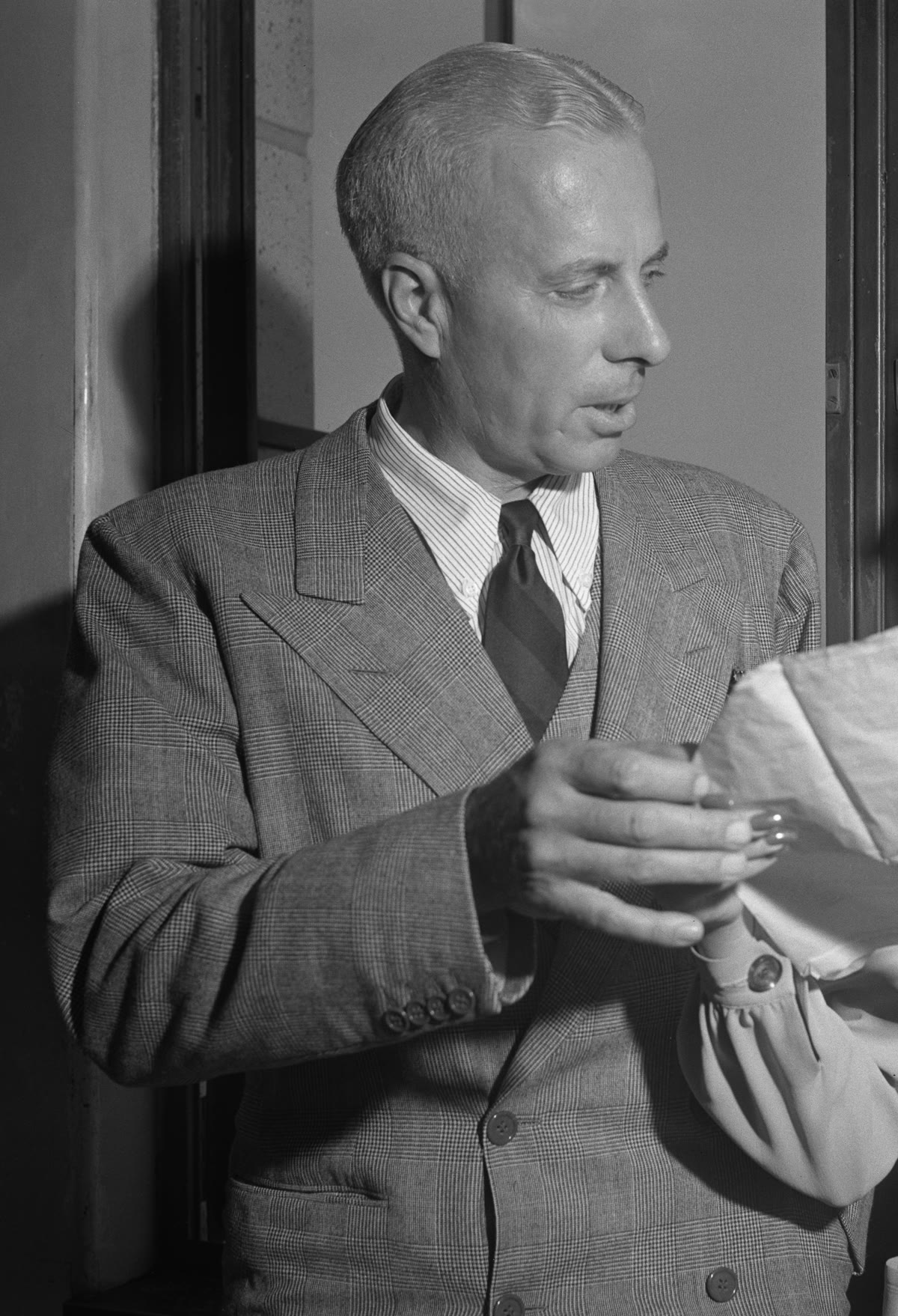
Howard Hawks is one of the few Hollywood directors whose films can jump from aviation melodrama to screwball comedy to cattle-drive western without losing their human temperature.[1][2] That is why the old description of him as merely a versatile studio craftsman has never been enough. The French critics who later promoted Hawks into the auteur canon were responding to something concrete, but his signature is not mainly a camera tic or a decorative worldview.[1][3] It is a recurring social experiment. Put a small group under pressure, give them work that matters, add a woman who can match or upset the room's code, and watch whether competence produces intimacy or collapse.
That pattern is why Hawks still feels so current.[2][3] His characters do not reveal themselves through confession first. They reveal themselves in tempo: how quickly they answer, whether they can take a joke, whether they keep functioning when the room turns dangerous, whether they know when self-reliance has stopped being strength and started becoming vanity. Genre in Hawks changes the equipment and the clothing. The deeper drama stays the same.
Image context: the lead image uses a real 1943 portrait of Hawks from the Los Angeles Daily News collection at UCLA, preserved on Wikimedia Commons.[9] It works better than a random publicity still here because this essay is about a directorial method, not one title. The photograph fixes attention on the filmmaker whose movies kept turning work, rhythm, and group behavior into a moral test.
Hawks does not worship heroes; he tests working groups
Biography matters here, but only if it stays attached to form. Britannica notes Hawks's engineering degree, early work in film production, and World War I aviation experience; Senses of Cinema likewise emphasizes how much autonomy he preserved inside the studio system.[1][2] Those facts help explain why Hawks's films are so alert to procedures, tools, and group hierarchies. He does not romanticize work in the abstract. He wants to know who can actually do it, who freezes, who talks too much, and who becomes more legible once labor begins.
Only Angels Have Wings is one of the clearest statements of that method.[3] The film is nominally about an airmail operation in South America, but what it really studies is a professional culture built around risk, emotional compression, and earned reliability. Hawks makes danger feel ordinary because the characters have no use for ornamental speeches about courage. They keep flying, keep joking, keep measuring one another by whether they can return to the runway and do the next task. What matters is not heroic posturing but whether someone remains trustworthy after fear has entered the room.
That same logic governs Hawks even when the scale expands. Criterion's essay on Red River is useful because it shows how Hawks can move from the intimacy of a working team to the breadth of an epic cattle drive without changing his central question.[7] The conflict between Thomas Dunson and Matthew Garth is not just father-versus-son melodrama. It is a dispute over judgment inside a collective enterprise. Who knows what the situation now requires? Who is mistaking authority for competence? In a Hawks film, rebellion becomes legitimate when it serves the job better than obedience does.
In Hawks, romance is usually a work relation under another name
This is why Hawks's love stories rarely feel soft-centered.[3][5][6] He does not build attraction out of reverent longing or grand declarations. He builds it out of pace, verbal pressure, and the discovery that two people can operate at the same dangerous speed. A Hawks couple usually sounds like a team before it looks like a pair.
His Girl Friday gives the purest example.[4][5] Criterion's dialogue note stresses the film's overlapping speech and its ability to compress a huge script into a headlong ninety-two minutes.[4] That is not just a technical flourish. It is character revelation in audio form. Walter Burns and Hildy Johnson do not need a candlelit scene to prove affinity; the proof is that they can think and strike back on the same beat. The remarriage essay on the same film sharpens the point further: Hawks turns the question from whether Hildy will "go home" into whether she will return to the kind of work that actually matches her intelligence.[5] Romance becomes inseparable from professional equality.
Hildy matters because Hawks does not treat female intelligence as a charming interruption to male competence.[2][5] He treats it as a force that can reorganize the whole room. In His Girl Friday, her speed, emotional range, and reporting talent expose the men around her as both colleagues and inferiors.[4][5] When the newsroom briefly slows down, the pause does not diminish her authority; it clarifies it. She belongs there not by exception but by performance.
The screwball side of Hawks works through the same principle, only more playfully. Molly Haskell's essay on the ending of Bringing Up Baby is especially good on the way Hawks turns sexual friction into perpetual motion rather than serene closure.[6] Susan Vance does not "complete" David Huxley by calming him down. She drags him into a less defended, less ceremonious mode of life. Hawks's comedy keeps asking whether love might look less like rest than like a willingness to survive ongoing instability with the right partner. The battle of the sexes in these films is really a test of whether each side can live at the other's speed without becoming smaller.
Group trust matters more to Hawks than lone nobility
The easiest way to misread Hawks is to call him a poet of masculine self-sufficiency. Some of the surfaces invite that error: pilots, sheriffs, soldiers, cattle bosses, racers, detectives. Yet Senses of Cinema gets closer to the center when it describes how Hawks repeatedly builds identity through nicknames, working codes, and group incorporation.[2] People in Hawks are not most themselves when standing apart. They become themselves inside a formation whose respect must be earned.
That is exactly what makes Rio Bravo such a satisfying late work.[2][8] The BFI page describes it as a meditation on friendship, professionalism, and responsibility, and that phrasing is precise.[8] Sheriff Chance does not win by gathering the whole town behind him or by striking a pose of wounded virtue. He wins by learning which damaged, partial, or unlikely people can actually hold the line with him. The names alone tell the story: Chance, Dude, Colorado, Stumpy. Hawks is less interested in biography than in usable character. What can this person do when pressure arrives, and can the group make use of that capacity without sentimentality?
This is also why Hawks so often looks relaxed even when his plots are dangerous.[3][7][8] He trusts that once the right group chemistry is in place, suspense can emerge from delay, banter, and waiting rather than from nonstop incident. A Hawks room full of professionals buying time can be as revealing as another director's gunfight. Ease is never laziness in his films. It is what competence looks like once panic has been disciplined.
Why Hawks lasts
Hawks's modernity does not come from one trademark shot or one prestigious theme.[1][2][3] It comes from the way he keeps binding ethics to behavior. He asks who can keep talking clearly in danger, who confuses rank with authority, who mistakes romance for domestication, who deserves admission into the group, and what sort of woman the group must become intelligent enough to deserve in return. Those questions travel easily across genres because they are really questions about conduct.
That is why a Hawks film can feel both classical and surprisingly unsentimental now.[3][5][8] His people fall in love through competence, reveal loyalty through timing, and discover morality in the unglamorous business of showing up for the next task. The famous speed is not a mere surface pleasure. It is the sound of character being tested in real time. The loose camaraderie is not just atmosphere. It is the form through which trust becomes visible.
Across Only Angels Have Wings, His Girl Friday, Bringing Up Baby, Red River, and Rio Bravo, Hawks keeps staging the same hard question in new clothes.[3][4][5][7][8] When pressure strips away ceremony, can a group still hold together without flattening wit, desire, and mutual respect? Few directors have made that question look so easy. Fewer still have made the ease look so earned.
Sources
- Encyclopaedia Britannica, "Howard Hawks" biography page.
- David Boxwell, "Hawks, Howard," Senses of Cinema.
- Michael Sragow, "Only Angels Have Wings: Hawks's Genius Takes Flight," The Criterion Collection.
- The Criterion Collection, "Words in Edgewise: Dialogue in His Girl Friday."
- David Cairns, "His Girl Friday: The Perfect Remarriage," The Criterion Collection.
- Molly Haskell, "Bone of contention: the final scene of Bringing Up Baby," BFI / Sight and Sound.
- Geoffrey O'Brien, "Red River: The Longest Drive," The Criterion Collection.
- BFI, "Rio Bravo (1958)" film page.
- Wikimedia Commons, "File:Howard Hawks.JPG" archival photograph page.