
Rialto Pictures' 4K restoration trailer for Nights of Cabiria understands that Federico Fellini's film cannot be sold as a simple tragedy.[1] If all you wanted was plot, you could reduce the movie to one cruel sentence about a hopeful woman repeatedly betrayed by men and by class. The trailer refuses that reduction. It keeps the frame in motion: streets, dance floors, nighttime crowds, abrupt embraces, rain, rooms, and then Cabiria's face returning after each jolt.[1][2][3] The result is a preview built less on victimhood than on circulation.
That choice fits the film's place in Fellini's career.[3][4][5] Criterion describes Nights of Cabiria as the close of his early neorealist-inflected period, while BFI's Fellini guide treats it as one of the films that most clearly turns bleak Roman experience into something unexpectedly buoyant and transcendent.[3][5] Rialto's trailer compresses those two facts into one rhythm. The world Cabiria moves through is rough, commercial, and humiliating, yet the preview keeps insisting that movement itself is not exhausted by humiliation. Cabiria is thrown back into the city over and over, and the city never stops producing another test.
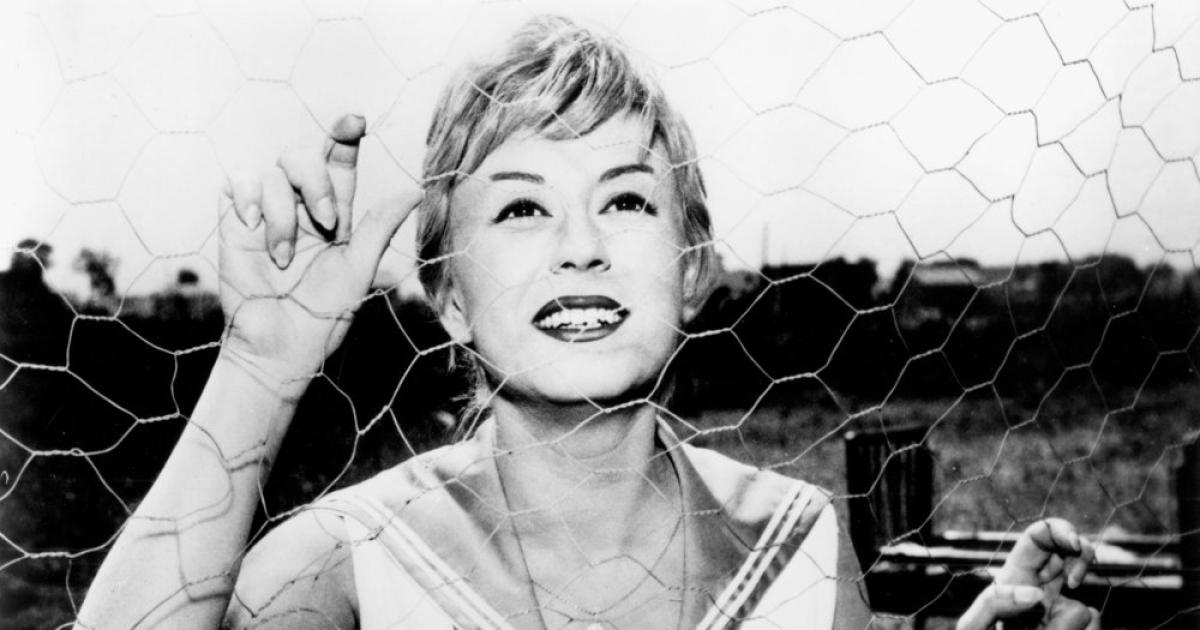
That is why Giulietta Masina matters so much to the trailer's structure.[1][3][5] Before the film can become "classic Fellini" in the later sense of parades, dream architecture, or autobiographical circus, it has to solve a more delicate problem: how do you film a woman who is repeatedly looked at, used, judged, and discarded without turning her into an emblem of pure suffering? The trailer's answer is simple and exact. It keeps returning to her face after every social scene. The crowd can label her, but the close-up reopens the question.
Image context: the cover uses BFI's still of Masina as Cabiria rather than a generic Rome view or a poster treatment.[4] That choice matches the trailer's method. The city gives the film its pressure, but Masina's face gives the pressure moral shape.
Around 0:05 to 0:34, the trailer introduces Cabiria as a public body moving through Rome's noisy social machinery
The first strong movement comes after the opening laurels and title cards, when the trailer drops into nightlife rather than reverence.[1] We get motion before explanation: street activity, a dance floor, men leaning in, Cabiria moving through environments where pleasure is always half commerce and half performance.[1][2] Rialto's catalogue description calls her "resilient," and the trailer earns that adjective by refusing to photograph her as still misery.[2] She is always entering or exiting a social current.
That current matters because Fellini's Rome is never a neutral backdrop.[2][3][5] Cabiria's vulnerability is social before it is psychological. Rooms are organized around who has money, who has access, who can disappear into glamour for an evening, and who gets left waiting near the edge of the frame.[1][2] The trailer makes this visible without lecture. A nightclub image and a crowded dance floor do not merely promise entertainment. They show a world where attention is unstable and rank changes by the minute.
The effect is sharper than pathos alone. Cabiria does not stand outside spectacle and comment on it. She is pushed through it. That is why the preview feels so alive in its first half-minute.[1] Fellini is not yet asking the viewer for noble pity. He is asking the viewer to register speed, noise, and exposure. The public world is the condition of the character. Before heartbreak becomes visible, the trailer teaches us how fully Cabiria has to live on the surface among other people's appetites.
Around 0:45 to 1:01, Masina's face interrupts the social whirl and turns every close-up into a fresh test of dignity
The trailer's center of gravity arrives when the montage slows down enough for Masina's face to take over.[1][3] One close-up follows another: Cabiria under an umbrella at night, Cabiria in an interior, Cabiria smiling just enough for the smile to look chosen rather than guaranteed.[1] This is where the preview becomes criticism. It proposes that the film's deepest special effect is not a set piece but Masina's ability to make recovery visible while it is still incomplete.
Criterion's film page is useful here because it emphasizes the mixture of bitterness and sweetness in the ending and in Fellini's vision more broadly.[3] The trailer does not wait for the ending to introduce that mixture. It builds it shot by shot through expression. Cabiria's face can brighten without becoming naive, and it can register hurt without collapsing into martyrdom.[1][3][5] That fluctuation is the movie's moral weather.
This is also where the preview becomes harder than a simple "sad classic" pitch. Dignity in Nights of Cabiria is not a stable possession. It has to be reassembled after contact with the world.[1][2][3] Each close-up in the trailer feels like a check on what remains after the previous scene's social damage. Has the city flattened her? Has romance tricked her again? Has hope become foolishness? Masina's great achievement is that the answer never settles into one word. The trailer understands this and keeps giving her face the last revision.
Around 1:01 to the end, the final smile matters because Fellini leaves hope inside the crowd instead of above it
The trailer's last movement is beautifully restrained.[1] After the tighter social scenes, it opens briefly outward, then returns to Cabiria in a quieter emotional register before ending on promotional cards and "Coming Soon."[1] What lingers is not a solved fate but a tonal fact: the film is willing to end on a smile that has already passed through injury. BFI's Fellini overview gets at the larger point when it describes the director's gift for finding strange uplift without denying the roughness underneath.[5] Nights of Cabiria may be the cleanest early example.
That is why the smile at the trailer's edge carries so much weight.[1][3] In weaker films, hope arrives as correction, as if suffering has finally been canceled out. Fellini does something harder. He lets hope remain exposed. Cabiria is not lifted into a private sanctuary where the world's humiliations no longer apply.[1][2][3] She stays in circulation with music, roads, strangers, bad luck, and one more morning after disappointment. The trailer preserves that logic by refusing a falsely triumphant crescendo.
Seen this way, the preview's real subject is not innocence but recommencement.[1][2][5] Cabiria is memorable because she does not become pure wisdom, pure despair, or pure symbol. She returns to motion. That is why the trailer keeps hope moving. It sells the film as a drama in which moral life is measured not by whether pain can be avoided, but by whether a person can re-enter the world without surrendering the last available spark of openness.
When you watch the full film after this trailer, keep an eye on how often Fellini pairs public scenes with private recomposure.[1][2][3] Watch what crowds do to scale, how men use status to bend a room around themselves, and how Masina keeps turning the next close-up into a new beginning rather than a replay.[1][3][5] The trailer is short, but it points to the right question. What survives in Cabiria after the world has taken its turn? Not purity, and not illusion. Something more durable than both: the ability to keep feeling in motion.
Sources
- Rialto Pictures, "NIGHTS OF CABIRIA - 4K Restoration Trailer," YouTube video.
- Rialto Pictures, "Nights of Cabiria" catalogue page with synopsis, credits, and restoration framing.
- The Criterion Collection, "Nights of Cabiria (1957)" film page with synopsis, cast, awards, and edition notes.
- BFI, "Le notti di Cabiria (1957)" film page.
- BFI, "Where to begin with Federico Fellini."