Hiroshi Shimizu's road is a line drawn straight into the image. Figures approach along it while the camera retreats; a bus sees laborers ahead, passes them, then looks back as they dwindle. Children run down a village path. Travelers at a hot-springs inn drift into one another's company, then out of it. After the war, a returning soldier and a band of orphans cross a country that cannot yet promise them a home. The signature is directional, not merely scenic: Shimizu films the same route as an approach and a departure.
That two-way construction gives his apparently light films their unusual pressure. Roads, buses, footpaths, coastlines, and resort corridors are not neutral scenery. They are social instruments: narrow spaces in which people of unequal means must briefly share a direction. A plot may follow one passenger, but the frame keeps admitting workers, migrants, children, women under economic threat, disabled travelers, and people whose stories cannot be settled during the encounter.[1]
Shimizu directed across the silent and sound eras, from the 1920s into the 1950s, and the sheer scale of his career—more than 160 films by the count used in the 2024 North American retrospective—can make him sound like an industrious studio figure before he sounds like an artist. Yet a durable method runs through the abundance. He took crews outside the major production centers, favored regional landscapes and nonprofessional performers, loosened plot around chance meetings, and developed a precise axial grammar: people and vehicles advance or recede along the line of the lens while the surrounding country stays active.[1][2]
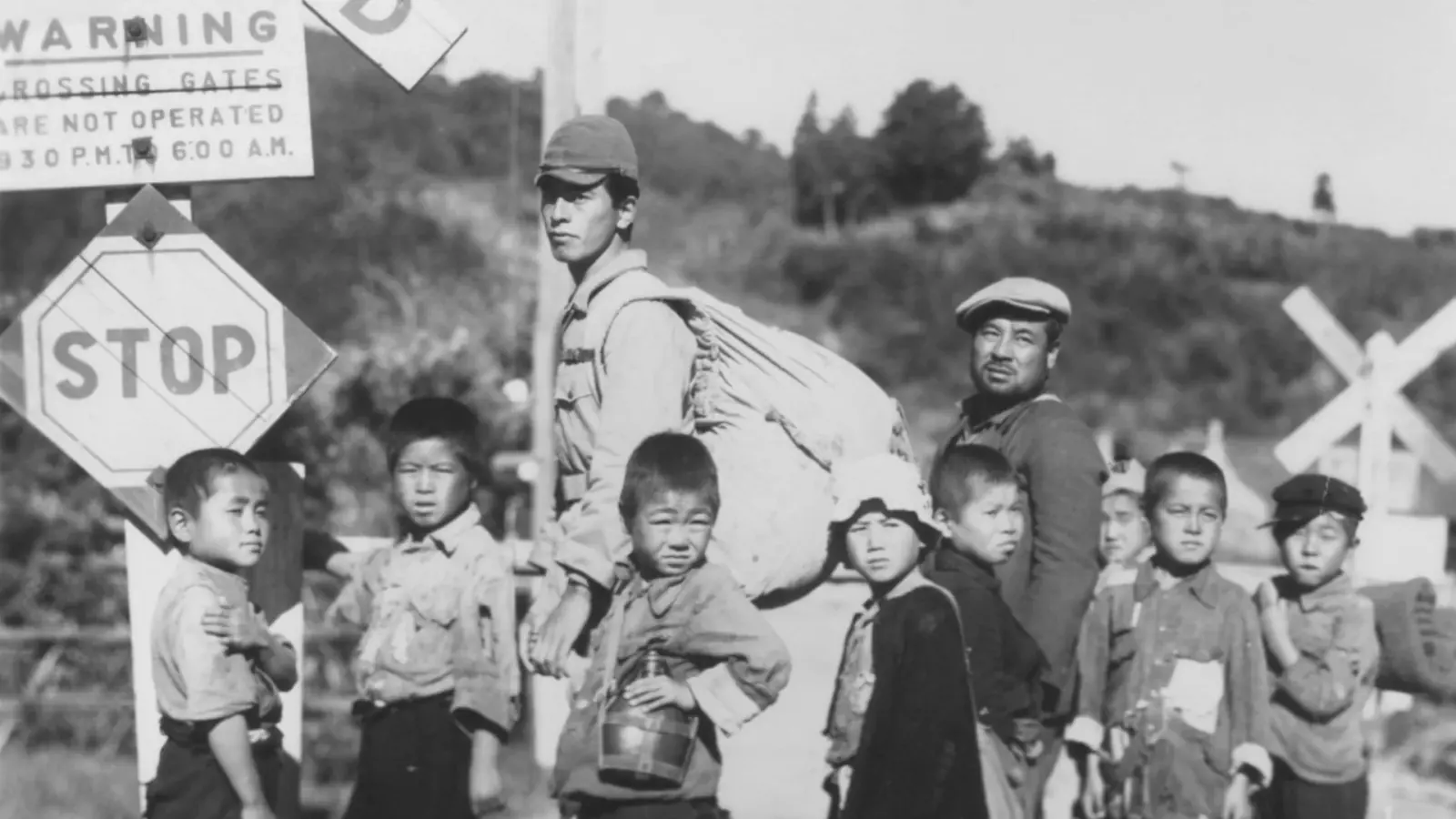
The lead still comes from Children of the Beehive (1948), a postwar film in which that method became inseparable from Shimizu's life beyond the studio. Its traveling children do not illustrate a general idea of innocence. They have weight, fatigue, momentum, and one another. The image is a fitting threshold to his career because it catches the central wager of his filmmaking: keep bodies in a shared landscape long enough for relation to become visible, but do not pretend the camera can finish their lives for them.[6][7]
The bus makes progress answer to its wake
In Mr. Thank You (1936), a bus carries passengers through the Izu hills while its driver repeatedly thanks pedestrians who step aside. The premise could support a genial string of roadside jokes, and Shimizu does keep the ride buoyant. But the route also passes itinerant performers, Korean road laborers, migrants, and rural people bearing the cost of industrial change. Inside the bus, a destitute mother is taking her daughter toward a future the film understands as economic coercion, not adventure.[3]
Shimizu's formal control prevents this social cross-section from becoming a roll call of misery. David Bordwell describes how the opening organizes the road into alternating views: the bus approaches people, the driver acknowledges them, and then the vehicle leaves them receding behind it. The pattern tightens and varies, even making room for a joke when the driver thanks chickens. Later, passengers who have left the bus diminish in the distance as the journey continues. Forward motion is always paired with what it abandons.[2]
This is more than graceful camera work. By giving each encounter a forward and rearward orientation, Shimizu makes continuity argue with itself. The bus embodies modern connection, yet its wake contains the labor and displacement that connection does not cure. The people beside the road have lives before the vehicle reaches them and after it passes. The driver can carry a message or perform a kindness, but he cannot absorb every hardship into the journey's cheerful rhythm. His courtesy acknowledges another person's claim on the route without cancelling the fact that he gets to continue.
The reverse tracking shot makes that social geometry physical. When the camera retreats before someone walking toward it, the figure advances while the world continues to unfold behind and around them. Shimizu can keep a face legible, a gait specific, and a landscape socially active in the same movement. The distance does not make the figure anonymous; it prevents expression from monopolizing the shot. Context remains in the picture as something a body moves through, uses, and is constrained by.[1][2]
Children occupy the world at their own scale
Shimizu's films about children sharpen the same principle because children are so easily made to carry an adult filmmaker's message. Children in the Wind (1937) follows two brothers after their father is falsely accused of forgery and arrested. BAMPFA's archival program note emphasizes both the variety of outdoor locations and the film's near-exclusive attention to the children's world. Adult injustice creates the crisis, but the film does not turn the boys into miniature lawyers arguing the case.[4]
Instead, movement preserves their scale of experience. Paths are for running, dares, evasions, games, sulks, and sudden alliances before they are symbols of social mobility. The camera's relative distance allows play to coexist with fear without requiring every gesture to announce which one it represents. A child can be resilient in one shot and overwhelmed in the next; neither state cancels the other. What adults have done becomes visible obliquely, through the altered space in which children must keep moving.
That is why Shimizu's reputation for warmth needs qualification. Sentiment would make the children valuable because they are pure, wounded, or exemplary. His stronger films value their unruly present tense. They fall out of formation, invent uses for space, and withhold the tidy reaction an adult drama might require. The director's patience is not a claim that childhood exists outside history. It shows history arriving as a disruption of ordinary bodily freedom.[2][4]
Stopping can be another form of movement
The Shimizu road does not always require literal travel. In Ornamental Hairpin (1941), a mountain onsen gathers visitors in a semipermanent pause. A soldier played by Chishu Ryu remains after injuring his foot on a hairpin; its owner, played by Kinuyo Tanaka, returns and helps him recover. Families, a professor, and other guests come and go around them. The film's wartime setting stays mostly beyond the resort, but that absence is charged enough that a contemporary critic attacked the production for wasting scarce film stock on something so unmilitaristic.[5]
Here the corridor, path, and riverside inn perform the work of a road. They bring strangers into provisional orbit without guaranteeing that proximity will become a stable future. Recovery takes the form of repeated walks. Romance grows in borrowed time. The resort offers neither a heroic retreat from history nor a sealed refuge outside it; it is a place where the demand to rejoin the prescribed route can briefly be delayed.[5]
Shimizu's looseness is crucial. A more forceful plot would make every comic routine point toward the couple and every guest comment on their fate. His digressions keep the shared space from belonging entirely to them. Other bodies have other tempos: children rush, a convalescent measures progress, guests settle into habit, departures break the pattern. The main story becomes one current among several, which is why its tenderness never hardens into a private exemption from the world.
After the war, location became an obligation
Children of the Beehive pushes this method into much rougher terrain. Shimizu self-produced the 1948 film after leaving Shochiku. A repatriated soldier travels with war orphans across coastlines, railways, salt ponds, logged forests, mountain roads, and a Hiroshima still carrying the mark of atomic destruction. The children were themselves war orphans from a home Shimizu had established; the film was shot entirely on location.[6][7]
The production history must not be allowed to masquerade as formal innocence. Shimizu still selected, staged, framed, edited, and shaped a journey; lived hardship did not remove his authority over the image. What changes is the field in which that authority operates. The earlier films' attention to children and roadside lives now reaches into production: who travels together, who is housed, who appears, and what damaged places the camera agrees to face.
The archival still carries that tension. It is evidence of a fiction and a trace of actual children moving through postwar conditions. Shimizu's long views refuse to isolate them as emblems of suffering, yet the landscape cannot be reduced to picturesque background. Bodies and country press on each other. A child crossing the frame changes the meaning of the road; the scarred road changes the meaning of childhood.[6][7]
This is where Shimizu's humanism becomes more demanding than kindness. Kindness can remain a property of a benevolent hero. His cinema repeatedly redistributes attention away from that center. The bus driver matters, but so do the people he leaves behind. The soldier matters, but the orphans are not merely proof of his decency. A couple matters, but the resort keeps other lives in motion around them. The frame is hospitable because it is never finally theirs.
Shimizu did not solve social inequality by photographing people in open air, and his light touch should not be mistaken for political innocence. What he achieved was narrower and more durable: a film form in which forward movement cannot erase lateral encounter. His roads lead somewhere, but they also keep asking who had to move aside, who can travel, who must stop, and whose journey continues after the story has gone. The camera retreats, the person advances, and the world remains open at the edge of the frame.
Sources
- The Japan Foundation, New York, "Hiroshi Shimizu" — retrospective overview of Shimizu's career, location shooting, linear traveling shots, nonprofessional performers, marginalized characters, and postwar work with children.
- David Bordwell, "Pierced by Poetry," Observations on Film Art, May 13, 2009 — formal analysis of Shimizu's axial compositions, road tracking shots, loose plotting, and the forward-and-reverse visual structure of Mr. Thank You.
- BAMPFA, "Mr. Thank You" — archival screening note on the 1936 film's location route, passengers, Korean road laborers, migrants, and industrial-era social portrait.
- BAMPFA, "Children in the Wind" — archival screening note on the 1937 film's outdoor locations, two brothers, and child-centered point of view.
- BAMPFA, "Ornamental Hairpin" — archival screening note on the 1941 film's onsen setting, convalescent romance, location work, and pointedly unmilitaristic wartime reception.
- BAMPFA, "Children of the Beehive" — archival screening note on the 1948 film's war-orphan cast, location production, postwar landscapes, Hiroshima passage, and tracking shots.
- Japan Society / Kobe Planet Film Archive, archival still from Children of the Beehive (1948) — direct source asset used as the article image.