A two-story house has a direction built into it: upward. In Kim Ki-young's The Housemaid (Hanyeo, 1960), that direction initially means success. Music teacher Dong-sik, his seamstress wife, and their two children have left a smaller home for a Western-style house with an upper floor, an upright piano, broad glass doors, and enough room to display the life they are working toward.
It is also too much house for the family to run. Mrs. Kim has sewn until she collapses, and the new rooms turn achievement into more cleaning, carrying, watching, and climbing. Hiring Myung-sook, a young woman recommended through Dong-sik's factory music class, is supposed to close that labor gap. Instead, it gives the household's contradictions a body that can move through them.[1][3]
The usual shorthand is that Myung-sook invades a respectable family. The film's sharper idea is that the family has expanded beyond the labor it can acknowledge. Its staircase is therefore more than an omen or a convenient place for people to fall. It is the mechanism that links class aspiration to domestic dependency: every character tries to climb toward security, authority, or intimacy, and every such movement makes the house less stable.
Spoiler and version note: this close reading discusses the ending. It refers to the 2008 digital restoration by the Korean Film Archive, made with The Film Foundation's World Cinema Project and HFR-Digital Film laboratory.[2][7]
The achievement already needs another worker
The opening credits appear over the Kim children playing cat's cradle. One child receives a figure of string, pulls it apart, and hands back a new arrangement. The game is an elegant model for the film: the same lines keep becoming a different enclosure. Robin Chapman's study of the movie connects this shifting geometry to Kim's use of frames within frames—the stair rails, windows, glass doors, and room divisions that repeatedly reorganize whoever stands inside them.[6]
That geometry begins with work. Dong-sik earns money teaching music to women at a textile factory. Mrs. Kim adds income by sewing at home. The factory and the household are not opposites; paid female labor in one helps finance unpaid and underpaid female labor in the other. Even the piano crosses the boundary. It is Dong-sik's profession, a marker of cultivation, and eventually the instrument through which a factory worker enters the private home for lessons.
The new house looks like the reward for this combined effort, but its size immediately creates a demand for another woman's body. Myung-sook does not introduce labor into a previously effortless domestic cocoon. She replaces the labor Mrs. Kim can no longer sustain. A 2025 study of the film's spatial politics reads the ground floor, upper floor, and staircase as a hierarchy where class, patriarchal authority, and reproductive labor become visible.[5] Kim makes that hierarchy tactile: trays must be carried, rooms crossed, doors opened, rats removed. Respectability is a daily logistics problem.
This does not make Myung-sook an innocent emblem. She is volatile, invasive, and later lethally vindictive. But the film has already denied the comforting idea that evil simply arrives from outside. Before she appears, a factory worker's love letter to Dong-sik has been reported to a dormitory supervisor and followed by the worker's departure from her job; Mrs. Kim is ill from overwork; and the family has acquired more domestic space than it can manage alone.[1] Myung-sook enters a system under strain, not a sanctuary.
The staircase gives desire a route
Kim seldom lets a room remain a sealed container. Characters watch through glass, hear the piano across floors, or pause where the stairs expose them to one level while carrying them toward another. The house is claustrophobic not because it is tiny but because sight and sound travel farther than authority does. The BFI aptly describes it as a bourgeois cage whose doors, windows, and ominously framed staircase compress the family as concern for status traps them inside.[4]
Myung-sook's upstairs room offers proximity without belonging. She can ascend farther into the house, but the climb does not convert employment into membership. Chapman notes that her repeated movement upstairs gives class mobility a literal route.[6] The cruel joke is that vertical access only sharpens the distinction between a room she occupies and a household she can claim.
The piano makes the route audible. Dong-sik's measured playing carries the authority of teacher, wage earner, and cultivated patriarch. When Myung-sook strikes dissonant notes at night, the same instrument becomes a summons. Order does not disappear; it is replayed in a key the family cannot control. Dong-sik climbs toward the noise, and the professional tool that helped pay for the house draws him into its most dangerous private space.[6]
After Myung-sook watches Dong-sik reject another woman's advance, she and Dong-sik have sex while Mrs. Kim is away. The staging matters more than a verdict about who first tempted whom. Gazes pass through the glass; sound passes between floors; Dong-sik crosses the stairs; secrecy depends on the very architecture meant to exhibit his family's arrival. Desire does not breach the house from the street. It follows the routes the house has already built.
Rat poison is part of the domestic inventory
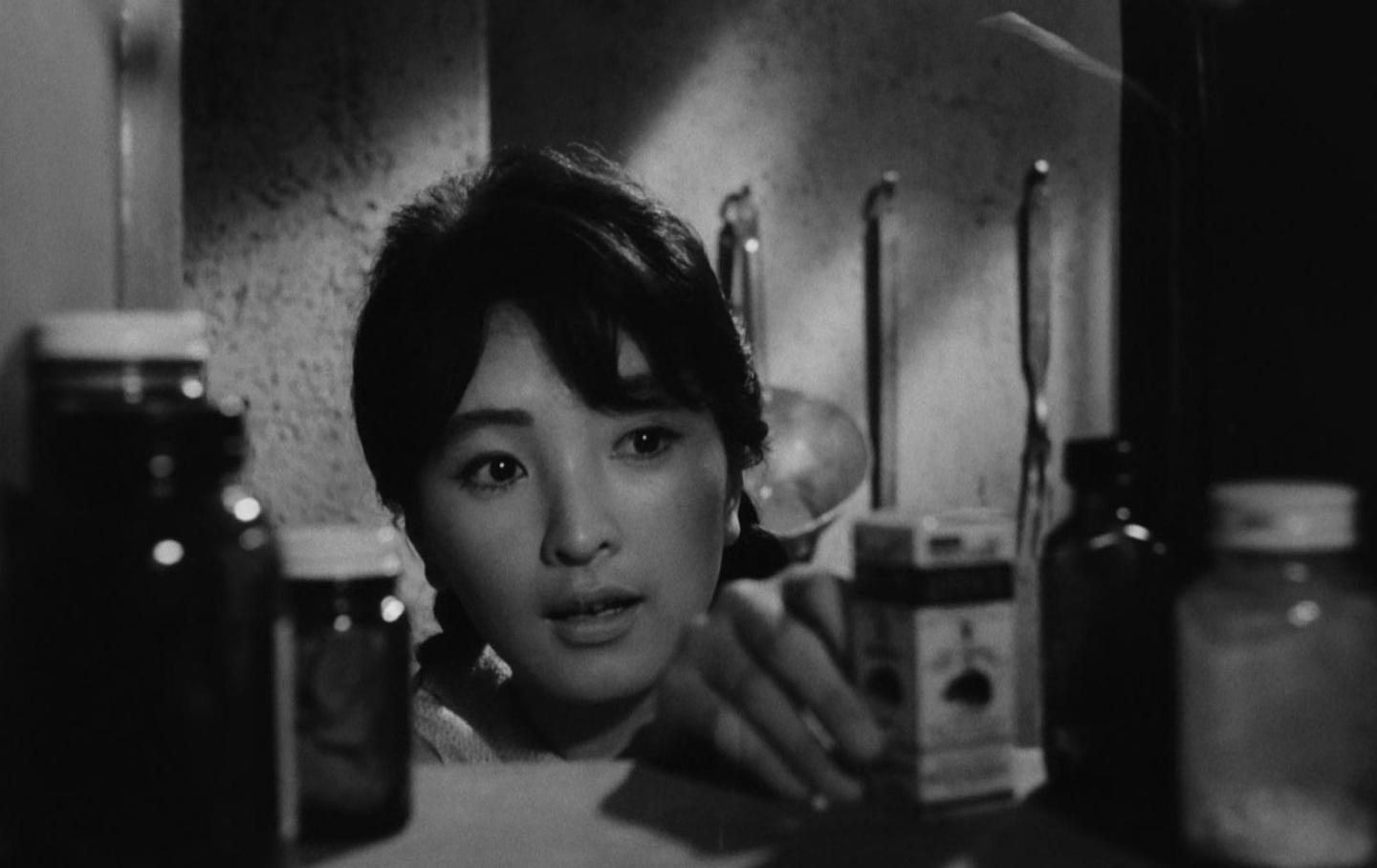
Myung-sook's introduction to the kitchen is brutally practical. She catches a rat with her bare hands and is told that poison is kept in the cupboard. The moment establishes her as alarming, but it also establishes poison as ordinary household equipment. It sits beside the tools of care, waiting to become a tool of discipline.
That cupboard is a miniature of Kim's method. Sewing supports the family until it exhausts Mrs. Kim. The piano produces income until it carries forbidden intimacy. A larger home signifies security until it requires a live-in worker. Rat poison protects the kitchen until knowledge of it gives fear a permanent address. Objects do not suddenly reverse their meanings; the uses already latent in domestic management are pushed toward violence.
When Myung-sook becomes pregnant, Mrs. Kim coerces her into ending the pregnancy by throwing herself down the staircase. Later, Myung-sook gives Chang-soon a glass of water and tells him it was poisoned. He runs toward his parents, falls on the same stairs, and dies.[1][2][8] The symmetry is pitiless. The first fall uses architecture directly against Myung-sook's child. The second needs no chemical poison at all: a statement, a frightened body, and the staircase are enough to take the family's older son.
This is why it is too simple to say the stairs symbolize rising and falling status. They convert authority into action. Mrs. Kim cannot erase the affair herself, so she turns the house into an instrument against another woman's pregnancy. Myung-sook cannot acquire a secure place in the family, so she turns the same route against Chang-soon. Each woman is constrained by Dong-sik's decision and by a household organized around preserving his public standing; each, in turn, redirects violence toward a child. The film sees oppression without pretending that suffering makes retaliation just.
Every ascent returns as a fall
By the final movement, the upper floor has become a regime within the regime. Myung-sook uses the threat of exposing Dong-sik at the factory to demand his presence upstairs. Mrs. Kim, trying to preserve the family and its income, sends her husband to the maid's room. The spatial order remains outwardly intact—wife below, maid above, husband moving between them—but its supposed head no longer controls where he sleeps or what his movement means.[1]
The climax makes descent agonizingly slow. After Dong-sik and Myung-sook drink rat poison, he tries to return to his wife below. Myung-sook clings to his leg; as he forces his way down, her body is dragged headfirst over the steps and left dying on the staircase.[1][2][8] The banister throws elongated bars of shadow across the wall, turning the family's badge of advancement into something between a cage and a seismograph. Chapman's formal analysis emphasizes how expressionist light distorts the familiar geometry here.[6] The staircase is no longer merely where consequences happen. It seems to register the household's breakdown in every repeated rail and lurching body.
Three descents now answer the original dream of ascent: Myung-sook's first fall ends her pregnancy; Chang-soon's fall kills the family's older son after Mrs. Kim has delivered another baby; Dong-sik's poisoned crawl brings the patriarch back to his wife only in time to die.[1][2][8] No one reaches the lower floor restored. The house delivers each person to the place where the family can see the damage, after hiding the decisions that produced it upstairs.
Kim then performs his most audacious reversal. The film returns to the opening conversation, recasting the catastrophe as a cautionary scenario prompted by a newspaper story. Dong-sik addresses the audience and warns middle-aged men that desire for younger women can lead them to ruin.[1][8] On its face, the gesture flattens everything into a patriarchal lesson: police male desire, blame the outsider, resume the ordinary evening.
The frame tries to quarantine the nightmare inside a cautionary tale. Whether each factory incident and every detail of Mrs. Kim's exhaustion belongs to the outer reality or to the scenario is deliberately unsettled. What the return clearly preserves is the two-story home, its dependence on a maid, and Dong-sik's authority to explain what it all means.[8] The direct address can revoke the deaths, but it cannot neutralize the household hierarchy the film has made visible. By converting that hierarchy into a warning about male desire, Dong-sik tries to contain the story without answering it.
That tension is what keeps The Housemaid from becoming either a tidy class allegory or a simple tale of a monstrous servant. Its maid commits monstrous acts. Its family also asks a worker to maintain an aspiration that depends on her remaining close, useful, and socially beneath them. Kim's staircase holds those truths together. It promises that one can rise through the new house, then reveals that there is no upward step that does not redistribute weight onto someone below.
The survival of that staircase is itself the result of reconstruction. The original negative, located in 1982, lacked reels five and eight; a damaged release print found in 1990 supplied the missing material, complete with large, hand-written English subtitles burned into the image. KOFA's restoration had to join these unequal sources and digitally reduce the lettering and damage.[7] That history fixes the version boundary for this reading: the precise frames discussed here come from the 2008 restored composite, not from a wholly surviving original negative.
Sources
- Korean Film Council (KOFIC), KoBiz, “The Housemaid (1960)” — official database record with release details, credits, cast, and full synopsis.
- Korean Film Archive, “The Housemaid” — official Blu-ray/DVD record for the digitally restored film, including edition specifications, restoration-release history, and the version referenced for direct scene observation.
- Harvard Film Archive, “The Housemaid” (February 28, 2005) — program note on the seamstress household, the maid's arrival, the film's initial success, and its 1997 critical revival.
- John Berra, “10 great South Korean horror films,” British Film Institute (July 11, 2024) — claustrophobia, the staircase's class function, and source page for the film still.
- Jeong-ae Park and Yoon Eui Suk, “The Spatial Representation of the Oppressed Body: Focusing on The Housemaid (1960),” Journal of Humanities Therapy 16, no. 1 (2025) — domestic hierarchy, reproductive labor, and spatial power.
- Robin Chapman, “Passing Through the Pane: Genre, Art and Meta-textuality in Kim Ki-young's The Housemaid,” WRoCAH Journal — close analysis of the staircase, piano, glass frames, lighting, and cat's-cradle credits.
- The Film Foundation, World Cinema Project, “The Housemaid / Hanyo” — restoration partners, surviving elements, technical process, and Korean Film Archive image provenance.
- Lisa Mullen, “Pointing the finger: the ending of The Housemaid,” Sight and Sound, British Film Institute (May 4, 2022) — sewing-funded aspiration, the staircase deaths, the final descent, and the direct-address frame.