Benjamin Christensen's Häxan keeps escaping the names meant to contain it. It is a silent-era witchcraft film, a pseudo-lecture, a horror pageant, a historical montage, a medical case argument, an illustrated essay, and a piece of grotesque theater. BFI describes it as a 1922 Swedish-Danish production by Christensen, released in the United Kingdom as Witchcraft Through the Ages, and still striking enough after a century to feel more like a category problem than a settled classic.[1][2]
That category problem is the point. Häxan is disturbing not simply because it shows demons, witches, torture, or sabbath imagery. It is disturbing because it borrows the confidence of nonfiction while staging images that nonfiction cannot safely master. The film begins with diagrams, woodcuts, models, and historical framing; then it turns those explanatory materials into a license for visions of possession, domestic intrusion, clerical cruelty, female suffering, and social panic. By the time Christensen arrives at modern medical language near the end, the viewer has already learned to distrust every authority that claims to explain too cleanly.
This is why Häxan belongs in movie history as a movement and genre hinge rather than as a curiosity on the horror shelf. It was made before documentary had hardened into one institutional style and before horror had fully sorted out its feature-film grammar. The film therefore behaves like a workshop where several future modes are being tested at once: archive film, exploitation lecture, folk-horror tableau, historical reenactment, medical social film, special-effects spectacle, and essay cinema. Its most modern quality is the way those modes contaminate one another.
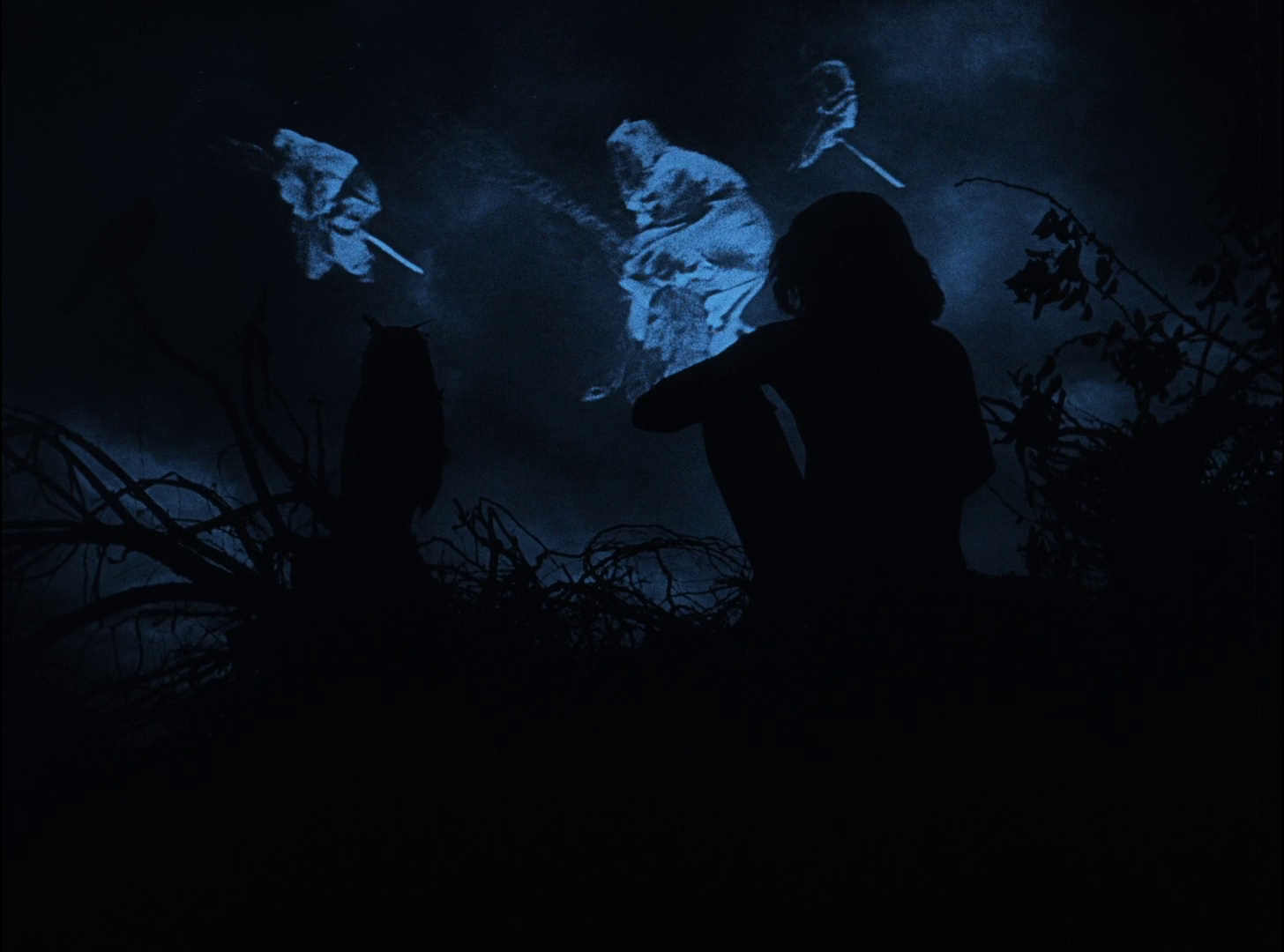
Image context: the cover is a real archival frame from the film, sourced from the English Wikipedia file record and credited there to a public-domain Internet Archive copy.[5] It is not fan art, a poster variant, a diagram, or a generated occult mood image. The frame is especially apt because it shows the film's unstable method: a staged nightmare presented with the force of documentary evidence.
A Lecture That Keeps Losing Control
The opening of Häxan looks like a film trying to educate before it tries to frighten. Christensen organizes the early movement around old cosmologies, church images, demonological belief, and the intellectual world that made witch persecution plausible.[1][3] The Public Domain Review's presentation of the film emphasizes this hybrid shape: Häxan is not a straightforward fiction but an attempt to move through the history of witchcraft, superstition, and persecution with unusually elaborate visual invention.[3]
That matters because the film's first claim to seriousness is informational. It acts as if the archive can discipline the imagination. A medieval drawing becomes a teaching object; a model of the cosmos becomes a map of thought; images of devils and punishment appear to be evidence of past belief rather than merely the film's own appetite for spectacle. The viewer is invited to look historically before being asked to look fearfully.
But Christensen does not keep the lecture stable. The film's "evidence" begins to behave like cinema. Images do not remain safely pinned to the desk. Demons get bodies. Temptations enter rooms. Superstition becomes domestic, physical, and theatrical. The historical explanation turns into an engine for staged episodes, and the staged episodes make the earlier explanations feel less neutral. The film seems to ask: if an old image was once believed, what happens when cinema makes it move again?
That is where Häxan becomes more than an antiquarian tour. Its archive is not passive. The woodcut, the clerical text, the torture chamber, the kitchen, the sickbed, and the devil mask all become moving parts in a social machine. The film's lecture voice wants to tell us what witch belief was. Its images keep showing how belief takes possession of institutions, neighbors, families, and bodies.
Horror Arrives Through Procedure
Modern horror often announces itself through atmosphere: the cursed house, the shadowed corridor, the monster's arrival, the sound cue that tells the body to tense. Häxan often gets there by procedure instead. A rumor is interpreted. A woman is accused. A confession is pressured into existence. Authority translates illness, poverty, age, desire, or eccentricity into evidence. The horror is not only that demons may exist in the film's imagined medieval world. The horror is that a bureaucracy can make demons administratively useful.
BFI's feature on the film's centenary underlines Christensen's unusually expensive and ambitious production, as well as the film's reputation for images that have remained shocking, funny, scholarly, and grotesque in different measures.[1] The San Francisco Silent Film Festival likewise frames the film as a major silent work whose mixture of historical argument and phantasmagoria still resists a simple genre tag.[6] Those descriptions are useful because Häxan is not scary in only one register. It is scary as a monster show, but also as a process film about interpretation under pressure.
The torture and interrogation passages are central to that pressure. Christensen is interested in how fear turns into a system. A woman's body becomes a text to be read by people who have already decided the answer. Pain produces speech, speech produces further accusations, and accusations give the institution permission to continue. The film's most frightening social insight is that bad explanation can look orderly while it is doing violence.
That procedural horror also keeps the supernatural scenes from becoming simple fantasy. When witches fly, demons leer, and grotesque rituals unfold, those images are not sealed off from the courtroom or the cell. They are the fantasy life of a culture that has built procedures for punishing fantasy as fact. The film understands that persecution needs both paperwork and nightmare. Each authorizes the other.
The Devil Is Also a Special Effect
Christensen himself plays the Devil, and that casting choice gives Häxan one of its strangest self-portraits.[1][2] The filmmaker becomes the tempter inside his own illustrated argument. He is not just documenting superstition or dramatizing it from the outside. He enters the apparatus as a performer, turning the film's scholarly mask toward theatrical mischief.
This is one reason the movie still feels alive rather than merely historically important. The Devil scenes are playful, obscene, comic, and unsettling because they make the film's method visible. A tongue sticks out; a face looms; a body sneaks through a room; an impossible image appears with a magician's timing. Christensen is fascinated by belief, but he is also fascinated by what a camera can make viewers half-believe for a moment. The film studies superstition while practicing a controlled version of it.
That double movement places Häxan near several future traditions. It anticipates horror films that use historical or folkloric material as more than costume. It anticipates essay films that assemble archive, quotation, argument, and staged material into a personal structure. It anticipates exploitation lectures that justify sensational material through a public-interest frame. It also anticipates documentary skepticism: the uneasy sense that presentation style can make an argument feel authoritative before the audience has tested it.
The effects are therefore not decorative interruptions. They are part of the thesis. When the film makes a demon appear, it is not only showing what people believed. It is showing how images persuade. Cinema becomes both a tool for explaining superstition and a new machine for producing it. That is the film's deepest joke and its deepest danger.
The Medical Ending Does Not Cleanly Rescue the Film
The final movement of Häxan is often treated as the film's rational correction. Christensen links earlier witchcraft accusations to modern understandings of hysteria, sleepwalking, kleptomania, and other medicalized or psychological categories of his period.[1][3] In broad terms, the film asks viewers to see accused witches not as servants of Satan but as vulnerable people misread by their societies. That humanitarian pivot is real, and it is one reason the film remains more morally interesting than a mere parade of diabolism.
But the ending is not a clean rescue from superstition into modern truth. It is more unstable than that. The film critiques old demonology, yet it also inherits the confidence of early twentieth-century medical explanation. It challenges clerical cruelty, yet it risks replacing one authoritative vocabulary with another. The modern case study can become its own kind of spectacle. The woman once displayed as witch may now be displayed as patient.
That ambiguity is what keeps the film from settling into a simple progress story. The viewer can accept Christensen's basic ethical correction, that persecution was a human disaster built from fear and misinterpretation, while still noticing that the film's modern categories are historically situated. The medical ending tells us something important about 1922 as well as about the Middle Ages. It shows a filmmaker trying to drag horror into explanation, and explanation into sympathy, using the best tools he thinks he has.
The Swedish Film Institute's centenary note points to the film's durable international afterlife, including its restored circulation and renewed attention around its hundredth anniversary.[4] That afterlife makes sense because each era finds a different Häxan. Silent-film viewers could see shock, virtuosity, and scandal. Horror audiences can see occult imagery that feels startlingly physical. Documentary audiences can see a strange early essay film. Contemporary viewers may be most struck by the film's argument about social panic: once a community has an interpretive machine, almost any vulnerable person can be fed into it.
Why Its Genre Still Will Not Sit Still
Calling Häxan a horror film is not wrong. The image system belongs to horror: night flights, demonic bodies, graveyards, sacrilege, violated rooms, and faces distorted by fear. But calling it only horror loses the pressure that makes the film unusual. Its terror comes from genre instability. The movie keeps asking whether a frightening image is evidence, reenactment, fantasy, symptom, teaching aid, or cinematic trick. Often the answer is yes to several at once.
Calling it a documentary is also not wrong, provided the term is allowed to be historically loose. The film argues, cites, illustrates, compares, and explains. BFI's film page and BFI Player listing both preserve the work's standing as a 1922 film by Christensen whose subject is witchcraft through history, not a conventional story about one invented protagonist.[2][7] Yet the film's nonfiction impulse is inseparable from staging. It does not merely show historical materials. It builds a theater around them.
That is why the movement-and-genre context is so valuable. Häxan sits at a moment when cinema was still discovering how many kinds of truth effect it could produce. A film could lecture like a museum talk, shock like a sideshow, argue like a reform pamphlet, reconstruct like a historical pageant, and frighten like a nightmare. Christensen did not choose one lane. He made a film in which the lanes are the subject.
The result is still uncomfortable because it implicates the viewer's own desire to understand. We want the film to tell us what witchcraft "really" was. It gives us history, then spectacle. We want spectacle to stay safely unreal. It ties spectacle to courtrooms, doctors, priests, and neighbors. We want modern explanation to end the nightmare. It shows explanation becoming another performance of authority. Häxan survives because it knows that bad seeing can be learned, taught, institutionalized, and beautifully photographed.
The film's most lasting horror, then, is not Satan on the screen. It is the human confidence that claims to have identified Satan in someone else. Christensen's genius was to make that confidence visible as cinema: seductive, elaborate, self-important, and dangerous even when it comes dressed as knowledge.
Sources
- BFI, "Häxan: the silent-era witchcraft film that still casts a spell at 100" - centenary feature on the film's production ambition, hybrid form, and lasting shock value.
- BFI, "Häxan (1922)" - film page identifying Benjamin Christensen's Swedish-Danish witchcraft film and its release context.
- The Public Domain Review, "Häxan: Witchcraft Through the Ages (1922)" - public-domain presentation of the film's historical, occult, and essayistic structure.
- Swedish Film Institute, "Wordwide success for Häxan" - centenary restoration and international-circulation note on the film's renewed afterlife.
- English Wikipedia, "File:Haxan (1922) witches.jpg" - archival film frame used as the article image, with source and public-domain file metadata.
- San Francisco Silent Film Festival, "Häxan" - festival program note framing the film's mixture of historical argument, spectacle, and silent-era strangeness.
- BFI Player, "Häxan" - streaming listing preserving the film's alternate English title and concise subject framing.