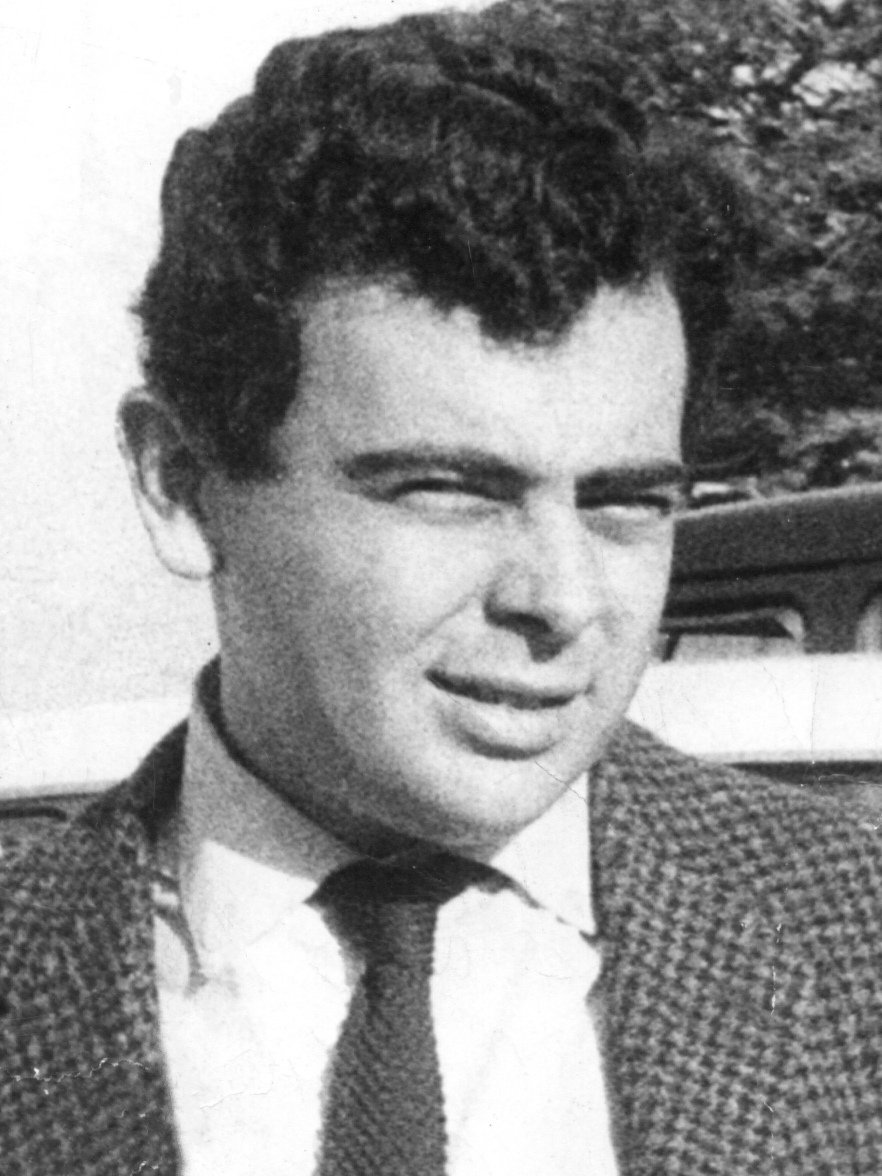
Spoiler note: this profile discusses major turns and ending images in several of Rocha's films.
Glauber Rocha's last feature was designed so it could begin almost anywhere. A 2026 Cinemateca Portuguesa program note for its 149-minute 35mm copy documents both the habitual fixed order and Rocha's repeated proposal to let projectionists rearrange the reels. While developing A Idade da Terra (The Age of the Earth, 1980), he conceived its sections as independent, interchangeable blocks; he later gave the film a definitive order. The film itself has no conventional opening or closing credits to settle which end is truly the beginning.[1]
This was not disorder added as a flourish. A Idade da Terra assembles recurring Christ figures, an imperialist antagonist, political denunciation, ritual, street life, and openly didactic passages without making them obey a single dramatic road. Brazil appears as a field of competing forces: Indigenous and Black traditions, militarism, capitalism, popular spectacle, revolutionary desire, and religious myth occupy the same work without resolving into one national portrait.[2]
The temptation is to call that a late-career breakdown. It is more useful to see it as a culmination. From his first feature onward, Rocha distrusted the smooth image that pretends a country can be observed from one stable position. His camera could be ecstatic or accusatory, handheld or ceremonial, but it kept discovering a split inside every certainty. Land could be material fact and prophecy. A political leader could be hope and fraud. Popular religion could be consolation, discipline, and creative power at once.
Rocha began as a critic in Salvador before he became an internationally known filmmaker.[6][7] He never stopped behaving like criticism could be made from movement, sound, faces, and cuts rather than delivered after the film was over. His public identity became inseparable from manifestos, arguments, festivals, exile, and unfinished projects.
Start With The Reels
The archival version documented by Cinemateca Portuguesa follows a customary order: sunrise over Brasília's Palácio da Alvorada at the start, the Maracanã sequence at the end. Yet the projectionist proposal keeps another possibility alive: sunrise might arrive in the middle; spectacle might precede prophecy; an apparent conclusion might become a premise.[1] Viewers ordinarily encounter a fixed cut—the point is Rocha's documented alternative exhibition proposal, not that every circulating version arrives shuffled. Reordering does not make every sequence mean anything whatsoever. It changes the relations among sequences, forcing viewers to build and rebuild the political whole.
That distinction matters. Randomness would merely scatter the film. Rocha's proposal instead refuses hierarchy. No single character becomes the authorized Brazil, and no one city, myth, race, or political vocabulary receives the privilege of explaining all the others. The film's Christ figures are not pieces of a tidy theological puzzle. They are incompatible claims about liberation passing through bodies and places that a conventional plot would normally rank, reconcile, or discard.[2]
Even authorship becomes unstable. Rocha's directions and presence leak into the work rather than remaining safely outside it, so the movie sometimes exposes the labor of trying to command its own unruly material.[1] The gesture does not disavow authority; it makes control visible as a struggle. The film even lets Rocha's voice announce confidence in a future dialectical synthesis of capitalism and socialism, while its fractured form refuses to make that certainty stable.[1]
The production itself sharpens that contradiction. This formally insurgent film was made with Embrafilme, Brazil's state film company.[2] By 1980, Rocha carried international prestige and bitter political disputes, and had stirred controversy through his public praise of President João Figueiredo and the military-managed abertura.[1][6] The unfinished image is therefore not proof of purity. It is a way of keeping compromise, ambition, and failure inside the frame.
Exile Turned The Nation Into A Moving Border
Working backward, the fractures of A Idade da Terra lead into an international phase that began before and continued through Rocha's early-1970s exile. In 1970, The Lion Has Seven Heads confronted colonial power in Congo-Brazzaville and Cutting Heads moved a decaying dictator into a Spanish castle. History of Brazil, co-directed with Marcos Medeiros and developed from archival material in Cuba, attempted a political inventory; Claro later looked at Rome through a Brazilian and anticolonial lens.[6][7] The map widened, but the old problem remained. How could a filmmaker speak from Brazil when Brazil had become a place he carried through other countries?
Rocha did not solve that problem by abandoning material politics for private mysticism. His 1965 "Aesthetics of Hunger" and 1971 "Aesthetics of Dream" are better understood as complementary pressures. The first attacks the foreign gaze that beautifies poverty while keeping the colonized safely distant. The second turns toward myth, trance, and the imaginative resources of Indigenous and Black popular cultures as forms of resistance.[3][11] Hunger names a structure that hurts bodies; dream names powers that cannot be reduced to the oppressor's account of reality.
That pairing helps explain why the exile films resist the clean grammar of the political pamphlet even when they contain pamphleteering. Rocha's arguments arrive through grotesque rulers, ecstatic speech, ritualized gesture, and collisions of place. The films do not ask myth to replace history. They ask whether history can be grasped without the desires, fears, religions, and inherited stories through which people experience it.
In a 1967 interview, Rocha described Cinema Novo as a spontaneous collective rather than a uniform organization and defended poetic cinema against fixed narrative grammar.[4] The point is crucial to his profile. He was a leading voice of the movement, not its sole author. And his notion of political form depended on variation: a shared emergency could produce different films, just as one reel could change meaning when placed beside another.
Trance Is The Opposite Of A Lesson
Terra em Transe (Entranced Earth, 1967) makes that method impossible to miss. Set in the fictional Latin American country of Eldorado and made three years after Brazil's 1964 coup, it follows a poet-intellectual who moves between a conservative strongman and a populist candidate, finding domination and self-deception in both camps.[6][8] The film does not stand outside the crisis with a correct platform. It places intellectual ambition, popular representation, oligarchic power, and revolutionary impatience inside the same fevered machinery.
Speeches become performances before they become policies. Crowds can look like a constituency, a chorus, an ornament, or a population being ventriloquized. The camera presses into ceremonies and arguments rather than calmly diagramming them. Music, rhetoric, abrupt movement, and allegorical acting make politics feel less like a sequence of positions than a struggle over who gets to stage reality.
That is why the film's despair is not the same as political neutrality. Its target includes the intellectual who imagines that proximity to power gives him control over power. Rocha turns that fantasy against himself as well: the poet with a vision cannot make the people, the leaders, or the movie submit to a clean historical script. The FIPRESCI jury at Cannes awarded Terra em Transe its 1967 international critics' prize ex aequo, but the film's deeper achievement is to make prestige feel irrelevant to the failure it exposes.[9]
Two years later, Antonio das Mortes returned to the sertão and to a hired killer first seen in Black God, White Devil. Now in color, the landscape becomes a popular stage of flags, cloth, dance, armed power, and peasant revolt. The central mercenary must discover that the role assigned to him no longer explains the conflict he has entered. Rocha won the 1969 Cannes directing prize for the film, shared with Vojtěch Jasný.[6][10] Yet the honor did not domesticate the work. Genre itself—western, saint's legend, political allegory—keeps changing sides.
Hunger Had To Enter The Form
The source of that instability is already fierce in Black God, White Devil (1964). Ranch hand Manoel and his wife Rosa cross the dry northeastern sertão after he kills the employer who cheats him. They pass first into the orbit of a messianic preacher, then toward the cangaceiro Corisco, while Antonio das Mortes is paid to end both religious and bandit revolt. Rocha does not offer the couple a safe ideology. Each promise of deliverance reproduces violence in another shape.[5]
The film's opening finds politics before anyone gives a speech: pale, rough ground; the remains of a cow; Manoel's partially hidden face. Fábio Andrade's Criterion essay shows how Rocha builds the journey from the caatinga's specific material conditions while mixing Villa-Lobos, sung narration, theatrical performance, close-ups, and mobile landscape.[5] Form does not illustrate deprivation from a tasteful distance. It makes the world abrasive, unstable, and difficult to consume as scenery.
One year later, Rocha gave that method a name. In the manifesto "Aesthetics of Hunger," presented in Genoa in 1965, he argued that hunger could not remain a topic packaged for European interest. It had to become an aesthetic violence capable of breaking with paternalism and imported industrial models.[3] This is the hinge in his career: poverty is not ennobled, and roughness is not automatically virtuous. The demand is that a film's language register the unequal conditions from which it is made.
That helps explain the final movement of Black God, White Devil. Manoel and Rosa run across the sertão, and a cut transforms dry land into sea—the old prophecy that the sertão will become the sea achieved not by a miracle inside the story but by editing.[5] Rocha gives utopia an image while showing the cut that produces it. Liberation is imaginable; the film refuses to pretend it has already arrived.
The First Feature Already Disagrees With Itself
Rocha inherited Barravento (1962) after beginning as its producer. The film centers on a Bahian fishing village where collective labor, capitalist exploitation, and Candomblé belief are bound together. Firmino returns from the city determined to attack the traditions he sees as instruments of submission, but his effort to enlighten the community carries its own arrogance and destructive force.[6][7]
The movie's politics seem ready to separate reason from mystification. Its images do something more complicated. The sea, nets, bodies at work, and ritual have a density that Firmino's diagnosis cannot cancel. Rocha's first feature is pulled between a combative Marxist fable and the power of the world it wants to classify. That tension is not an early defect later overcome. It is the generative dispute of the whole career.
Cinema Novo itself requires the same double vision. The movement rejected imported polish and confronted the realities hidden by Brazil's postcard image, but recent BFI context also stresses its blind spots: a predominantly white, middle-class group of filmmakers could turn marginalized communities into the terrain of a national project while leaving race and gender insufficiently examined.[12] Rocha's force does not exempt him from that problem. On the contrary, Barravento shows how quickly a revolutionary intellectual can mistake his analysis of a community for authority over it.
This is why the reorderable reels at the end of Rocha's career matter. They do not excuse political contradictions; they prevent contradiction from being edited into innocence. Across two decades, his cinema keeps returning power to the clash among image, body, sound, landscape, belief, and spectator. It offers arguments, but it will not let any argument become the last reel.
Glauber Rocha refused a finished image of Brazil because a finished image would belong too easily to whoever had the power to declare the film complete. His greatest works leave the nation open without making it vague: scorched ground remains scorched ground, a coup remains a coup, hunger remains hunger. What stays unfinished is the arrangement—the question of who speaks, who is seen, which myth liberates, which leader captures hope, and what might happen if the reels are placed in another order.
Sources
- Cinemateca Portuguesa-Museu do Cinema, "A Idade da Terra" program note (January 14, 2026) - the film's interchangeable sections, habitual fixed order, projectionist-reordering proposal, missing conventional credits, and Rocha's audible intervention.
- Banco de Conteúdos Culturais / Cinemateca Brasileira, "A Idade da Terra" - official archive record with synopsis, political archetypes, production credits, and Embrafilme involvement.
- International Center for the Arts of the Americas at the Museum of Fine Arts, Houston, "Uma estética da fome" - archive record and synopsis of Rocha's 1965 manifesto, its Genoa context, and hunger as violent aesthetic rather than distant subject.
- Agneša Kalinová, "Entrevista com Glauber Rocha" (1967), Significação: Journal of Audiovisual Culture, Portuguese translation published 2023 - primary interview on Cinema Novo as a collective and Rocha's defense of poetic form.
- Fábio Andrade, "Black God, White Devil: Feeding on Hunger," The Criterion Collection (July 17, 2024) - close analysis of landscape, labor, sound, montage, messianism, and the film's relation to the 1965 manifesto.
- Gabriela Trujillo, "Glauber Rocha, le cinéma intranquille," La Cinémathèque française (January 29, 2025) - career overview from Barravento through the major Brazilian films, exile work, and late contradictions.
- Banco de Conteúdos Culturais / Cinemateca Brasileira, "Glauber Rocha" - official career chronology covering his early criticism, Barravento, international productions, the Marcos Medeiros collaboration, return to Brazil, and archival holdings.
- Banco de Conteúdos Culturais / Cinemateca Brasileira, "Terra em Transe" - official film record with its Eldorado setting, political factions, production details, and synopsis.
- Festival de Cannes, "Glauber Rocha" - official selection and award record for Black God, White Devil, Terra em Transe, Antonio das Mortes, and Di Cavalcanti.
- Festival de Cannes, "Awards 1969" - official record identifying Glauber Rocha and Vojtěch Jasný as the year's co-winners for directing.
- Academia Brasileira de Letras, "Ivana Bentes encerra o ciclo 'Vida de artista' com conferência sobre Glauber Rocha" (March 17, 2026) - account of the complementary material and mythical dimensions of the 1965 hunger and 1971 dream manifestos.
- Tiago de Luca, "10 great Cinema Novo films," BFI (May 21, 2026) - movement history, formal and political context, Black God, White Devil, and a contemporary account of Cinema Novo's racial and gender blind spots.
- Wikimedia Commons, "Glauber Rocha, sem data" - undated archival portrait, unknown photographer, Correio da Manhã collection, Arquivo Nacional, accession BRRJANRIOPH0FOT40260001.