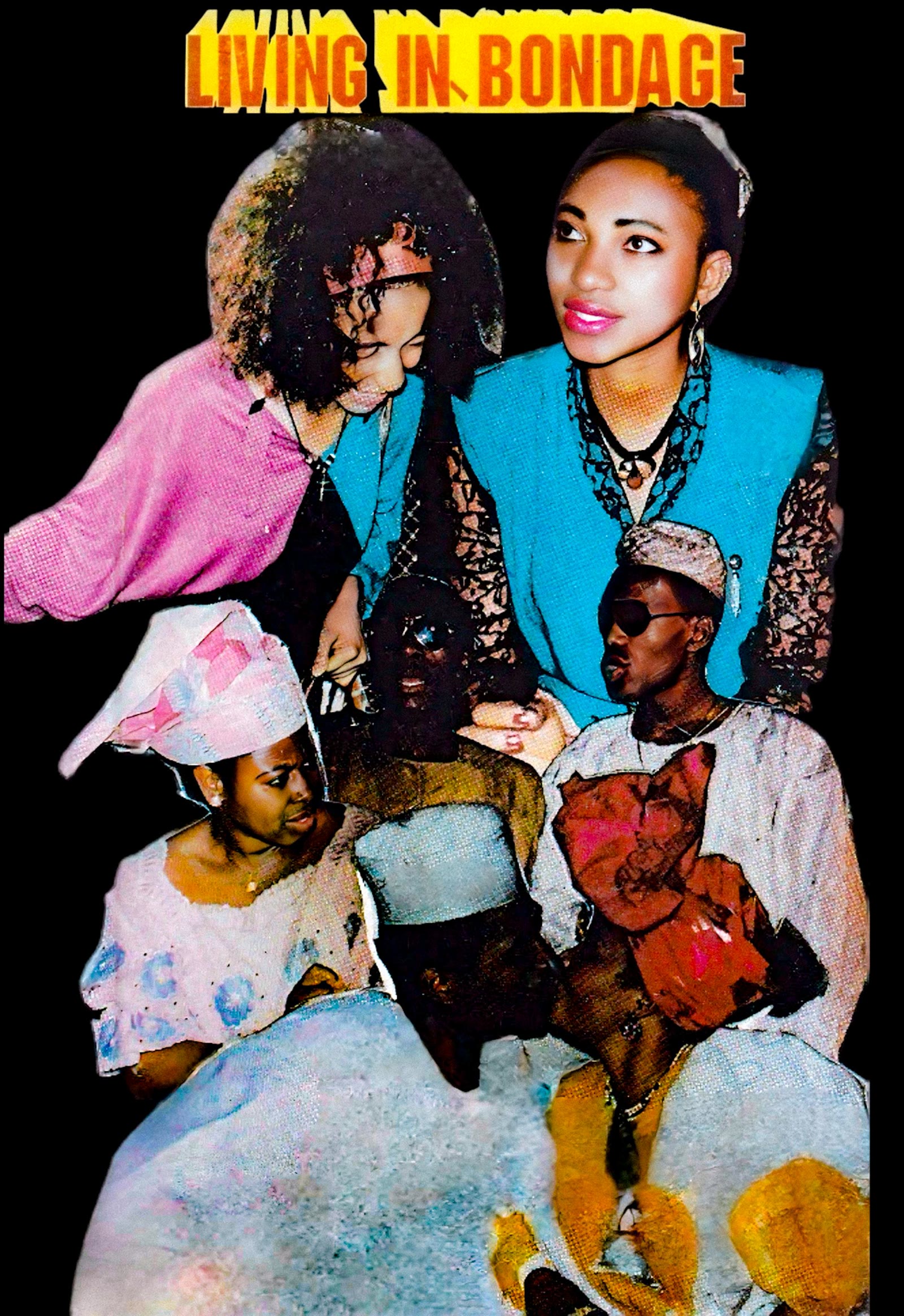
A videocassette is a small, stubbornly physical thing: a plastic shell, two reels, a label, a box. Yet in Nigeria in the early 1990s, that object could do work normally divided among a studio, a distributor, a cinema chain, and an advertising campaign. It could carry a locally made feature from a camera to an electronics market, then into a living room, a video shop, or an improvised neighborhood screening. The cassette was not merely where a movie ended up. It was the route that made a new kind of movie business possible.
That is the most useful way to understand early Nollywood. The familiar story says that cheap video replaced expensive celluloid and released a flood of rough popular films. The deeper story is about a circuit. Television workers, traveling-theatre performers, writers, actors, electronics traders, duplicators, market sellers, and viewers assembled an industry without waiting for the conventional institutions of cinema to become available. Format, finance, genre, and audience arrived together.[1][3][4]
The name Nollywood came later. Digital Nollywood, the University of Kansas project preserving the medium's material history, notes that Nigerian video-film practice emerged in the 1990s and was only subsequently gathered under that label. It also cautions against a creation myth with a single starting gun: Yoruba video films existed before the 1992 hit Living in Bondage, while Yoruba traveling theatre, television, and Nigeria's older celluloid culture all supplied personnel and forms that video would recombine.[2] The cassette did not create storytelling from nothing. It created a practical meeting place for traditions that were already moving.
Before the boom, a broken route to the screen
Nigeria had filmmakers, performers, and audiences long before Nollywood. What it lacked by the end of the 1980s was a dependable path connecting them. Jonathan Haynes identifies two especially important precursors: Yoruba traveling theatre, which moved through stage, television, and film, and the Nigerian Television Authority, whose serials trained workers and cultivated a national audience. At the same time, economic crisis and structural adjustment damaged celluloid production, while the informal trade that circulated foreign tapes had already built a distribution infrastructure around VCRs.[1]
Film Comment's 2004 account adds the exhibition problem. Earlier Nigerian directors often had to produce and distribute their own films, without a durable national theater network. Street violence and curfews made cinema-going less viable in the 1980s, while recorded Hausa performances, Igbo comic sketches, Yoruba traveling-theatre work, and television had already taught audiences to encounter local performance through a screen at home.[4] Video succeeded not simply because its image was cheaper. It fit the route that remained.
That distinction matters. If early Nollywood is described only as a technological shortcut, its real invention disappears. A VHS camera lowered one barrier, but the decisive change was organizational: traders who understood cassettes as goods could also understand films as goods; performers accustomed to serial and theatrical rhythms could work quickly; viewers with televisions did not need a purpose-built auditorium. Production no longer had to begin by solving the problem of theatrical exhibition.
Living in Bondage found the circuit's story
Living in Bondage, directed by Chris Obi Rapu and released in 1992, was not literally the first Nigerian work made on video. It was the film that showed how powerfully the pieces could lock together. Haynes's production history places three different kinds of worker at its center: marketer Kenneth Nnebue, television director Rapu, and writer-producer Okechukwu Ogunjiofor. Their collaboration was already a miniature of the emerging industry—commerce, broadcast craft, and popular narrative joined without a legacy studio mediating among them.[1][2]
The film's plot made the new economy emotionally legible. A man seeking sudden wealth enters an occult bargain and sacrifices the domestic life that his success was supposed to improve. BFI describes the film as a foundational Nigerian melodrama whose greed, betrayal, haunting, and punishment established a pattern rather than an embarrassment to be outgrown.[5] Haynes places it more specifically at the junction of money-ritual narrative, domestic melodrama, Igbo social values, and Pentecostal moral discourse.[1]
That combination was not random sensationalism. This essay's inference is that Living in Bondage gave the cassette economy a story about the fear inside rapid accumulation. The film circulated through a market system built on speed, trust, duplication, and informal capital; on screen, wealth also moved quickly, opaquely, and at terrible moral cost. The medium did not mechanically cause the theme. But the same society that made the video boom possible supplied its most urgent dramatic material.
Its Igbo language mattered too. The cassette could address a culturally specific audience without first proving itself to a national theater chain. Haynes notes that Glamour Girls shifted into English in 1994, helping Nigerian video reach a wider national and international public, while the industry continued to include work in Yoruba, Hausa, Igbo, English, and other languages.[1][3] Nollywood was never one uniform language or style. What united much of the early boom was a production-and-circulation logic.
The market did the work of a studio
In a conventional studio system, a company raises capital, hires a production unit, develops stars, manufactures prints, arranges publicity, and books screens. Early Nollywood distributed those functions across social and commercial networks. The key figures were often called marketers: distributors from informal electronics markets who could finance a production, judge what audiences might buy, arrange duplication, and push copies through regional trading routes.[1][4]
This made the market more than the last stop after a film was finished. It could shape casting, genre, pacing, title, and release strategy before shooting began. Stars became recognizable labels on cassette covers. A successful occult thriller, family melodrama, comedy, or urban morality tale could generate variations quickly because the people funding the next production were standing close to the evidence of sales. The system listened to audiences, but it listened through purchases rather than surveys.
It also carried a contradiction. The same informal networks that moved films rapidly made ownership and revenue difficult to secure. Haynes summarizes the bargain bluntly: a leaky distribution system kept budgets low even as it supported extraordinary output.[3] Duplication expanded a film's reach while unauthorized duplication could erase the producer's return. Informality lowered the threshold for entry, but it also limited durable companies, contracts, archives, and reinvestment. Calling the cassette a studio system should not romanticize precarity. It should identify where the industry's coordinating power actually sat.
The living-room screen wrote back
Every distribution system leaves fingerprints on form. A film expected to play on a household television does not need to behave like one designed for a palace-sized screen and a fixed two-hour slot. In a 2009 Yale interview, film scholar Dudley Andrew observed that Nigerian video films often used close-ups and a television-derived visual grammar suited to small screens. He also described village viewings in living rooms, where audiences contributed toward the cassette and the generator.[6] Onookome Okome's audience research widens that picture to domestic screenings, street-corner gatherings, and for-profit video parlours where talk during a film could turn melodrama into collective argument about wealth, religion, gender, and power.[7] The viewing unit could be domestic without being solitary.
This helps explain why faces, voices, confrontations, revelations, and repeated moral turns carried so much weight. Domestic rooms were both affordable locations and the natural arena of melodrama: marriage, kinship, aspiration, jealousy, faith, and money could collide within spaces viewers knew. Film Comment describes early video film as a hybrid open to traveling theatre, television, telenovelas, Bollywood, Hong Kong cinema, local performance, and professionally trained broadcast actors.[4] What critics sometimes treated as impurity was the form's capacity to absorb whatever the circuit could use.
Long and multipart stories also made sense within this ecology. They extended a successful title, gave performance room to accumulate, and treated the cassette as an episodic object rather than a substitute theatrical print. The resulting rhythm could be uneven, but unevenness is not the whole analysis. Early Nollywood's strongest popular forms made moral causality unmistakable across interruptions: a promise creates a debt, a secret returns, wealth reveals its price, a family argument opens onto a social system.
The small screen therefore did not merely shrink cinema. It changed what counted as sufficient spectacle. A face registering suspicion, a living room reorganized by new money, a prayer meeting, a supernatural warning, or a confrontation held in dialogue could become the event. The spectacle was proximity.
The container changed; the circuit survived
VHS was never a permanent constitution. UNESCO's 2021 mapping of Nigeria's film industry dates a transition from tape to VCD and DVD in the early 2000s, the return of modern multiplex exhibition in 2004, and the later growth of pay television, streaming, and renewed theatrical production. It also records the persistence of independent disc distribution through cities including Lagos, Onitsha, Asaba, and Ibadan.[8] Each new platform changed budgets, lengths, technical expectations, and routes to viewers.
This is why “old Nollywood” should not be mistaken for a sealed primitive stage before the real cinema arrived. Digital Nollywood notes that old and new production styles overlap, while posters, covers, and other vulnerable materials from the video era require active preservation.[2] A streaming platform may replace a cassette shelf, and a multiplex release may reward different kinds of polish, but both inherit a central Nollywood question: how can a film reach its intended audience through the infrastructure that actually exists?
The cassette was Nollywood's first studio system because it joined the whole chain. It let production begin from available tools, let trade networks perform distribution, let popular genres carry social argument, and let viewers turn domestic screens into exhibition spaces. Its limitations were real: fragile rights, unstable finance, rushed work, and endangered archives. So was its achievement. Before buildings and corporations could stabilize the industry, a plastic box connected the people who could make Nigerian movies to the people who wanted to see themselves in them.
Sources
- Jonathan Haynes, Nollywood: The Creation of Nigerian Film Genres, University of Chicago Press, 2016 — chapter abstracts on traveling theatre, television, informal video distribution, Living in Bondage, language, and genre.
- Digital Nollywood, University of Kansas, “About this Project” — institutional history of Nigerian video film, its pre-1992 roots, later naming, and material preservation.
- Jonathan M. Haynes, “Video Boom: Nigeria and Ghana,” Postcolonial Text 3, no. 2 (2007) — scholarly overview of economic conditions, multilingual production, genre, and distribution.
- Olaf Möller, “Olaf's World: Nigerian Videofilm Culture,” Film Comment, March–April 2004 — exhibition history, traveling-theatre continuity, market distribution, and formal hybridity.
- Wilfred Okiche et al., “Around the world in melodrama: 9 countries, 45 essential films,” BFI, November 26, 2025 — Nigerian melodrama context and source of the Living in Bondage video art.
- Ted O'Callahan, “What is Nollywood?” interview with Dudley Andrew, Yale Insights, April 28, 2009 — contemporary account of small-screen form and communal home-video exhibition.
- Onookome Okome, “Nollywood: Spectatorship, Audience and the Sites of Consumption,” Postcolonial Text 3, no. 2 (2007) — study of domestic viewing, video parlours, and discussion around screenings.
- UNESCO, The African Film Industry: Trends, Challenges and Opportunities for Growth, 2021 — Nigeria country mapping on home video, format transitions, exhibition, and distribution.