Spoiler note: this essay discusses the film's final movement.
Alan J. Pakula's The Parallax View is easy to describe as a 1970s conspiracy thriller and harder to describe as an image system. The plot gives the viewer a journalist, a political assassination, a suspicious corporation, and a trail of deaths. The craft gives something more disturbing: a world where empty space seems to have authority before any villain enters the frame. Pakula and cinematographer Gordon Willis make paranoia less a private condition than a visible arrangement of bodies, rooms, screens, corridors, and civic architecture.[1][3][4]
That is why the film still feels so cold. It does not merely say that Joe Frady is being watched. It keeps placing him where looking itself has become impersonal. AFI's record fixes the industrial grounding: the 1974 feature was directed and produced by Pakula, photographed by Willis, written by David Giler and Lorenzo Semple Jr. from Loren Singer's novel, and developed across the early 1970s before principal photography began in April 1973 in Washington State and Los Angeles.[1] Those facts matter because The Parallax View is not a free-floating dream of suspicion. It is a studio thriller built out of real American locations, real contemporary architecture, and a wide frame that had to decide what to do with all that horizontal room.
Pakula's answer is to make space accuse the hero.
The hero keeps losing the center
Most thrillers use the wide frame to widen action. The Parallax View often uses it to make action look misregistered. Frady may stand near the middle of a shot, but the center rarely feels secure. A ceiling grid presses down. A wall divides the image. A dark room swallows the sides. A public building gives him so much room that his body begins to look procedural rather than heroic.
The Guardian's 2026 rewatch is useful on this point because it notices how Gordon Willis's precise compositions and shadowed Americana make characters appear small beside imposing structures.[3] That is the craft key. The film's paranoia is not only a matter of what Frady learns. It is a matter of where the frame puts him while he is learning it.
The Space Needle opening makes that logic public. The assassination does not simply happen at a landmark. It happens in a space built for looking: elevated, circular, touristic, civic, spectacular. People have gathered to watch a politician and a skyline. The crime turns that act of public looking against them. From then on, Frady's investigation keeps passing through locations that seem to know more than people do: offices, airports, dams, convention spaces, and corporate interiors. The built world is not background. It is the conspiracy's first language.
Architecture replaces the mastermind
One reason the film resists ordinary payoff is that it never gives conspiracy a satisfying face. The Parallax Corporation has function, offices, recruitment methods, paper, screens, and intermediaries, but it does not need a memorable mastermind sitting in a leather chair. That absence is a craft decision. The system becomes scarier because it is distributed through spaces that already look normal.
The Guardian piece stresses the film's habit of placing U.S. landmarks, pageantry, and frontier iconography beside corporate and authoritarian visual pressure, while Campbell's BFI Film Classics synopsis frames the movie as actively constructing a paranoid worldview rather than merely reflecting one.[3][4] That shift matters. Classic noir often turns darkness into atmosphere. Pakula turns clean modern space into a threat. Bright lobbies, escalators, glass, catwalks, and committee rooms do not promise transparency. They promise that power has learned to hide inside official surfaces.
The film's compositions keep returning to that contradiction. A person can be visible and still powerless. A room can be bright and still unreadable. A public event can be photographed from many angles and still produce an official story that explains the wrong thing. Frady is not trapped because no one can see him. He is trapped because the system can keep assigning meaning to what is seen.
That is the film's deepest technical joke on investigative cinema. The reporter believes that more looking should reveal truth. Pakula keeps showing that looking can be organized before the investigator arrives.
The training room makes the viewer complicit
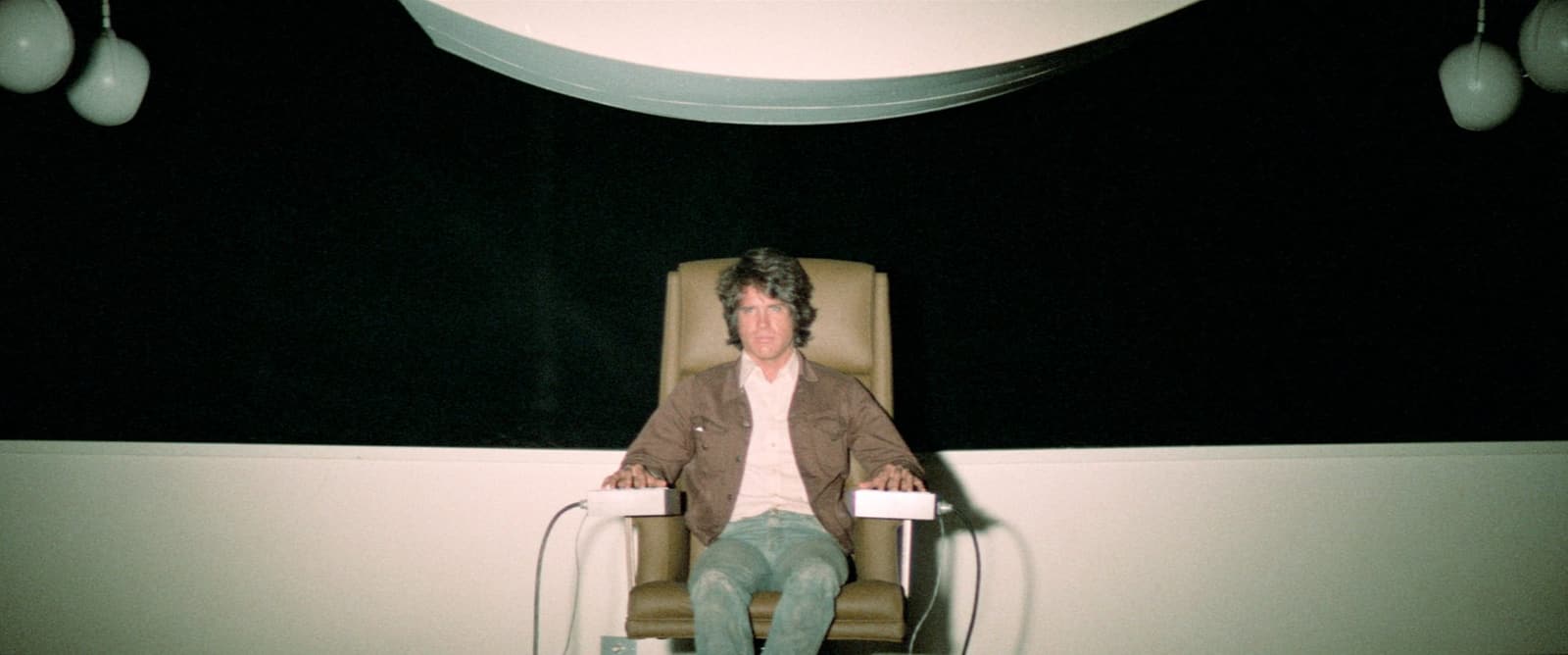
The most famous sequence is the Parallax training film, and it works because Pakula refuses to treat it as mere exposition. Frady sits in a chair in a stark screening chamber, isolated by negative space. The image used for this article comes from that setting: Beatty's body is small but frontal, the chair has the unnerving symmetry of a testing device, and the black wall behind him turns the whole room into a waiting aperture.[2]
The BFI Film Classics synopsis for Mark Campbell's study identifies the central brainwashing sequence as a six-minute film-within-a-film built from pop culture, advertising slogans, and violent imagery, connected to 1970s anxieties about corporate and media power.[4] That description gets at why the scene remains so invasive. It is not only that Frady is being tested. The movie also tests the audience's confidence in its own watching. Pakula makes us sit through the conditioning material with him, so the cinema screen briefly becomes the corporation's screen.
The technique is deceptively simple. Words like home, mother, father, enemy, love, me, country, and happiness are attached to images that refuse stable moral sorting. Patriotic icons, erotic charge, violence, family sentiment, authority, slaughter, and comic-book force are not arranged into an argument that can be calmly refuted. They arrive as association. The scene understands something about screen power: a sequence can make meaning before the viewer has time to defend against it.
This is why the room around Frady matters as much as the montage. The chamber looks empty, but it is not neutral. Its emptiness removes ordinary social cues. No one explains the test. No one argues. The architecture reduces the subject to posture, face, hands, and reaction. Negative space becomes an instrument. It gives the images room to enter.
The music makes danger attractive
Michael Small's score sharpens the trap by refusing blunt menace. Freq's review of the restored soundtrack describes the music as understated, shadowy, and built around low strings, snare taps, harp, and an insistent two-note piano idea; it also treats the Parallax Test cue as maliciously gentle before the sequence turns overwhelming.[5] That is the sound-world version of Willis's images. The film does not only darken the room. It makes the darkness inviting.
Small's broader score works by surgical placement. It does not flood the movie with warning. It appears like a pressure change. Freq's account of the soundtrack repeatedly ties Small's cues to off-center framing, isolation, and the film's movement toward an inescapable final trap.[5] That slight wrongness is essential. If the score screamed conspiracy, the viewer could keep it at a distance. Instead, the music behaves like institutional ceremony with something warped hidden in it.
The result is a film where sound often feels like architecture. It creates a room before the image finishes building one. It can make an official inquiry feel ceremonial and contaminated at once. It can make the training sequence feel almost pleasurable before the viewer recognizes how ugly the associations have become. Pakula's paranoia is audiovisual, not just narrative.
The ending denies heroic closure
The final sequence completes the film's craft argument by pushing Frady toward a space that can absorb him. A conventional conspiracy thriller might let the journalist expose the machine, even if the victory were costly. The Parallax View instead turns the investigative hero into material for an official account. Freq's soundtrack review is blunt about this final turn: Frady's single-minded search for truth becomes the weakness that Parallax can use against him.[5]
Frady's last movements do not feel like mastery. They feel like choreography inside a space that already knows how to absorb him. Catwalks, darkness, distance, and official spectacle reduce him to a moving figure that can be reassigned as evidence. The frame gives him motion without agency. The conspiracy does not have to explain itself because the architecture and the later report can do the explaining.
That is the bitter precision of the film. It does not say that truth is impossible. It says that truth can lose to framing. A body in the wrong place, a rifle found where it needs to be found, a committee speaking with official calm, a camera placed far enough away: these are craft elements inside the movie and administrative elements inside the story. The same tools that make the thriller legible also show how reality can be edited by power.
The Parallax View endures because its paranoia is built from film form rather than from topical references alone. The assassinations, Watergate-era dread, and corporate anxiety anchor it historically.[3][4] But the sensation is more durable than any one context. A wide frame can isolate. A bright room can conceal. A score can seduce while warning. A training film can turn attention into compliance. A public report can make a dead man into a story that serves the living system.
Pakula's craft makes the viewer feel that process happening before it can be summarized. Negative space becomes the trap because it looks empty until it has already done its work.
Sources
- AFI Catalog, "The Parallax View (1974)" - production history, credits, cast, release data, and filming-location context.
- Criterion Collection S3 image asset, frame still from The Parallax View used as the article image.
- Brogan Morris, "The Parallax View: remember when Hollywood made potent political cinema?" The Guardian, May 5, 2026 - recent critical rewatch of the film's 1970s political context, Willis's visual style, and training-film montage.
- AbeBooks listing for Mark Campbell, The Parallax View (BFI Film Classics), 2024 - synopsis of Campbell's study covering the film's paranoia context, Gordon Willis, and the central brainwashing sequence.
- David Solomons, "Michael Small - The Parallax View OST," Freq, May 20, 2021 - soundtrack review covering Small's score, the testing-center cue, and the music's role in the film's final trap.