Freaks is still hard to discuss cleanly because its title, marketing history, and surviving language belong to a world that treated disability and bodily difference as public spectacle. That discomfort cannot be wished away. Tod Browning's 1932 MGM film was built around real sideshow performers, was received with revulsion by many early viewers, and was cut down after preview trouble before becoming one of Hollywood's most notorious pre-Code objects.[1][2][3][4] Yet the film's lasting power comes from refusing to stay in the place its own exploitation seems to promise. It draws viewers toward the carnival tent, then slowly makes the act of staring feel like the real sideshow.
The plot is blunt melodrama. Cleopatra, a trapeze artist, pretends to love Hans, a sideshow performer with an inheritance, while planning with Hercules to poison him and take his money.[1][3] The structure could have produced a simple shock show in which the disabled performers were used only as scenery. Browning does something more unstable. He lets the performers' community form the film's moral center, gives the glamorous outsiders the predatory role, and then makes the audience sit with the fact that sympathy and voyeurism can occupy the same seat.
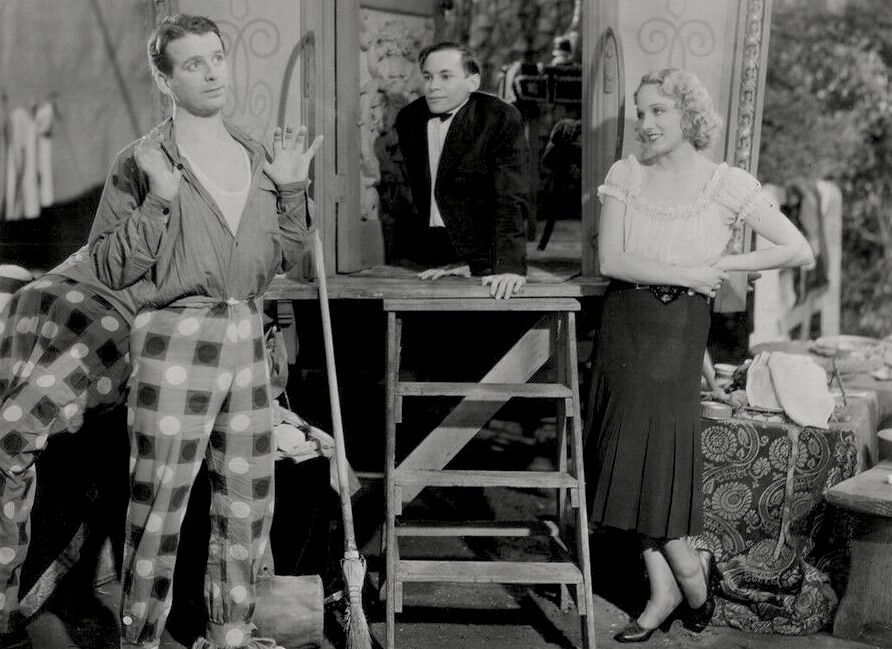
Image note: the cover is a real 1932 photographic publicity still from Freaks, not a generated image, diagram, or poster illustration. Wikimedia Commons identifies Wallace Ford, Johnny Eck, and Leila Hyams and describes the file as a publicity still for the film.[5]
The film keeps moving the line of normality
The most radical move in Freaks is not that it shows bodies mainstream Hollywood rarely allowed on screen. It is that it repeatedly changes who is being looked at and why. Early scenes show the sideshow performers eating, talking, doing laundry, smoking, flirting, parenting, and negotiating ordinary routines. JSTOR Daily's Betsy Golden Kellem frames the film around a double pressure: it asks viewers to think about exploitative display while also showing the sideshow as a place of community.[2] Before the revenge plot takes over, Browning makes the performers' everyday life visible enough that the viewer's first shock is given time to soften into attention.
That does not make the film innocent. The camera is still inviting curiosity; the production still depends on the market value of unusual bodies. But the scenes are not organized only as display. They show a world with rules, jokes, care, and boundaries. Madame Tetrallini's defense of the performers as children of her household, the wedding feast, and the small domestic scenes all work against the barker's logic that difference exists to be consumed. The film says: these people are not props placed around a crime story. They are a society, and the outsiders are the ones who refuse to learn its terms.
That reversal makes Cleopatra so important. She is conventionally beautiful, mobile, and professionally spectacular; by old studio logic she should be the figure the viewer is trained to desire. Browning turns that expectation inside out. Her beauty is not condemned by itself, but it becomes attached to contempt. She looks at Hans as money and at his friends as something beneath recognition. Hercules, with his physical strength and masculine display, plays the same inversion. The bodies coded as "normal" by polite society become the bodies least able to practice ordinary decency.
A wedding feast turns acceptance into a test
The banquet is the film's moral hinge. It is famous because the chant of acceptance has traveled far beyond the film, often detached from its context.[3][4] In the scene itself, the sideshow performers try to welcome Cleopatra into their group. The gesture is communal rather than monstrous: a cup passes, voices rise, and the phrase that later popular culture often treats as a threat first appears as an initiation.
What breaks the scene is not the performers' difference. It is Cleopatra's refusal to receive fellowship from people she despises. The moment is painful because the film understands humiliation as public action. Cleopatra's disgust does not simply hurt Hans; it exposes the whole group's vulnerability. Their code of acceptance has been offered to someone who treats acceptance as contamination.
This is where the film's ethics become knotty rather than clean. The later revenge sequence draws on horror imagery and risks converting the performers back into frightening spectacle. The BBFC's case history is useful because it tracks that unresolved problem across decades: the board refused the film a certificate in 1932 and again in 1952, then allowed a limited adult release in 1963, and later wrestled with whether the climactic sequence might redirect sympathy into fear or disgust.[3] The censor's record is not the final word on the film, but it names the pressure point. Freaks asks viewers to reject cruelty toward disabled people, then stages vengeance in a mode that can reawaken the very looking it has been criticizing.
That contradiction is why the film lasts. It is not a tidy plea for tolerance. It is a film caught between empathy, exploitation, revenge fantasy, and genre sensation. A more comfortable movie would separate those impulses. Browning lets them grind against each other.
The studio system briefly let the margins speak
The shock of Freaks is sharper because it came from MGM, not from a tiny underground outfit. BFI's film entry places the surviving film at just over an hour, directed and produced by Browning, with Wallace Ford, Leila Hyams, and Olga Baclanova among the listed cast.[1] JSTOR Daily notes the studio context more sharply: MGM's Irving Thalberg hired Browning after the success of Universal's monster cycle, hoping to compete in horror.[2] MGM was associated with polish, glamour, controlled production values, and stars. Browning brought into that system performers whose lives and labor came from circus and sideshow economies, then built the film around a conflict between polished outsiders and an outcast community with its own forms of loyalty.
The result damaged Browning's career. The University of Wisconsin Cinematheque notes that the film's early reception, cuts, and commercial failure were widely tied to the decline of Browning's power as a major Hollywood director, before later screenings and cult attention shifted its reputation.[4] That same afterlife made the film a recurring reference point for debates about disability representation, class, eugenics, and countercultural identification.[4] The movie sits exactly where several histories collide: pre-Code permissiveness, horror's appetite for taboo, carnival labor, studio prestige, and the changing social meaning of bodily difference.
The pre-Code context matters because the film speaks before Hollywood's later Production Code enforcement narrowed what major studios could show. It also speaks from a Depression-era world in which economic vulnerability is everywhere under the melodrama. Hans' inheritance makes him desirable to Cleopatra; the sideshow exists because mainstream society has given its performers few other ways to earn a living; the carnival family is both refuge and workplace. The film's community is tender, but it is not utopian. It is a survival arrangement inside a market that sells them as attractions.
Looking is the film's real subject
The most productive way to watch Freaks now is not to ask whether it is simply progressive or simply exploitative. It is both more interesting and more troubling than either label. The film humanizes performers whom much of 1932 society treated as objects, but it also profits from the draw of looking at them. It criticizes cruelty, but it uses horror grammar. It gives the sideshow community moral authority, then lets the revenge finale brush against nightmare spectacle. The contradiction is built into the film's nervous system.
That is why the viewer's position matters so much. The film keeps asking what kind of attention we brought with us. Are we watching Cleopatra because she is glamorous, Hans because he is vulnerable, Johnny Eck because his body was marketed as extraordinary, or the group because we want a taboo thrill? Browning does not release us from those questions. He keeps rearranging identification until the viewer's own curiosity becomes unstable.
The University of Wisconsin Cinematheque notes that Freaks entered the National Film Registry in 1994 as a work deemed culturally, historically, or aesthetically significant.[4] That selection acknowledges importance rather than comfort. Freaks is important partly because it remains uncomfortable in historically revealing ways. It preserves not only a story but a record of how entertainment industries organized looking, how censors described harm, how audiences recoiled, and how later viewers tried to recover a plea for community from inside a compromised object.
The film's enduring line is not only "one of us." It is the question beneath it: who counts as "us," and who gets to decide from the safety of the audience? Freaks still unsettles because it makes that boundary move. By the end, the beautiful are not safe, the strange are not merely strange, sympathy has not stayed pure, and the viewer has been made part of the show.
Sources
- British Film Institute, "Freaks (1932)" - film entry with director, producer, principal cast, country, year, and runtime.
- Betsy Golden Kellem, "Tod Browning's Freaks," JSTOR Daily (October 29, 2025) - essay on sideshow display, community, horror context, and the film's cultural afterlife.
- British Board of Film Classification, "Freaks (1932)" case study - classification history from 1932 refusal through later reappraisals and rating decisions.
- Ashton Leach, "One of Us: Rediscovering Browning's FREAKS," University of Wisconsin-Madison Cinematheque (September 14, 2023) - reception history and contemporary critical framing.
- Wikimedia Commons, "File:Wallace Ford, Johnny Eck, and Leila Hyams in Freaks.jpg" - source page for the 1932 photographic publicity still used as the article image.