Contains discussion of the ending of Moonrise.
Charles Boyer draws a woman's face on his hand and lets it do the asking. In Frank Borzage's History Is Made at Night (1937), his character, Paul, wants to learn about Irene, played by Jean Arthur, without frightening her. The little hand puppet makes conversation possible. Irene has escaped a threatening encounter; now she can play.[1]
It is an unusually modest introduction to a director associated with overwhelming romantic faith. Before love can defeat anything, someone must make another person comfortable. A joke, a place to sit, a gentler way of asking: Borzage gives exalted feelings practical beginnings.
From westerns to an attic
Borzage came to filmmaking through performance. Raised in Salt Lake City, he worked in a traveling stage company before finding screen roles in Hollywood in 1912, including westerns for Thomas Ince. His breakthrough as a director came with Humoresque (1920), about a young violinist emerging from poverty. UCLA's retrospective notes trace the development of his reputation through stories in which romance and material hardship occupy the same world.[2]
That apprenticeship matters. The celebrated romantic was a working actor and filmmaker before he became an adjective in criticism. Performance remains a useful way into his work: feeling acquires a visible action, and an attachment becomes understandable through bodies sharing space.
In 7th Heaven (1927), that space has an address above the streets of Paris. Charles Farrell's Chico works in the sewers and lives in an attic; Janet Gaynor's Diane finds refuge with him. Pamela Hutchinson's BFI account emphasizes the contrast between his work below ground and the apartment near the stars. War interrupts their domestic life, but the film gives their attachment a mystical continuity across the separation.[3]
The apartment makes that belief imaginable before the story asks us to accept its miraculous reach. Heaven begins as a room that poor people can occupy. Its height matters because Chico's working day has placed him so low. The romance changes the meaning of the distance between the two.
This is also where a viewer can resist Borzage. The leap from shared shelter to spiritual certainty is enormous. His films ask us to take that leap with the lovers. Their persuasiveness depends on how much life the actors have already put into the shelter.
A restaurant with room to breathe
The partnership with Gaynor and Farrell continued through Street Angel (1928) and Lucky Star (1929). Sound brought other temperaments into Borzage's films, including Margaret Sullavan in Three Comrades (1938) and The Mortal Storm (1940). The recurring concern survived these changes of voice and performer: how can an attachment hold when the surrounding world becomes intolerable?[4]
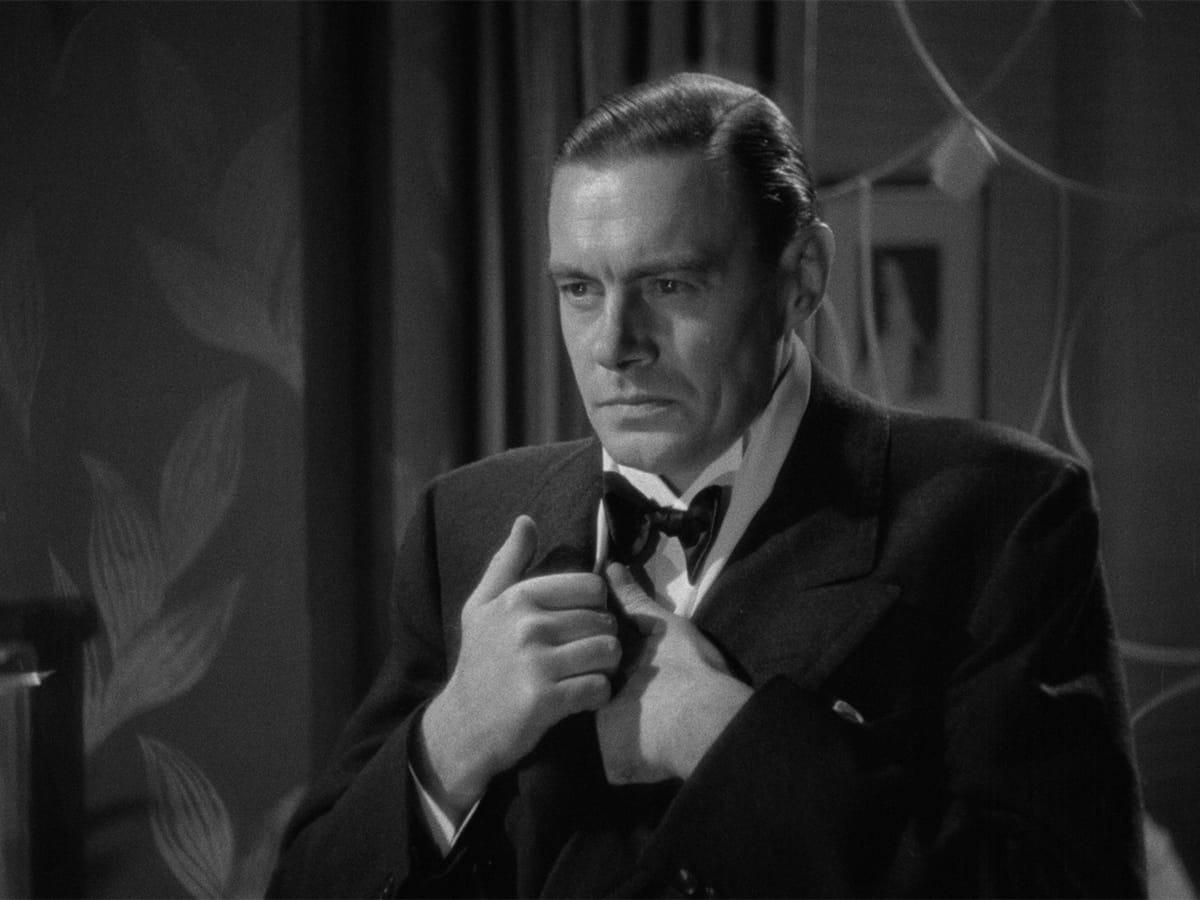
History Is Made at Night gives that question a particularly mobile form. Irene is a socialite married to a possessive shipping magnate; Paul is a French headwaiter. Their affair crosses continents, while the film moves through romantic comedy, melodrama, and a maritime catastrophe. Criterion's account identifies that succession of genres as central to the film's unusual shape.[5]
Changing genre changes what the couple must survive. A comic misunderstanding can be negotiated; coercion is harder; a disaster can overwhelm everyone. The movement keeps enlarging the scale of the danger around a connection established through small gestures.
At the restaurant, after the hand-puppet conversation, Paul and Irene dance. Her slippers get in the way; he helps replace one, and she eventually kicks them off. As Dan Callahan observes, Arthur makes Irene's growing abandon legible through changes in voice and movement.[1] The scene gives pleasure time to develop. We can see a frightened person become willing to occupy more space.
There is an ethical distinction inside that movement. The husband wants to retain possession of Irene. Paul's attentiveness allows her greater freedom. In this reading, Borzage makes romance credible by showing what it permits the beloved to do.
When the refuge has to open
Borzage's career also complicates the idea that these enclosed worlds simply shut history out. MoMA curator Charles Silver places Three Comrades and The Mortal Storm within the director's early engagement with the fascist threat. The latter appeared in 1940, before the United States entered the war.[4] His romantic commitments could bring him directly into political subjects.
The limit of the private refuge becomes especially clear in Moonrise (1948). Dane Clark plays Danny Hawkins, a man persecuted because of his father's criminal past. When Danny kills a tormentor, the danger ceases to be only something imposed on him. His developing relationship with schoolteacher Gilly, played by Gail Russell, exists alongside an act for which he must answer.[7]
Philip Kemp describes how the film's studio settings, shadows, and constricted compositions make Danny's world feel inescapable. At the end, Danny leaves his rifle at his father's grave and surrenders. The sheriff allows him to walk with Gilly without handcuffs; the view opens toward distant hills.[6]
That widening changes the meaning of romantic rescue. Danny still faces the law. He can, however, walk toward it accompanied, having relinquished both his weapon and the belief that his father's fate must determine his own. The landscape opens because his relationship to other people has changed.
Across these films, Borzage repeatedly finds a place where someone can stop being entirely defined by fear. An attic offers shelter; a restaurant permits play; an open view makes room for a difficult return. His lovers need those spaces. The most moving of them also learn when to leave.
Sources
- Dan Callahan, “History Is Made at Night: Taking a Chance on Love.” The Criterion Collection, 13 April 2021 — the hand puppet, restaurant dance, and Jean Arthur's performance.
- UCLA Film & Television Archive, “Moonrise,” screening notes for 21 October 2013 — Borzage's theatrical apprenticeship, early screen work, and Humoresque.
- Pamela Hutchinson, “10 great silent romances.” BFI, 25 January 2018 — the 7th Heaven entry, its attic setting, and the lovers' separation.
- Charles Silver, “Frank Borzage's History Is Made at Night.” Museum of Modern Art, 4 January 2011 — recurring performers, the sound-era career, and the anti-fascist films.
- The Criterion Collection, “History Is Made at Night” — film record, cast and credits, genre shifts, and the distributor-published still reproduced here.
- Philip Kemp, “Moonrise: Dark of the Moon.” The Criterion Collection, 8 May 2018 — studio staging, restrictive compositions, and the surrender sequence.
- The Criterion Collection, “Moonrise” — the 1948 film's premise, characters, and credits.