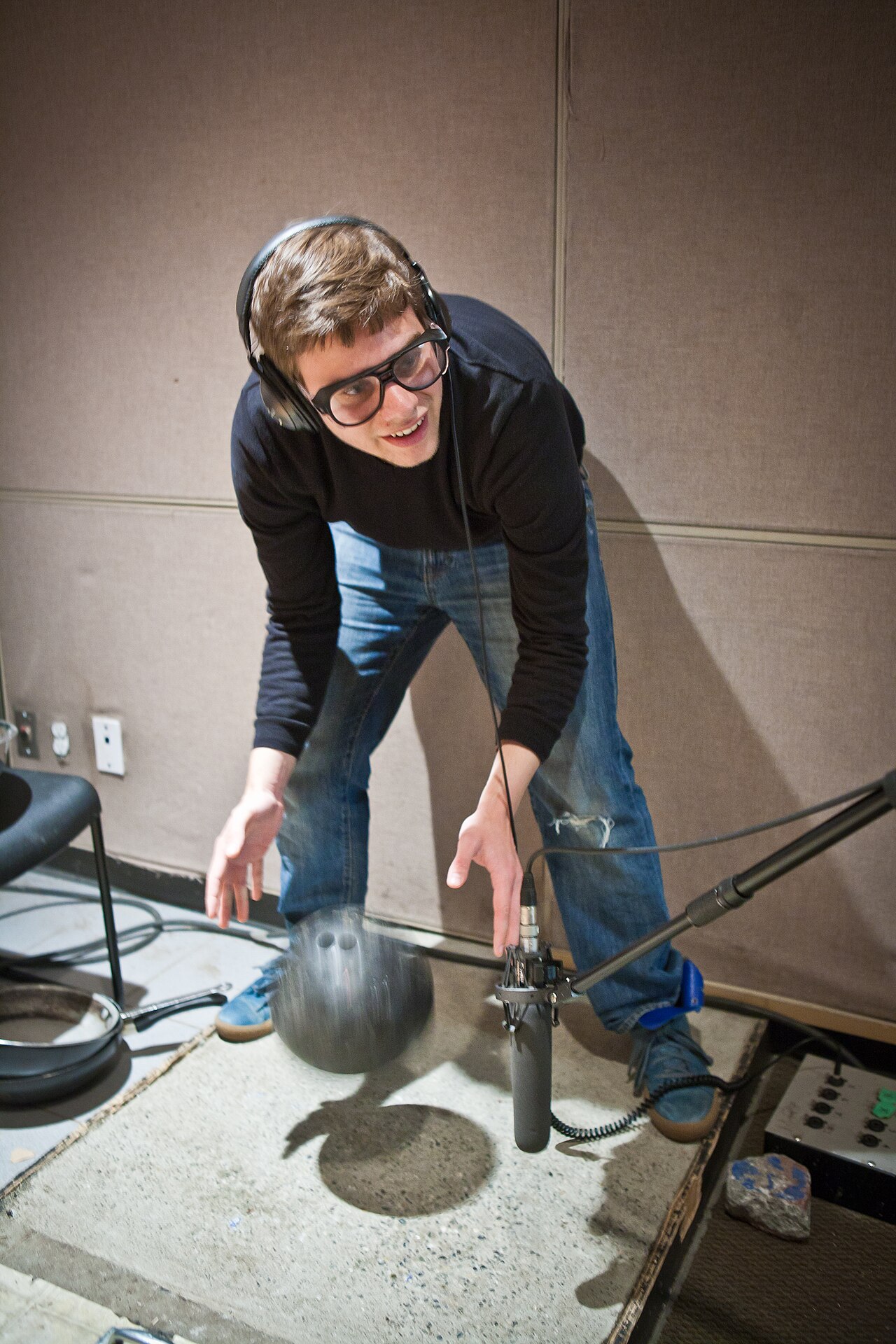
Foley is easy to underrate because it is designed to disappear. If a shoe lands on gravel, a sleeve brushes a coat, a glass is set down too hard, or a body shifts in a chair, most viewers do not think about postproduction. They think the scene is simply there. That invisibility is the achievement. Foley turns recorded images back into physical events after the shoot has ended.
The industrial story matters because Foley is not just "sound effects." It is a performance system. The artist watches picture, follows cue sheets, chooses shoes and surfaces, handles props, matches body rhythm, and records sounds that can be cut, layered, and mixed with dialogue, music, ambience, and designed effects. The lead image is useful for exactly that reason: it shows the work as a human action in a room, not as an abstract waveform or library search.[1]
Named for Jack Foley, a Universal worker who moved through the silent-to-sound transition, the practice belongs to the moment when Hollywood had to rebuild itself around synchronized sound. FilmSound's account places Foley inside that conversion: a studio employee from the silent era who adapted to the shock after The Jazz Singer and helped make live, synchronized effects part of Universal's sound procedure.[2] The key point is not only biography. Foley emerged because cinema's new promise, that pictures could speak and sound like a world, created a new gap. The camera could photograph action, but the set recording could not always deliver usable, expressive, controllable physical sound.
Sound Needed A Body Double
The first temptation is to ask why filmmakers do not simply keep the real production sound. Sometimes they do. But production sound is usually built around dialogue and immediate set conditions, not around every small material action a scene will need in the final mix. A microphone that hears an actor cleanly may miss shoes, cloth, chair pressure, or a prop at the right scale. A location may have traffic, crew noise, hum, wind, or continuity problems. A stunt, insert, or close-up may be shot in ways that make the real sound useless or absent.
Foley solves that by making the screen body a second time. A person walks when the character walks, shifts weight when the character shifts, opens a drawer at the frame where the drawer opens, and lets the sound mixer decide later how near, dry, comic, harsh, or ghostly that action should feel. CineMontage's history of the craft stresses the room-level labor: Foley artists, mixers, editors, stages, surfaces, and props convert silent or thin recorded movement into usable synchronized tracks.[3] That is a different job from finding a canned effect. A library may offer "footstep on wood." Foley asks whose foot, how tired, how close, how fast, on what kind of wood, under what emotional pressure.
This is why footsteps remain the symbolic center of the craft. They are simple enough for anyone to recognize and difficult enough to expose bad timing immediately. If a footstep lands a little early, the body becomes weightless. If it lands too loud, a private room becomes theatrical. If it lands too softly, danger or comedy can evaporate. The Foley artist is therefore doing more than imitation. The artist is assigning mass and intention to the photographed body.
The Prop Is Not The Point
Foley has a famous comic surface because its substitutions can sound absurd out of context: vegetables, leather, sand, coconut shells, celery, gloves, doors, pans, metal trays, and whatever else a stage has learned to keep within reach. The risk is that public accounts turn the craft into a trivia list. The more useful reading is that every strange substitution is a practical theory of perception.
Film sound does not have to be materially literal to be emotionally true. The right prop is the one that makes the viewer believe the screen action at the scale the movie needs. A coat may need more cloth noise than it would produce in life because the scene is about unease. A glass may need a harder contact because the gesture is accusatory. A fight may need separate layers for skin, fabric, floor, breath, and debris because one recorded thud would flatten the choreography. The craft lives in that gap between physical source and cinematic truth.
That is also why Foley works best when it is coordinated with the whole soundtrack. Dialogue tells us what someone says. Music can tell us how the scene is leaning. Ambience tells us where the body is located. Foley tells us that the body is actually occupying the room. Helen Rosner's New Yorker feature is especially strong on the tactile strangeness of this labor: Foley survives inside a digital postproduction world because bodies, hands, props, and timing still create textures that are hard to get by menu alone.[4]
Digital Tools Changed The Edit, Not The Need
Digital audio workstations made Foley cleaner to record, edit, store, and combine, but they did not make the artist obsolete. If anything, they clarified the separation between performance and assembly. A modern Foley session may generate multiple passes: footsteps, cloth, prop handling, object contacts, body falls, character-specific accents, and alternates for mix choices. Those tracks can be nudged, stretched, trimmed, processed, or replaced, but the raw intelligence still comes from watching how a body moves on screen.
Pro Sound Effects' modern Foley primer frames the practice as a specialized postproduction layer rather than a generic effects bucket: artists perform movement and object sounds to picture so the final soundtrack can carry believable human detail.[5] That definition is plain, but its implications are large. Foley is one of the reasons a filmed body survives compression by lenses, edits, ADR, visual effects, and music. The image may have been built from takes shot hours or weeks apart. Foley can give those fragments one continuous physical surface.
The craft is especially important in genres that manipulate bodily belief. Horror needs floorboards, breathing, fabric, and wet contact to make unseen threat feel near. Comedy needs crisp timing so a pratfall or dropped object lands as rhythm rather than noise. Action needs impacts split into readable layers so scale does not become mud. Animation needs Foley because there was never a production body making those sounds in the first place. Even quiet drama depends on it: a ring placed on a table, a chair scrape, a hand on paper, a door that closes a little too carefully.
Foley Is Editing With Matter
The best way to understand Foley is to treat it as editing with matter. Picture editing chooses visible intervals; Foley chooses material intervals. It decides which physical details deserve attention and which should remain absorbed by the room. It can sharpen a cut by giving the next shot an immediate contact. It can smooth a cut by carrying a movement across the join. It can make an offscreen body present before the camera finds it. It can tell us that a character is nervous before the line of dialogue admits anything.
That power also explains why bad Foley is so exposed. Viewers may not name the failure, but they feel it. Shoes seem disconnected from the floor. Props sound weightless. A fistfight becomes a pile of identical hits. Cloth rustles with no relation to movement. The failure is not only technical. It is dramatic, because the soundtrack has stopped believing in the body.
The irony is that Foley's prestige comes from not calling attention to itself. A spectacular visual effect may ask to be admired. A virtuosic shot may announce its coordination. Foley usually succeeds by letting the viewer forget there was a second performance at all. But the second performance is there, cue by cue, making the film's physical world legible after the camera has moved on.
That is why Foley remains one of cinema's most durable technologies. It is low-tech in its materials and high-precision in its timing. It belongs to the sound era's earliest industrial scramble and to the most modern digital mix. It turns a room full of shoes, surfaces, props, microphones, and listening bodies into something more than accompaniment. It gives screen life weight.
Sources
- Wikimedia Commons, "File:Foley Room at the Sound Design Campus.jpg" - photographic source for the lead image, showing a Foley artist performing beside a microphone.
- FilmSound.org, "The Story of Jack Foley" - historical account of Jack Foley's Universal career, the silent-to-sound transition, and early synchronized-effects practice.
- CineMontage, "Foley: They Make the Noises for the Talkies" - professional account of Foley stages, performers, mixers, editors, props, and synchronized postproduction labor.
- Helen Rosner, "The Weird, Analog Delights of Foley Sound Effects," The New Yorker, July 4, 2022 - reporting on contemporary Foley practice, tactile props, and the persistence of live sound performance in digital postproduction.
- Pro Sound Effects, "The Other F Word: What is Foley in the 21st Century?" - modern industry explainer on Foley's role in recording performed movement and object sounds to picture.