Jacques Tourneur's Out of the Past is often treated as the noir that has everything: Robert Mitchum's exhausted cool, Jane Greer's lethal stillness, Kirk Douglas smiling like money has learned to speak, Nicholas Musuraca's hard shadows, a fatalistic plot that folds back on itself, and enough betrayal to make summary feel like a bad map.[1][2][3] But the film's deepest force is not that it is complicated. It is that every place that promises escape becomes another enclosure.
That is why the title still feels exact. The past in Out of the Past is not a flashback safely sealed behind the present. It is a climate system. It follows Jeff Bailey from Bridgeport to Acapulco, from a gas station to a nightclub, from open lakes to private rooms, from mountain light to black interiors. The film keeps changing locations, yet the moral space tightens. Tourneur makes motion feel like entrapment.
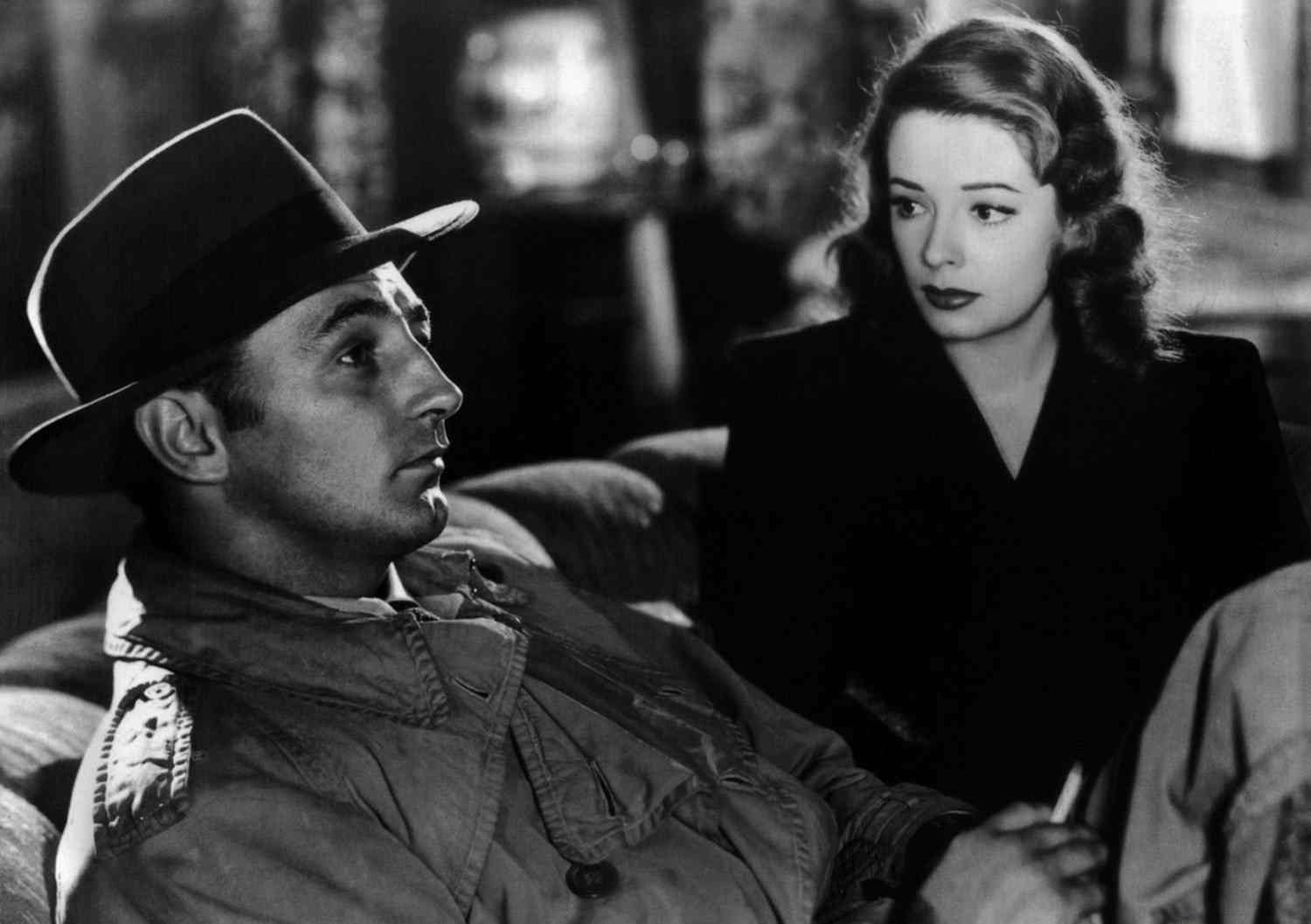
Image context: the cover uses a real 1947 RKO publicity photograph of Robert Mitchum and Jane Greer preserved on Wikimedia Commons.[5] It is not a poster, diagram, or generated noir mood piece. It is a film-related archival photograph, and it belongs here because the essay is about how Tourneur makes proximity unstable: Jeff and Kathie can share a frame without sharing a future.
Bridgeport is not innocence; it is a pause with a signpost
The opening mountain-town world looks, at first, like refuge. AFI's catalog record gives the basic production frame: Out of the Past is a 1947 RKO film noir directed by Jacques Tourneur, starring Robert Mitchum, Jane Greer, and Kirk Douglas, with a 95- to 97-minute runtime and a November 1947 release date.[1] Those facts matter because the film is compact without feeling small. It has the proportions of a studio crime picture and the pressure of a fatal landscape.
Yet the movie begins in a surprisingly open key. A signpost and a drive into a Sierra Nevada town place Jeff in a world of lakeside ease with Ann before the old names return. The signpost is more than local color. It tells us from the first image that this is a film about directions, distances, and the false comfort of knowing where the roads go.
Bridgeport appears clean because the film lets it breathe. The gas station, diner, church, road, and lake seem to belong to a different movie than the later rooms of blackmail and murder. But Tourneur does not make the town innocent. He makes it temporary. Joe Stefanos arrives from Jeff's old life, and the whole mountain refuge is revealed as a pause in a longer sentence. The past does not break into the present with melodramatic thunder. It arrives in a car and asks for directions.
That restraint is crucial to Mitchum's performance. Jeff does not react like a man surprised by fate; he reacts like a man who has been waiting for a bill to come due. His calm is not mastery. It is fatigue disciplined into style. He can run a gas station, take a girl fishing, and speak softly beside the water, but the frame never lets us believe he has outrun the story that made him.
Acapulco sells sunlight as a trap
The great trick of Out of the Past is that its most dangerous romantic zone is not initially dark. Jeff finds Kathie in Acapulco, where the film gives us heat, white fabric, fans, verandas, and languid public space. This is noir by glare as much as by shadow. Tourneur understands that fatalism does not require rain on every window. Sometimes the trap works better when it looks like a vacation.
The Acapulco section also explains why the film's gender politics are more interesting than a simple femme-fatale label. BFI uses Out of the Past to ask whether noir is really only about fate and dangerous women, or whether its richest versions reveal something broader about losing within a social and economic race.[3] AFI's Robert Osborne note also preserves the later shorthand around Jane Greer's Kathie: the role became one of the classic femme-fatale reference points, strong enough to echo into the 1984 remake Against All Odds.[4] That reputation matters, but the film is richer when Kathie is not reduced to a supernatural force. She is a person who has learned how to survive by moving through men who want to possess, employ, rescue, or punish her.
Jeff's mistake is not merely desire. It is his belief that desire can make a clean border. He lies to Whit, runs with Kathie, and tries to turn Acapulco into a private exception from the world of bosses, debts, and surveillance. The film immediately starts undoing that fantasy. Rooms are watched. Travel routes are traced. Money leaves evidence. Former partners reappear. A couple can disappear for a while, but they cannot make the system forget them.
This is where the film's famous convolutions become emotionally legible. The plot is full of switches, affidavits, hidden money, tax records, and murder frames, but the underlying movement is simple: every escape route produces a new dependency. Jeff's romance creates leverage for Whit. Kathie's return to Whit creates leverage over Jeff. Jeff's attempt to solve one frame only pushes him deeper into another.
Musuraca makes the hallway remember what people deny
The film justifies its noir reputation scene by scene. TCM calls Out of the Past a consummate example of the golden-age noir mode, emphasizing its fatalism, cynicism, hard dialogue, and triangle of Jeff, Whit, and Kathie.[2] Those genre labels are useful because the image system keeps earning them. Shadows in Out of the Past are not decoration laid over a crime plot. They are a form of memory. They cross faces before characters admit what they know. They break hallways into bars and diagonals before the law has arrived. They make rooms confess earlier than people do.
The locations are therefore never merely backdrops. Out of the Past is almost a demonstration of how place can become pressure. Bridgeport does not simply stand for peace; it tests whether peace can hold. Acapulco does not simply stand for erotic escape; it exposes how quickly fantasy becomes exposure. San Francisco does not simply advance the plot; it turns anonymity, apartments, corridors, and office errands into a net.
The close reading should therefore stay spatial. When Jeff walks into a room, ask what the room already knows. When Kathie appears in light, ask who controls the exit. When Whit smiles in a bright, wealthy setting, ask why the brightness does not feel safe. Tourneur's direction keeps refusing the neat moral contrast that a lesser noir might enforce. Light can be corrupt; darkness can be honest; openness can be temporary; enclosure can arrive in daylight.
This is also why Mitchum's slowness matters. He does not merely underplay because cool is attractive. He underplays because the world around him is already overdetermined. Fast panic would be redundant. Jeff's delayed speech and heavy stillness let the film's architecture do the tightening. He moves as if he knows that the room has reached the conclusion before he has.
The road is not freedom if it only returns you to the same bargain
The road in Out of the Past looks like freedom because it keeps cutting across landscapes: mountain roads, city streets, the route toward Tahoe, the fatal final drive. Yet the road rarely creates a new life. More often, it carries old claims into new scenery. Tourneur's great irony is that mobility is the film's visible energy and entrapment is its actual structure.
AFI's catalog notes that modern critics often regard Out of the Past as a quintessential film noir, while TCM's essay treats it as one of the consummate examples from the movement's 1940s and 1950s peak.[1][2] That afterlife is fitting because the movie itself is about preservation of another kind: the past preserved as obligation, rumor, document, body, and road. Nothing stays buried because every action has been stored somewhere: in a bankbook, an affidavit, a witness, a hired man, a lover's memory.
By the end, Jeff's choices narrow to an almost mathematical ugliness. If he goes with Kathie, he repeats the fantasy that already destroyed him. If he rejects her, the law and Whit's machinery still close in. If he tries to protect Ann, he may have to let her misunderstand him. The ending's cruelty is not that Jeff had no choices. It is that every choice has already been priced by earlier choices.
That is why the final lie matters. The boy's gesture to Ann, allowing her to believe Jeff chose Kathie, is both mercy and another wound. It releases Ann from waiting, but it also seals Jeff inside the very story he tried to escape. Noir often ends by proving that truth has no practical refuge. Out of the Past goes further. It suggests that even a compassionate lie can become the last room built by the past.
Why the film still feels modern
The film's modernity is not only its labyrinth plot or its influence on later noir. It lies in how precisely it distrusts the language of fresh starts. The gas station is a fresh start until someone recognizes the man behind the counter. Acapulco is a fresh start until love becomes evidence. San Francisco is a fresh start until work, documents, and apartments become a trap. The road is a fresh start until it runs toward a roadblock.
BFI's framing of noir as an unstable category helps explain the film's durability.[3] Out of the Past is not great because it checks every noir box. It is great because it makes those boxes feel like lived pressure: fate as accumulated consequence, the femme fatale as a role produced by unequal bargains, the detective as a man whose intelligence cannot save him from his own willingness to believe in one more exit.
Tourneur makes every escape look plausible for a moment. That is the film's ache. Jeff is not foolish because he sees no danger; he is doomed because he keeps seeing a passage just beyond danger. A mountain town, a Mexican cafe, a lover's promise, a packet of documents, a final car ride: each one looks like a way out until the shadows rearrange and reveal the walls.
Sources
- AFI Catalog, "Out of the Past (1947)" - feature-film catalog record with release date, runtime, genre, cast, critical-context note, and remake information.
- Turner Classic Movies, "Out of the Past (1947)" - noir article summarizing the film's fatalistic genre position, major characters, and classic-era noir context.
- Brad Stevens, "Home of the weak: Out of the Past and four ways of framing film noir," BFI Sight and Sound - noir framing essay using Out of the Past as its central case.
- American Film Institute, "Robert Osborne - OUT OF THE PAST" - short AFI note on Greer's femme-fatale reputation and the later Against All Odds remake connection.
- Wikimedia Commons, "File:OutOfThePastMitchumGreer.jpg" - archival RKO publicity photograph used as the article image.