Rotoscoping is often explained with one deceptively simple verb: trace. An actor moves, an animator copies the actor frame by frame, and a drawing inherits the movement. That account gets the order right and the craft wrong. Max Fleischer's patent did not describe a machine that automatically converted a body into a cartoon. It described a route by which performance could be photographed, stopped, inspected, selectively redrawn, and photographed again.[1]
The distinction sits inside the patent's own language. The artist could trace only the elements necessary for the cartoon, exaggerate or modify features, and preserve what Fleischer called the action's “essentials or dominating lines.”[1] The live-action image supplied evidence, not a command. Rotoscoping kept gravity, timing, and bodily coordination within reach while leaving the drawn figure free to become something the filmed body had never been.
That is why KoKo the Clown remains the technique's ideal first star. His movement began with Dave Fleischer performing in a clown suit, but his screen identity emerged through selection: black cloth became a graphic mass, white gloves became readable punctuation, and a human gait could end in an elastic ink body. The rotoscope did not eliminate the animator between camera and cartoon. It gave that animator a moving argument to answer.
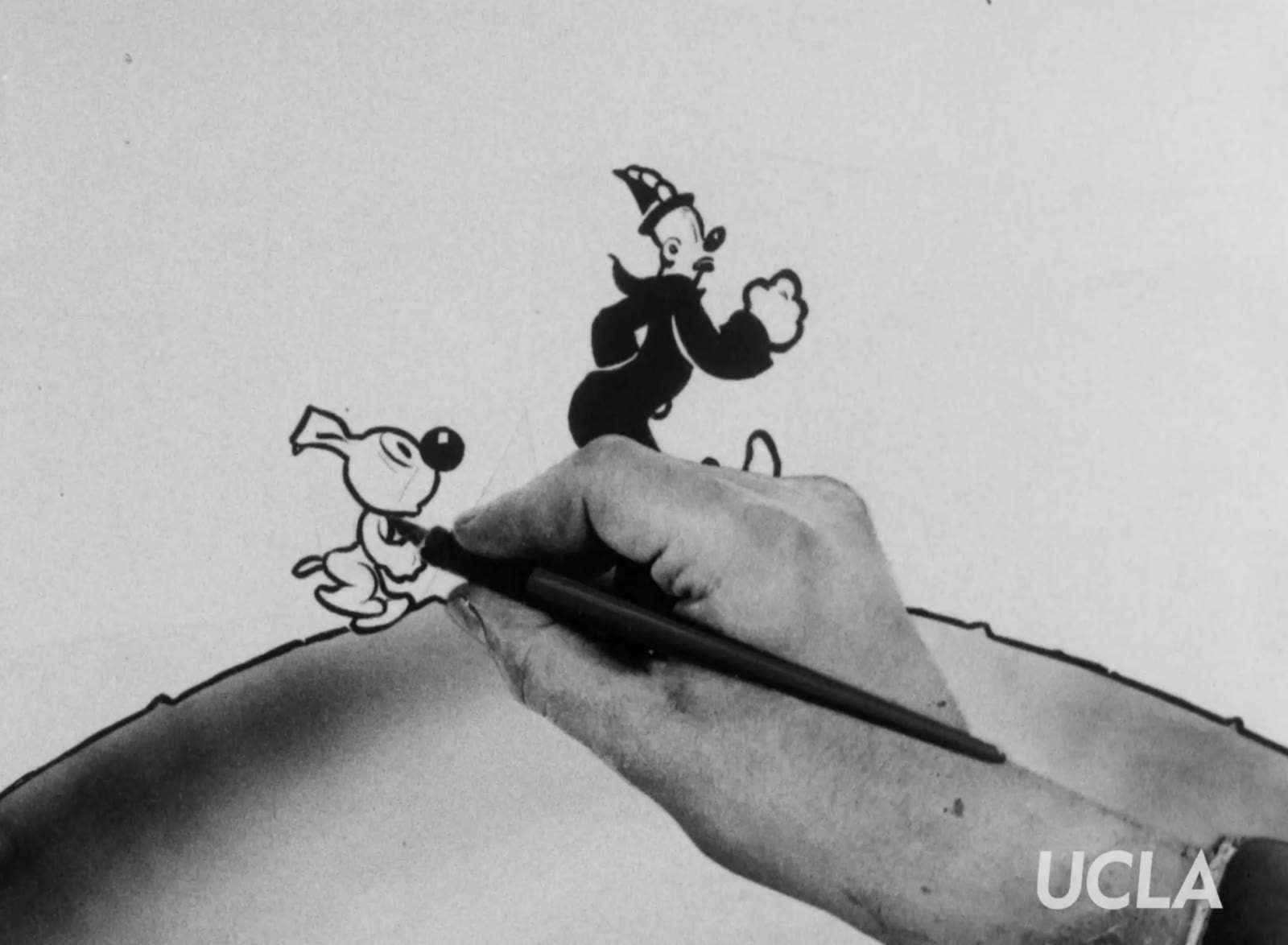
Image context: the lead image is an archival frame from UCLA's preservation of KoKo's Earth Control (1928). A real hand and pen occupy the foreground while KoKo and Fitz appear on the paper above them. The frame does not prove that this particular action was rotoscoped; instead, it visualizes the larger Fleischer contract, in which photographed bodies, drawing labor, and fictional bodies continually cross one another's space.[5]
Before the drawing, there was a performance
Fleischer filed his “Method of Producing Moving-Picture Cartoons” patent on December 6, 1915; it was granted on October 9, 1917.[1] The title matters. The document never uses the word rotoscope, a gap that researcher Iwasaki Hirotoshi has traced through later accounts of the term.[7] What Fleischer claimed was not a branded object so much as an ordered production method.
That order began away from the drawing board. Dave Fleischer had worked as a clown and owned a loose black costume with large pom-poms, white gloves, and a pointed hat. The Fleischer studio's historical account stresses why those choices helped: the strong black-and-white separation gave the camera clear contours that would remain legible when projected for drawing.[2] Costume design was therefore already animation design. Before an artist selected a line, a performer and camera had to create a line worth selecting.
The brothers filmed Dave moving in the costume, then spent much of the following year producing roughly 2,500 drawings for a short test.[2] Whatever efficiency the invention later offered, its first proof was not push-button automation. It was a long translation between kinds of labor: Dave organized motion with his body; film divided it into exposures; Max and his collaborators reconstructed those exposures as marks.
The test eventually led to the Out of the Inkwell series. Film historian Mark Langer's Film Comment account describes the early clown as a rotoscoped version of Dave and follows the Fleischers from their experiment to John Randolph Bray's studio and, after World War I, to their own company.[3] “KoKo” is retrospective shorthand here: the figure was still the Little Clown in these experiments and did not receive that name until 1923.[2][6][8] The 2025 Giornate del Cinema Muto program identifies surviving early titles such as Boxing Kangaroo (1920) as making extensive use of the process.[6] Rotoscoping was not an isolated trick. It became one working foundation for a series in which an ink figure could appear more physically assured than the world trying to contain him.
The apparatus divided motion into decisions
The patent lays out a chain of six representations. First an actor performs for a motion-picture camera. The exposed film records a succession of poses. A projector on an inclined platform then presents those photographed frames one at a time onto tracing paper behind a screen at the platform's upper end. The artist makes a drawing from each successive image. Finally, a second camera photographs the drawings to produce the cartoon film.[1]
Even advancing the reference was physical. Fleischer specified a pull cord linked to a spring lever, pawl, and ratchet wheel so the artist could move through the projected film. The apparatus slowed cinema down into handle-sized increments. A gesture that had lasted a fraction of a second for Dave became a sequence of pauses during which another person could ask what the gesture actually required.
This is the machine's most important intervention. It does not merely transfer an outline from one surface to another; it changes the time available for judgment. Live performance arrives continuously, with weight shifting through a whole body at once. The animator receives that performance as discrete images and must rebuild continuity from marks. Knees, elbows, coat hems, facial features, and the relation of one foot to the floor all become separate decisions, even when their timing comes from the same photographed action.
Calling the result a copy hides both losses and gains. Texture, volume, costume detail, and the performer's individual face can disappear. In return, silhouette can sharpen, proportions can change, and an ordinary movement can belong to an impossible creature. The photograph is not the finished truth behind the cartoon. It is an intermediate surface where one kind of truth—how a body moved—can be detached from another—what kind of body seems to be moving.
The patent protects deviation
Fleischer was unusually explicit that accurate tracing was not the goal in every frame. His specification permits the artist to exaggerate or alter a grotesque character while retaining the photographed action's dominant structure.[1] One example goes further: film a dog wearing a horse-head mask, he suggests, and the resulting drawings can present a miniature horse performing the dog's movement. The reference body and the represented body need not belong to the same species.
That example reveals the rotoscope as an engine of mismatch. A real action can be credible precisely because the final actor is unreal. The live subject contributes contact with the floor, transfer of weight, hesitation, recoil, and follow-through. Drawing contributes the body to which those forces will appear to belong. The persuasive motion of the “horse” does not certify that a horse performed it; it records how carefully one motion has been reassigned.
Kim Walden's study of rotoscoped performance makes the same boundary central: although the process sought more lifelike animation, it has never been only about verisimilitude.[4] The crucial aesthetic event is the processing of a performance. A viewer senses a filmed body's continuity and a drawn body's instability at the same time.
This is also why the patent's phrase “arbitrarily drawing” should not be mistaken for carelessness.[1] It names authority. The artist decides which contours carry the action, which can be dropped, and which should be pushed beyond the reference. Rotoscoping supplies more information than the final drawing needs. Style begins in the refusal to keep all of it.
KoKo carries two kinds of timing
The clown's earliest rotoscoped design makes that selective inheritance easy to see. Dave's costume offered the reference image a strong black center, high-contrast hands, and a pointed cap. In the cartoon, those elements are simplified into a figure whose limbs read quickly and whose white gloves can announce a change of direction. Within the reference-based passages, the human performer supplies coordinated timing and the graphic design distributes that timing into a few emphatic shapes.[2][8]
The result is neither a portrait of Dave nor motion without an author. It is a double performance. Dave decides how to step, stumble, dance, or recover; the animator decides when the outline hugs that action and when it departs. Because every drawing must work beside the next, a single altered shoulder or delayed foot can change the apparent intention of the whole gesture.
That account needs a boundary. Michael Barrier finds Dave-based rotoscoping already diminishing in the early series and detects it only at the opening of Modeling (1921), not throughout the short.[8] It would therefore be unsafe to claim that every later KoKo gesture—or even the skating passage in Modeling—maps directly onto Dave's body.
As Langer recounts the film, the live-action Max tells the drawn clown to show more energy and prods him with a pen. KoKo slips on an icy scene, recovers, skates away, and later scratches a caricature into the ice.[3] The sequence is still a joke about command without serving as a frame-by-frame rotoscope demonstration. The animator demands “pep,” but the character's answer arrives as movement with its own timing, mischief, and graphic transformations. The technique's historical gift was the possibility of transferred performance, not a requirement that KoKo remain attached to Dave forever.
The hand on screen exposes the contract
The Fleischers repeatedly placed live action and drawing in the same films. Max appears as the “Boss,” a visible animator who summons KoKo from ink, argues with him, disciplines him, or becomes the target of his pranks.[3] These scenes turn a normally hidden production hierarchy into slapstick: hand above character, character against hand, inkwell as both birthplace and cell.
UCLA's preserved KoKo's Earth Control carries that collision into apocalypse. KoKo and Fitz find a control room at the top of the world; Fitz pulls the forbidden handle, and destruction escapes the cartoon realm into live-action Manhattan.[5] The lead frame catches a quieter boundary crossing. A photographed hand holding a pen shares the paper with both drawn characters. The scale is impossible but the contact looks matter-of-fact, as though creator and creatures have always occupied adjacent layers.
That frame should not be treated as a behind-the-scenes demonstration. It is a finished fictional image, and by 1928 KoKo's movement cannot simply be assumed to reproduce Dave frame for frame. Its relevance is conceptual. The pen that once converted filmed action into a cartoon is now a prop inside the cartoon's world. Production has become performance.
The gag also rearranges authorship. A giant hand can draw, erase, obstruct, or rescue, but KoKo's posture does not read as a passive diagram. He runs beyond the pen. The visible maker controls the paper while the character controls the scene's momentum. Rotoscoping helped give drawn action the continuity of a performance; the films use that continuity to let the drawing appear capable of refusing its maker.
Smoothness is not the same as obedience
Barrier documents contemporary praise for the little clown's unusually fluid movement, and smoothness became the rotoscope's easiest selling point.[8] But smoothness alone cannot explain the Fleischer appeal. Perfectly faithful outlines could preserve a human motion and still produce a dull cartoon. KoKo stays alive because the series joins bodily continuity to graphic mutability.
Langer notes that Modeling moves from smooth skating to bodies and objects changing shape and physical properties.[3] That combination is the essential one. Reference-based action can let the viewer feel how a slip becomes a recovery; drawing lets an ink figure, a snowball, or a sculpted nose refuse the stable identity that live-action photography ordinarily grants things. One system lends weight. The other makes weight negotiable.
The distinction offers a useful test for any rotoscoped sequence. Ask first what the reference contributes: cadence, balance, effort, a performer's recognizable gesture, or simply consistent spatial change. Then ask what the animator changes: silhouette, proportion, surface, identity, setting, or the action's emotional emphasis. If the second answer is “nothing,” tracing may indeed feel like a cage. In the Fleischer method as patented, however, alteration is not a betrayal of the process. It is built into the process's stated purpose.[1][4]
The method outlived its first machine
Once the patent's exclusivity ended, other studios adopted rotoscoping, and the principle traveled through later hand-drawn films, Ralph Bakshi's work, and Bob Sabiston's digital Rotoshop process.[4][7] The equipment changed, as did the look. What persisted was the layered relation between a recorded performance and a newly rendered body.
That history can tempt us to describe rotoscoping as an early version of motion capture. The comparison is helpful only up to a point. Fleischer's system did not capture an abstract skeleton and automatically drive a model. It asked an artist to look at a photographed surface, choose the lines that mattered, and draw a new surface. Its intelligence remained distributed among performer, costume, camera, projector, hand, and final design.
The surviving films are distributed too. The Giornate catalog notes that Fleischer materials were scattered among companies and archives after the studio closed, and documents recent restorations assembled from surviving 35 mm elements.[6] UCLA's presentation of KoKo's Earth Control comes from preservation supported by ASIFA-Hollywood.[5] What contemporary viewers see is therefore another translation: performance to film, film to drawing, drawing back to film, and fragile prints into restored access copies.
None of those passages is neutral. Each decides what can survive. That is the deeper lesson of the rotoscope. A trace is not the opposite of interpretation; it is interpretation with a visible dependency. KoKo moves because Dave moved first, but he does not merely repeat Dave. The camera preserves a performance, the projector holds it still, and the animator decides what kind of body it can become.
Sources
- Max Fleischer, “Method of Producing Moving-Picture Cartoons,” U.S. Patent 1,242,674, filed December 6, 1915 and published October 9, 1917 — apparatus, production sequence, selective tracing, and permission to exaggerate photographed action.
- Fleischer Studios, “KoKo the Clown” — studio history of Dave Fleischer's costume, the filmed performance, the early drawing process, and the development of Out of the Inkwell.
- Mark Langer, “Max and Dave Fleischer,” Film Comment (January–February 1975) — historical account of the rotoscope, Bray period, early studio, and close description of Modeling (1921).
- Kim Walden, “Double Take: Rotoscoping and the Processing of Performance,” Refractory: A Journal of Entertainment Media 14 (2008), University of Hertfordshire research record — rotoscoping as processed performance rather than verisimilitude alone.
- Jerry Beck, “Watch: Classic Animation by the Fleischers, Ub Iwerks and George Pal,” UCLA Film & Television Archive (June 22, 2023) — preservation context, synopsis, and archival lead-image source for KoKo's Earth Control (1928).
- Jane Fleischer Reid, “Max Fleischer & the Fleischer Studios,” Le Giornate del Cinema Muto 2025 catalog — early rotoscope production, surviving-film dispersion, restoration notes, and program records for the silent KoKo films.
- Iwasaki Hirotoshi, “Exploring the Etymology of Rotoscope,” Media Arts Current Contents, Agency for Cultural Affairs, Japan (August 28, 2024) — method history, later uses, and the term's absence from Fleischer's patent text.
- Michael Barrier, Hollywood Cartoons: American Animation in Its Golden Age (Oxford University Press, 1999) — scholarly account of the early clown experiments, contemporary response, the 1923 naming, and the rapid decline of Dave-based rotoscoping in later KoKo animation.