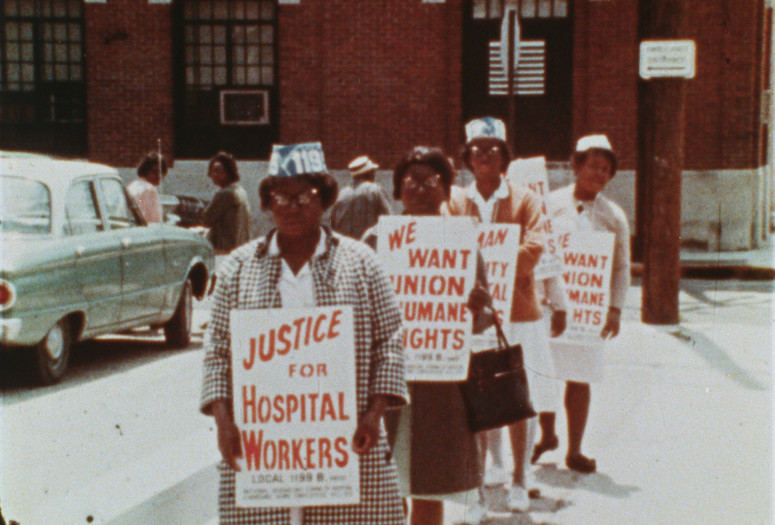

A documentary about a strike can easily turn people into evidence for an argument already settled. The picket line proves injustice; a leader explains the stakes; anonymous workers supply faces. Madeline Anderson's I Am Somebody (1970) reverses that hierarchy. Its striking hospital workers do not decorate the history. Through Claire Brown's first-person narration, they interpret the pictures in which they appear.
The film follows roughly 400 Black hospital workers who walked out in Charleston, South Carolina, in 1969 for union recognition and fair pay. Anderson made their struggle into a 30-minute work that is at once collective record and intimate address.[4][5] The distinction matters. Intimacy is not achieved by shrinking the politics to one exceptional personality; it comes from arranging public events so that ordinary participants remain thinking subjects.
Film at Lincoln Center's 2015 conversation with Anderson, recorded after a screening of I Am Somebody, Integration Report 1, and A Tribute to Malcolm X and uploaded in 2021, reveals how deliberate that arrangement was.[1] Watch Anderson speak as an editor as much as a director. She returns to access, labor, discarded plans, audience response, and the question of who gets to explain an image. Her later description of filmmaking as “like making a quilt” supplies the right model: documentary truth is not a seamless sheet. It is a joining of pieces whose origins still matter.[3]
Around 2:30 — access to the cutting room is part of film form
Early in the conversation, Anderson describes trying to enter the film editors' union. Of roughly a thousand members, she recalls, only ten were women and one was a Black woman; she would have been the second. The formal catch was brutally circular: a union job required membership, while membership required a union job. Anderson worked wherever she could in editing rooms, accumulating the skill and production credits needed to force open the door.[1]
This history is often compressed into the honorific “pioneer.” The video restores the mechanism hidden inside that word. A gate around employment was also a gate around authorship. Editors decide which face answers which statement, whether a march becomes spectacle or duration, and how an official speech sits beside a worker's gesture. Keeping Black women away from the cutting room restricted not only who received a wage, but whose sense of sequence could organize public memory.
Anderson's experience also established a material bond with the Charleston workers before she photographed them. She had encountered a version of their problem: institutions that needed their labor while withholding the recognition that made labor secure. In a later interview, she recalled exploitative and sometimes dangerous non-union work, along with the long fight that followed her union job on Shirley Clarke's The Cool World.[6] That does not make filmmaker and subjects interchangeable. It explains why Anderson approaches solidarity as a relationship built through work rather than a sympathetic pose.
Around 18:00 — the category comes after the obligation
The conversation turns to a 1971 women's film festival, where I Am Somebody drew criticism because Ralph Abernathy says the strikers will win together as “brothers.” Anderson does not respond by retrofitting the film into a perfectly purified statement. Around 19:20, she says the women's story felt like her story, calls them her sisters, and explains that she did not begin with a mandate to make either a feminist film or a civil-rights film. She wanted to make something “true to their experience.”[1]
That answer is not a refusal of feminism or civil rights. It is a statement about editorial order. If a category decides in advance what every shot must mean, the women risk becoming examples again. Anderson instead lets political meaning emerge from their speech, labor, fear, humor, and persistence—including details that do not sound perfectly composed for a later movement vocabulary.
Terri Francis's close reading of the film shows how this works from its opening. Charleston first appears through polished, almost travel-brochure images. Then Brown's voice redirects the view toward the city as it was for someone poor and Black. Anderson does not need to discard the idealized material; she makes its partiality audible. A picture can be factually present and politically false until another person establishes where it is being seen from.[2]
Around 20:30 — the first audience completes the edit
Anderson offers an unusually concrete test of her obligation. Local 1199 rented a large hall and screened the finished film for about 400 women. Anderson, who had given birth shortly after completing it, slipped into the back with her baby. When the workers saw themselves, she recalls, they stood, laughed, and cried. Their recognition gave her confidence that she had told their story.[1]
This is more demanding than the vague claim that a documentary “gives voice.” The women already possessed voices and a political analysis. The filmmaker's job was to build a form they could recognize without reducing recognition to flattery. Their response does not make every editorial decision beyond criticism, but it changes who is authorized to judge success. The first decisive review belongs not to a broadcaster or festival, but to the people whose lives have been cut into the film.
The production history reinforces that reversal. Networks had previously treated Anderson's proposed subjects as lacking a target audience or commercial value. By the time of the Charleston strike, she had already begun her research when Local 1199 approached her and supplied a proper budget, time, and production support.[6] The union did more than sponsor a message. It created the conditions in which an audience routinely dismissed by television could become the film's primary constituency. MoMA's program notes identify Local 1199 as producer and place the film within a tradition of nonfiction made as a catalyst for labor and racial justice.[5]
Around 30:00 — narration is an encounter with an image
The video's most revealing craft passage begins when Anderson discusses her relationship with the strikers. The union and Southern Christian Leadership Conference leadership around the campaign were largely male, she notes; the women were pleased that a Black woman had been chosen to tell their story. Anderson then explains how Claire Brown came to New York after the footage had been assembled. Some domestic scenes were filmed in Anderson's apartment, and Brown's walk was photographed near the East River. In the studio, Anderson showed her the edit and asked her to say what she saw, felt, and understood. After several days of recording, Anderson built the soundtrack from Brown's responses.[1]
The order is crucial. Brown did not read an omniscient script poured over silent workers. She encountered the images, remembered the strike, and spoke back. Her narration is retrospective without becoming remote, improvisational without being unshaped. Anderson's authorship lies in making the encounter possible and then editing it—choosing, timing, and composing Brown's words while preserving the grain of thought in progress. Francis notes that this method gives the voice an unrehearsed, personal quality even when Brown is not visible on screen.[2]
It also complicates the usual opposition between observation and narration. Synchronized testimony can certify that a voice belongs to the person pictured, but it can trap speech inside the moment a camera happened to capture. Brown's later voice ranges across the material. She can interpret the public Charleston sold to visitors, the private exhaustion of organizing, and the collective meaning of victory. The soundtrack does not merely identify what is on screen; it establishes a worker's right to connect one image to another.
The quilt is not a euphemism for scarcity
In a 2016 Harvard Film Archive conversation, Anderson explains the production logic behind her composite documentaries. Without money to dispatch a crew whenever events broke, she wrote treatments, searched film libraries for existing material, and filmed on location when resources became available. She compared putting stock footage and newly shot scenes together to making a quilt: pieces gathered in different places become a film through their arrangement.[3]
It would be a mistake to romanticize the shortage. Anderson's Metrograph interview is clear that I Am Somebody benefited from the first proper budget of her career.[6] Money bought time, travel, labor, and choices. Yet the quilt metaphor describes more than making do. Each kind of material carries a different authority. News footage may record the scale of a confrontation while retaining the distance of an institution. Anderson's camera moves among the workers. Brown's narration returns with knowledge produced after the event. Songs bring a collective history that no reporter's summary could replace. The edit does not pretend these pieces came from one neutral eye.
That is why the seams matter. Anderson can place an official version of Charleston beside Brown's correction, male movement leadership beside women workers, street action beside an apartment interior, injury beside laughter. One piece does not cancel the others; the relation between them produces the argument. The quilt is beautiful because it is constructed, not because construction has been hidden.
Near 35:20 — danger does not get the final word
Near the end, the moderator asks about rare footage and the risks of filming. Anderson remembers being followed on location and describes intimidation without inflating it into adventure. She then recalls the violence the women endured and the fact that they returned.[1] The emphasis falls on persistence, not on the filmmaker's access to danger.
That choice clarifies the ethics of the whole conversation. I Am Somebody does not deny police violence, institutional racism, low wages, or male power. It refuses to let those forces monopolize the workers' screen identities. Brown can analyze; women at a screening can laugh; a domestic space can enter labor history; an editor can turn footage controlled by networks into a record addressed to people those networks imagined had no value as an audience.
Anderson's quilt is therefore an editing theory and a political theory at once. A documentary becomes accountable not by eliminating perspective, but by locating perspective and giving subjects room to answer the images made of them. Research finds the pieces. Production brings them into proximity. Narration changes their direction. Editing makes the joins legible. Then the people represented look back at the finished work and decide whether it carries their experience. Solidarity is not the film's slogan. It is the method by which the film is assembled.
Sources
- Film at Lincoln Center, “From the Archives: Madeline Anderson on I Am Somebody,” YouTube video, February 24, 2021 — a 2015 post-screening conversation moderated by Michelle Materre.
- Terri Francis, “Within the Circle: Madeline Anderson's Cinematic Assemblages,” Seen / BlackStar, July 3, 2021 — analysis of Claire Brown's responsive narration and Anderson's participant-observer method.
- Harvard Film Archive, “Madeline Anderson Films,” November 7, 2016 — event history and full transcript of Anderson's discussion of archival material, production constraints, and the quilt metaphor.
- National Museum of African American History and Culture, “Filmmaker Madeline Anderson” — biographical context and an institutional account of I Am Somebody and the Charleston hospital workers' strike.
- The Museum of Modern Art, “Union Maids / I Am Somebody,” June 2025 — film details, production history, labor context, and source page for the Icarus Films still.
- Ashley Clark, “I Am Somebody: An Interview with Madeline Anderson,” Metrograph Journal, March 3, 2017 — Anderson on union access, research, network rejection, and Local 1199's production support.