

Federico Fellini is often reduced to excess: circus processions, impossible women, camera movement that seems to float on appetite alone.[4][5][6] The three official trailers gathered here suggest something more precise. Fellini keeps starting with public spectacle and then quietly loading private feeling into it. A roadside act, a stalled film production, a provincial parade season: each looks communal and outward-facing, yet each becomes the place where loneliness, guilt, desire, and remembrance are actually stored.[1][2][3][6][7][8]
That pattern is especially clear if you move through La Strada (1954), 8½ (1963), and Amarcord (1973) in one sitting.[1][2][3] The first is still close enough to postwar Italian realism to keep the road rough beneath the fable, yet its traveling performances already turn feeling into theater.[4][6] The second makes autobiography itself into a circus ring, with creative paralysis staged as a problem of too many entrances, memories, women, voices, and expectations pressing toward one director at once.[2][5][6] The third expands the method to the scale of a town. In Amarcord, adolescence, Fascism, church ritual, weather, gossip, and seasonal festivity all arrive as public pageant, but the film is really about how a life gets remembered through recurring communal images.[3][7][8]
That is why these videos work well as a collection rather than as isolated trailers.[1][2][3] They are not only selling plots. They are advertising Fellini's deeper habit of thought. He distrusts private psychology when it is presented naked. He prefers processions, stages, traffic, ceremonies, and fake grandeur because those collective forms let him show emotion with both tenderness and irony. The spectacle is never just decoration. It is the shell inside which memory can survive.
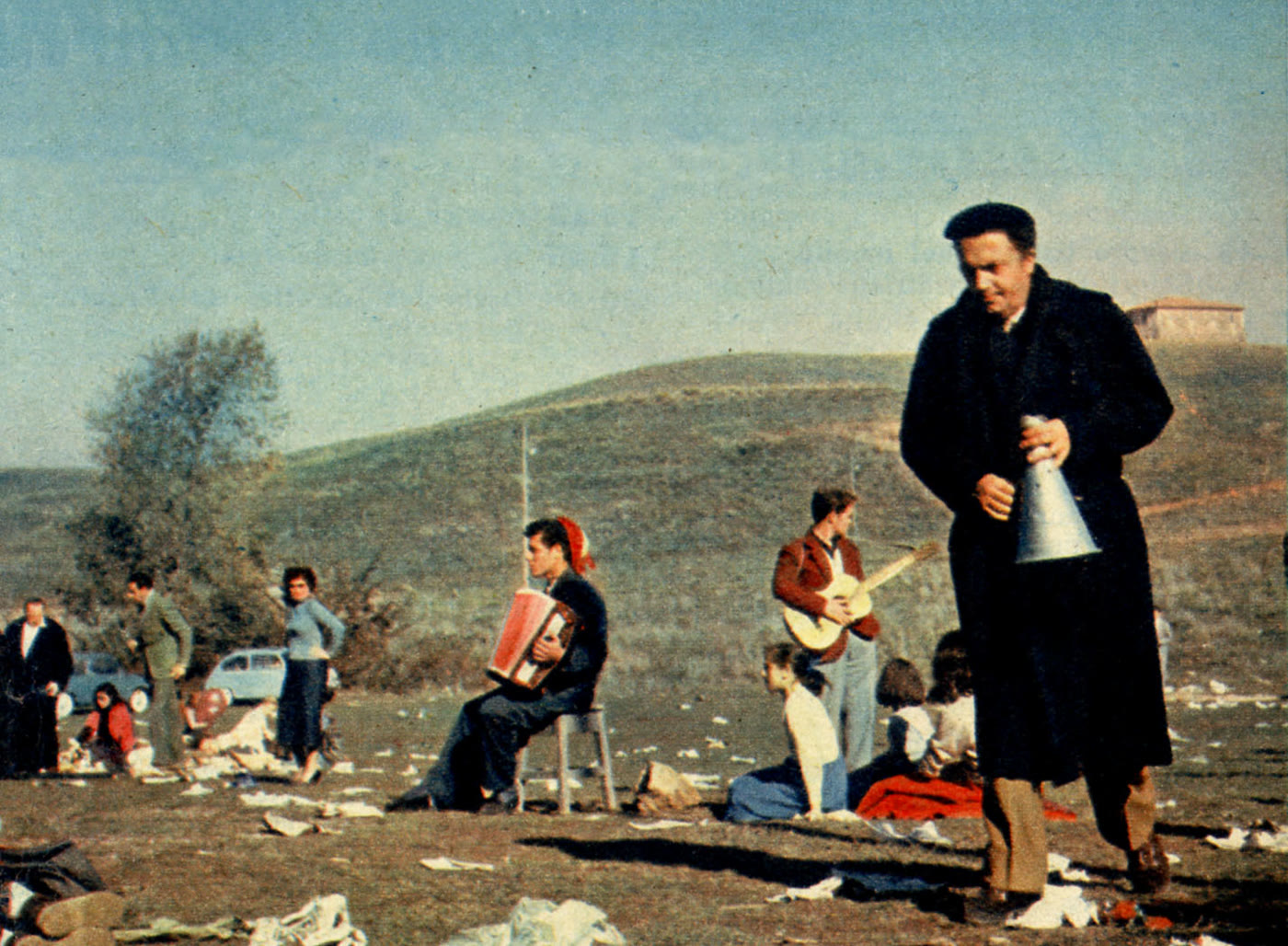
Image context: the cover uses a 1956 archival photograph of Fellini on the set of Le notti di Cabiria from Wikimedia Commons. It belongs here because this is a director-led movie collection, and the image catches Fellini not as a detached celebrity but as a builder of frames, already shaping the kind of theatrical pressure that would define the films discussed below.[9]
1. La Strada: the roadshow makes cruelty visible by making it public
The La Strada trailer is the right opening move because it places performance out in the open from the start.[1][4] Even before you get to the film's full moral weight, the promotional logic is clear: Fellini has taken a strongman act, a trumpet, a clownish young woman, a fool on a wire, and the dust of the Italian road, then arranged them so that entertainment and damage keep sharing the same frame.[1][4][6] BFI's account of the film as the breakthrough that launched Fellini's international career is useful here because it emphasizes both Giulietta Masina's singular presence and the way the film departs from strict neorealist typology toward something more fabulist and personal.[4] The trailer sells exactly that threshold. The world is materially hard, but the emotions arrive through performance.
What matters is the publicness of the humiliation. Gelsomina is not simply trapped in a bad private relationship; she is made to accompany Zampano's act, to carry props, to perform at the edges of his physical display, and to absorb the audience-facing economy of itinerant show business.[1][4] Fellini makes the roadside act do double work. It entertains villagers, but it also externalizes the terms of the bond: brute force in front, vulnerable feeling tucked into accompaniment. The trailer condenses this brilliantly. You feel the rough romance of the traveling spectacle, yet you also feel that the spectacle is the cage.
Seen against the later films in this set, La Strada is where Fellini discovers that performance can be morally diagnostic.[1][4][6] A public act strips the soul faster than a confession does. Gelsomina's fragility becomes legible because it has to survive inside a visible routine. Zampano's violence becomes legible because it arrives as a job, a gesture, a repeated show of masculine competence. The trailer is therefore more than a historical curiosity. It announces one of Fellini's central methods: people reveal themselves most fully when they are trying to hold a role in front of others.
2. 8½: the creative crisis becomes a parade that cannot stop entering the frame
With 8½, Fellini turns the public show inward without making it smaller.[2][5][6] The famous subject is artistic blockage, but the trailer does not pitch the film as a chamber drama about one sensitive man thinking too hard. It presents Guido's crisis as logistical theater: actors, producers, lovers, critics, childhood memories, church residue, and the skeletal remains of a science-fiction set all pressing toward one center that can no longer organize them.[2][5] BFI's fiftieth-anniversary piece calls the film exuberantly autobiographical, and that phrase matters because autobiography here is not diary writing. It is crowd management.[5]
The trailer is especially revealing because it shows how naturally Fellini thinks in terms of entrances, spectacles, and ceremonial overflow.[2][5][6] Even Guido's failure to make a film becomes a kind of performance arena. The unfinished spaceship set is not just a production obstacle; it is a monument to expectation. Bodies keep appearing around it with demands, seductions, and interpretations. The autobiographical material is therefore never sealed inside one psyche. Fellini stages it as a fairground of competing claims on the self.
That is the bridge between La Strada and 8½. In the earlier film, performance exposes a relationship. Here performance exposes consciousness itself.[1][2][5] Fellini does not ask us to inspect Guido's mind as if it were a transparent interior. He lets memory, fantasy, professional duty, erotic vanity, and religious shame arrive one after another like floats in a procession. The trailer captures this unstable grandeur beautifully. It promises confusion, but a beautiful confusion in which selfhood has become inseparable from mise-en-scene. Fellini's gift is to make artistic panic look like a pageant and then let the pageant explain the panic.
3. Amarcord: the town remembers by turning the whole year into a carnival of rituals
By the time of Amarcord, Fellini no longer needs a literal stage or a film set to produce the same effect.[3][6][7][8] The town itself becomes the apparatus. The Janus trailer sells the film as seasonal procession: boys in groups, church spectacle, Fascist ceremony, sexual boasting, family noise, weather changes, and the nocturnal wonder of the passing liner.[3][7][8] Criterion's page is helpful here because it frames the film as a return to the provincial landscape of Fellini's childhood rendered as a circus of social rituals and political subterfuge, while BFI's film page emphasizes the coming-of-age line and the film's carnivalesque show of oddities and wonders.[7][8] Those two descriptions belong together. Amarcord is remembrance, but remembrance has to borrow the shape of public ceremony.
What the trailer makes visible is Fellini's refusal to treat memory as solitary inwardness.[3][7][8] The remembered world is crowded, comic, vulgar, affectionate, and theatrical. Fascist Italy is not rendered only through speeches and uniforms; it leaks through the way the town assembles, watches, chants, desires, and submits to repetition. Adolescence likewise arrives not as one secret diary but as a public education in embarrassment, fantasy, and role-playing. The sea, the square, the schoolroom, and the seasonal rituals do the remembering on behalf of the people inside them.
This is what makes Amarcord such a decisive late-career statement.[6][7][8] Fellini has learned to fold tenderness and mockery into the same communal image. The town is ridiculous, but it is also cherished. Authority is satirized, but the rituals remain sensuously alive. The trailer sells the film through that tonal doubleness: spectacle is the medium of memory because spectacle can hold contradiction. A remembered childhood is never only intimate. It is built from repeated public scenes that stayed in the body after the crowds went home.
What the three videos reveal together
Taken together, these trailers show Fellini refining one durable cinematic law.[1][2][3][6] Public forms carry private truth better than direct explanation does. In La Strada, a roadside act reveals dependence and cruelty. In 8½, the chaos of production reveals a self split by ambition, desire, and memory. In Amarcord, civic ritual reveals how a childhood and a regime become inseparable in recollection.[4][5][7][8] The spectacles grow larger from film to film, but the governing mechanism stays constant.
That continuity also clarifies why "Felliniesque" is too often used lazily.[4][5][6] The point is not extravagance for its own sake. The point is that extravagance is structural. Fellini reaches for processions, clowns, loud rooms, staged entrances, and social ceremonies because they let him transform biography into something legible on screen. Feeling becomes visible when it has to pass through a shared image. These trailers, brief as they are, make that argument with unusual economy. They show a filmmaker who kept returning to spectacle not to escape the personal, but to give the personal a durable public form.
Sources
- StudiocanalUK, "LA STRADA - Official Trailer - Remastered and in cinemas May 19th," YouTube video.
- BFI, "Federico Fellini - 8 1/2 (New Trailer) - In UK cinemas 1 May 2015 | BFI Release," YouTube video.
- JANUS, "Amarcord Trailer (Federico Fellini, 1973)," YouTube video.
- BFI, "How La strada launched Fellini's international career and made a star of Giulietta Masina."
- BFI, "Fellini's 8½ turns 50."
- BFI, "Where to begin with Federico Fellini."
- Janus Films, "Amarcord."
- BFI, "Amarcord (1972)."
- Wikimedia Commons, "File:Federico Fellini 56.jpg."