Agnès Varda is often introduced through a cluster of labels that are all true and all slightly too tidy: Left Bank, French New Wave, feminist pioneer, essay filmmaker.[1][2] What those labels can miss is the everyday working principle that makes her films feel so alive. Varda keeps the world porous. She does not treat fiction, documentary, autobiography, photography, and chance as separate departments. She keeps passing energy between them until a face, a street corner, a voice-over, and a found object all seem to belong to the same thinking process.[1][2][6]
That is why a director profile suits her better than a canon list. Varda's cinema is less a march of masterpieces than a stable method carried across changing formats and decades.[1][2] She came to film from photography rather than cinephile orthodoxy, coined her own term cinécriture, and kept returning to walking, looking, collecting, and framing as if they were variations on one ethical question: how do you film a person or a place without flattening it into mere material?[1][2][5][6]
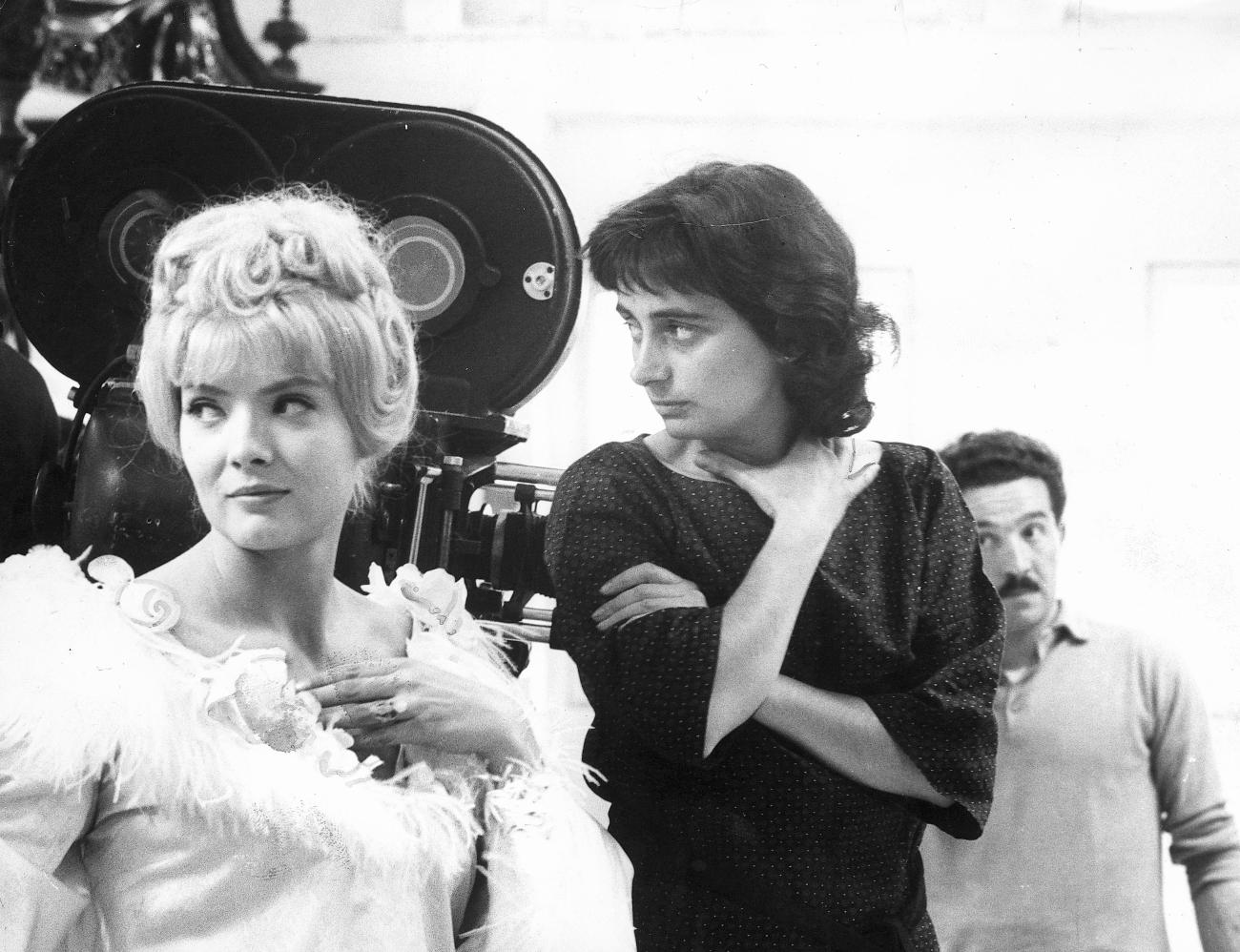
Image context: the lead image is a black-and-white production photograph of Varda with Corinne Marchand on the set of Cléo from 5 to 7. It is the right image for this essay because Varda's signature is not abstract authorship floating above the work. It is directed attention in real space: a woman filmmaker placing another woman inside a live city, with the street, the schedule, and contingency all left active inside the frame.[1][3]
She comes to cinema from still photography, so places are never background
BFI's introduction to Varda and Senses of Cinema's director profile both stress a fact that matters formally, not just biographically: before she was known as a filmmaker, Varda studied art history and worked as a photographer, including as the official photographer for the Theatre National Populaire.[1][2] That origin helps explain why her films keep treating a person and a location as equally legible subjects. In Varda, a room is rarely neutral. A market stall, a seaside block, a shopfront, a road shoulder, or a Paris street is already carrying social weather before the plot fully arrives.[1][2]
Her own term cinécriture clarifies the point.[1][2] Senses of Cinema summarizes it as a broad kind of "cine-writing" that includes editing style, commentary, location choice, season, crew, and light.[2] That definition matters because it prevents us from shrinking Varda into either a visual poet or a political reporter. She is both more concrete and more synthetic than that. She builds meaning by deciding where a body stands, what sort of daylight touches it, how long a shot listens, and when a voice is allowed to enter.[1][2][6]
This is also why Varda's images seldom feel imprisoned by prestige. Even when the composition is exact, it keeps some air around itself. She likes shop windows, mirrors, corridors, beaches, stairways, streets, and thresholds because they hold more than one condition at once: intimacy and exposure, performance and fatigue, beauty and transit.[2][3] Her frames are composed, but they do not look sealed. They feel available to accident, which gives them moral charge.
Walking is her most reliable dramatic engine
If one wanted a single Varda verb, it might be "walk."[1][3][4] Cléo from 5 to 7 remains the clearest demonstration. BFI's film page describes the movie as a portrait of a woman painted onto a documentary about Paris, and that is exactly the balance Varda keeps achieving.[3] Cléo begins as someone heavily seen by others, wrapped in pop-image vanity and medical fear, yet the film's wandering structure changes the terms of attention.[3] As Cléo moves through taxis, shops, cafes, staircases, and streets, the city stops behaving like décor and starts acting like a field of encounters. Time passes, but so does social texture. A walk becomes a change in consciousness.[3]
What is striking is that Varda never treats walking as mere freedom. Even in Cléo, where the streets of early-1960s Paris feel full of motion and wit, walking also registers exposure.[3] The character is out in public while waiting for knowledge she cannot control. Every shopfront reflection and passing stranger makes the world feel more present, but also less manageable. Varda turns movement into a way of measuring vulnerability.
By the time we reach Vagabond, that same verb has hardened.[1][4] BFI's beginner guide calls the film an emotionally hard-hitting blend of fact and fiction that forces viewers to confront social responsibility, while its survey of walking films emphasizes the brutal physicality of walking in Varda's 1985 drama.[1][4] That distinction is crucial. In Cléo, walking opens perception. In Vagabond, walking becomes attrition: a body exposed to class judgment, weather, labor, hunger, and the limits of social sympathy.[1][4] Varda does not romanticize drift. She makes locomotion itself carry evidence.
This is where her director's intelligence becomes unusually sharp. Many filmmakers use a journey to organize plot. Varda uses walking to reorganize what counts as knowledge.[1][3][4] Who notices whom? Who is read as spectacle, nuisance, burden, or neighbor? What does a body learn by crossing a city, and what does a city reveal by refusing comfort? Her films keep asking these questions in motion, which is why they rarely calcify into thesis cinema even when their politics are strong.
Essay form lets curiosity stay visible
The other great Varda verb is "glean."[1][2][5] BFI's note on The Gleaners and I calls it an essay portrait of society's scavenger-recyclers, with Varda herself included, and praises the freedom she finds with a small video camera.[5] That compact description gets very close to her late style. The handheld digital turn did not make Varda newly curious; it gave her a lighter instrument for a curiosity that had long been there.[1][2][5]
What changes in The Gleaners and I is the visibility of the method. Varda can now pivot quickly from a truck, a field, a museum painting, a hand, a passing stranger, or her own aging skin without pretending those jumps belong to separate kinds of cinema.[2][5] Documentary inquiry, visual joke, self-portrait, and social observation are allowed to share the same sentence. The film feels modern because it does not confuse looseness with vagueness. Every detour sharpens the larger question of value: what gets thrown away, who lives off the remainder, and how can a camera join that inquiry without standing above it?[5]
Varda by Agnès makes the whole pattern explicit.[6] Janus describes the 2019 film as a playful, personal summation of her artistic journey across films, photography, and installation work.[6] That late self-portrait matters because it shows that Varda never thought of medium boundaries as the deepest boundary. The real continuity sits elsewhere: attention to overlooked people, delight in objects with odd emotional charge, a taste for free association disciplined by form, and a refusal to separate tenderness from intelligence.[2][5][6]
This helps explain why Varda still feels younger than many younger directors. She does not chase novelty as branding. She keeps adjusting the tool so that curiosity can remain visible.[1][2][5][6] The small camera in The Gleaners and I and the reflective summation of Varda by Agnès are late works, but they do not read as retreat. They read as a director finding lighter, clearer ways to keep the world open.
Why the method still matters
Varda's durability in 2026 does not rest on museum reverence alone.[1][2][6] It rests on how practical her example remains. She shows that a director can be formally exact without becoming hermetic, political without becoming schematic, and personal without turning every image into confession. Photography teaches her to notice. Walking teaches her to test a world by moving through it. Cinécriture lets those observations become structure rather than leftover texture.[1][2][3][5]
That is why her best films keep feeling roomy even when their circumstances are harsh. The roominess is not softness. It is permission for reality to keep entering the frame. Varda does not seal the image after extracting its meaning. She leaves it porous enough for another face, another object, another accident, another thought. Few directors have made looking feel so much like a civic act.[1][2][5][6]
Sources
- Katherine McLaughlin, "Where to begin with Agnès Varda," BFI.
- Senses of Cinema, "Varda, Agnès."
- BFI, "Cléo from 5 to 7 (1962)" film page.
- Katherine McLaughlin, "10 great walking films," BFI.
- BFI, "The Gleaners and I (2000)" film page.
- Janus Films, "Varda by Agnès".