People often remember Technicolor as if it were a filter before filters: rich reds, lacquered greens, gold that looks somehow denser than ordinary yellow.[1][4] That memory gets the sensation right, but it misses the mechanism. Technicolor's real product was not color alone. It was control. The company sold studios an integrated package in which the camera, the crew, the lab, the consultant, and the print all belonged to one disciplined chain.[1][3][4]
That distinction matters because it explains why three-strip Technicolor felt so different from later color systems even when audiences described both with the same shorthand, "in color."[1][6][7] A three-strip Technicolor feature was not simply photographed on color stock. It was built through a workflow that separated color into three black-and-white records inside the camera, routed design choices through Technicolor supervision, and then rebuilt the image at the printing stage through dye transfer.[1][3][4] The famous look was therefore less a surface style than the visible result of a tightly managed production architecture.
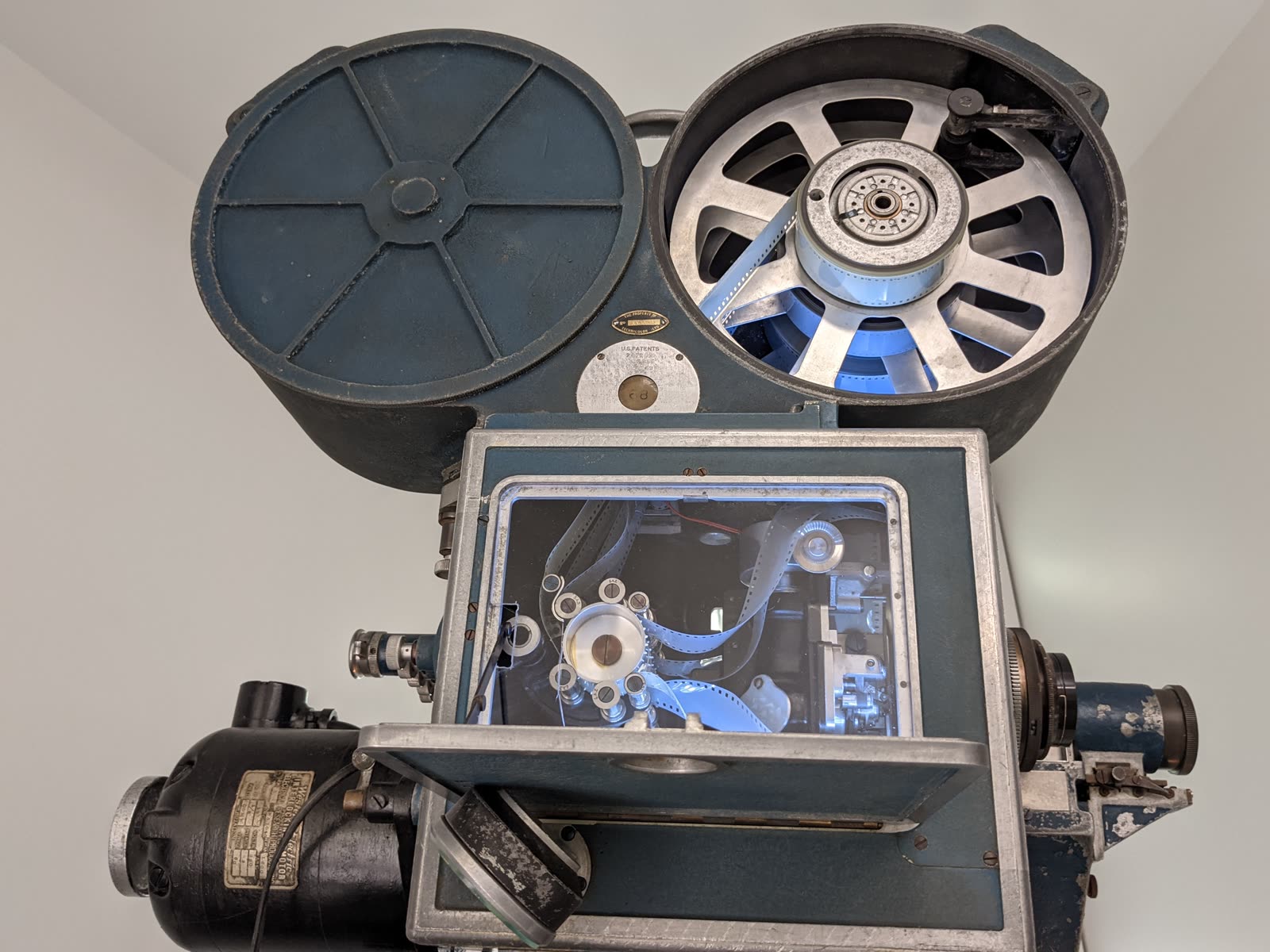
Image context: the lead image shows a surviving Technicolor three-color camera now preserved in Berlin. It is the right recognition image for this piece because the story here begins with apparatus, not with one single star vehicle or one famous poster. The hardware itself tells the argument: Technicolor's palette depended on a machine large enough, costly enough, and specialized enough to reorganize the whole set around it.[2][9]
The camera was already a contract before the film stock ever rolled
George Eastman Museum's overview of the three-strip camera is clear about the core innovation.[1] Light entered through the lens, hit a beam-splitting prism, and was divided into two optical paths. One strip recorded the green record on black-and-white film, while the other path exposed the red and blue records on a "bipack" of two black-and-white strips sandwiched together.[1] This meant that Technicolor's color image did not begin as one self-contained color negative. It began as three separate records that had to stay in exact relation to one another from exposure through printing.[1][4]
That design brought obvious visual advantages, but it also carried a production cost that shaped everything downstream. Eastman Museum's camera-image archive notes that the three-color camera weighed 200 pounds, cost more than $10,000 to manufacture, and was produced in only twenty-nine units between 1933 and 1950.[2] The same archive shows how the camera's sound made blimping standard practice and how valuable the apparatus was treated on set.[2] Once a camera is that heavy, scarce, and temperamental, it stops being a neutral recording tool. It becomes a scheduling problem, a lighting problem, and a staging problem before it becomes a photographic one.
This is the first place where Technicolor's mythology becomes easier to read. The lushness of the image did not come from liberating filmmakers into casual chromatic abundance. It came from a system that forced precision. The camera's bulk, rarity, and optical complexity meant that color could not be left to chance.[1][2]
The rise of the three-strip era was also the rise of the Technicolor package
Technicolor's commercial breakthrough arrived when that control system finally stabilized in the mid-1930s. Eastman Museum's 1935-1955 materials note that Pioneer Pictures was formed in 1933 specifically to exploit the new three-color process, and that Becky Sharp became the first full-length Technicolor feature in 1935 after nearly two years of testing.[5] The same Eastman materials show how quickly "Color by Technicolor" became part of a film's selling proposition by the end of the decade.[5][6]
That advertising success is easy to treat as branding alone, but it depended on Technicolor delivering a recognizable level of consistency. The company did not merely lease cameras. It supplied a package of equipment and expertise that let studios buy a controlled result.[3][6] Eastman's historical text describes this package as one of the keys to Technicolor's dominance before the antitrust pressures and postwar format shifts of the late 1940s and 1950s.[5][6]
The practical implication was enormous. A studio using Technicolor was not only choosing a look; it was choosing outside supervision over parts of production that black-and-white cinematography had left more loosely distributed. That is why the early three-strip classics often feel less like films that "happen" to be in color and more like films whose sets, fabrics, cosmetics, and lighting ratios have all been persuaded into the same discipline.[3][5]
Natalie Kalmus and the color-advisory regime turned taste into workflow
The cleanest evidence for Technicolor as a control system sits in the Color Advisory Service. Eastman Museum's company history explains that the Technicolor package included consultants who advised productions on makeup, costumes, set design, and color relationships throughout the filmmaking process.[3] This division, founded by Natalie Kalmus in the late 1920s, was built around her theory of "Color Consciousness," which treated color choice as a compositional and psychological problem rather than a decorative afterthought.[3]
That history matters because it clarifies what the Technicolor look really was. It was not just chemistry plus good taste. It was enforced coordination. From 1935 until Natalie Kalmus left the company in 1948, her credit appeared on nearly all Technicolor films.[3] Whether directors loved or resented that presence, the structural point stays the same: Technicolor inserted a color-governance layer between creative intention and the finished frame.[3][6]
Seen this way, many of the period's most memorable color images stop looking accidental. Saturation had to be balanced against skin tones. Set walls, furnishings, and costumes had to be planned so one element would not flare into dominance and flatten the rest of the frame.[3] Even the emotional logic of a scene could be routed through this discipline. Technicolor sold the reassurance that color would be designed all the way through, not improvised at the last minute.
Dye-transfer printing is why the look survived the camera
The company guarded one more advantage at the print stage. Eastman Museum's dye-transfer history describes Technicolor's printing method as the firm's greatest legacy.[4] For three-color work, cyan, yellow, and magenta dyes were added one at a time by pressing dyed relief matrices into contact with blank film.[4] Exact registration mattered, but when it worked the results were vivid, dense, and unusually stable.[4][7]
This is where Technicolor separated itself most sharply from later Eastmancolor-era memory. The Library of Congress film-preservation study explains that the three-strip camera created black-and-white records that involved no color dyes, while Eastmancolor's multilayer negative and print systems depended on dye couplers whose colors proved far less stable over time.[7] That is a preservation point, but it is also an aesthetic one. Part of what modern viewers call "the Technicolor look" comes from the fact that surviving Technicolor materials have often retained their chromatic authority better than many mid-century monopack color elements.[4][7]
Just as important, dye transfer outlived the original three-strip capture system. Eastman's 1955-1975 history notes that from 1952 onward Technicolor offered dye-transfer printing for films photographed in other color processes, so titles shot in Eastmancolor could still be released with the "Color by Technicolor" credit.[6] In other words, the company's most durable product eventually became the print finish and color-management discipline, not the camera itself.[4][6]
The system declined because cheaper flexibility beat integrated control
That also explains the speed of the collapse. Eastman Museum's post-1955 history is blunt: Eastmancolor and related processes were cheaper, more attractive to studios, and compatible with the widescreen systems that the old three-strip process could not easily serve.[6] From 1952 onward, Technicolor was already offering dye-transfer printing for films photographed in other color processes, which meant the company could remain visible on release prints even as the center of gravity in production moved away from the old three-strip camera.[6]
The decisive shift was not that audiences suddenly disliked Technicolor's palette. The shift was industrial. Studios wanted lighter cameras, simpler workflows, more location flexibility, and direct ownership over color decisions that Technicolor had previously mediated.[6] Once single-strip color negative and newer formats aligned with those priorities, Technicolor's integrated package began to look less like a premium guarantee and more like an expensive bottleneck.
Yet the decline does not make the older system less important. It makes its achievement easier to name. Three-strip Technicolor produced its famous images because it bound optics, design, labor, and printing into one chain strict enough to keep color coherent from set to release print.[1][3][4][6] Modern cinema has many ways to create lush color, but few have made color such an explicit organizational principle.
Why the three-strip story still matters
The durable lesson is broader than nostalgia for ruby slippers or studio-era spectacle. Technicolor shows that a "look" is often the visible trace of a workflow.[1][4][6] When people say those films feel richer, they are responding to a whole production regime: a scarce camera, specialized operators, controlled palettes, and a print process that rewarded exacting registration.[2][3][4]
That is why Technicolor still matters in 2026. It reminds us that style in cinema is rarely a single trick. More often it is an agreement between hardware, labor, and management. Technicolor's greatest trick was persuading the industry that this agreement could itself be sold as glamour. The color was magnificent. The deeper product was discipline.
Sources
- George Eastman Museum, "Three-Strip Camera" (beam-splitting prism design and three-strip capture overview).
- George Eastman Museum, "2c - Three-color camera (images)" (camera weight, cost, unit count, prism, and blimp captions).
- George Eastman Museum, "Color Control Department" (Technicolor package, Natalie Kalmus, and color-advisory role).
- George Eastman Museum, "2b - Dye-transfer printing (unedited text)" (matrix printing process and long U.S. afterlife of dye transfer).
- George Eastman Museum, "1b - 1935-1955 (images)" (Pioneer Pictures, Becky Sharp, antitrust pressure, and market-era captions).
- George Eastman Museum, "1c - 1955-1975 (unedited text)" (Eastmancolor competition, widescreen incompatibility, and the shift to Technicolor printing for non-Technicolor photography).
- Library of Congress, "A Study of the Current State of American Film Preservation: Volume 1" (three-strip negatives, dye-transfer prints, and Eastmancolor fading differences).
- George Eastman Museum, "Becky Sharp (35mm nitrate)" (first feature film entirely shot in three-color Technicolor).
- Wikimedia Commons, "File: Filmmuseum Berlin - Technicolor Three-Color Camera.jpg" (source page for the camera photograph used here).