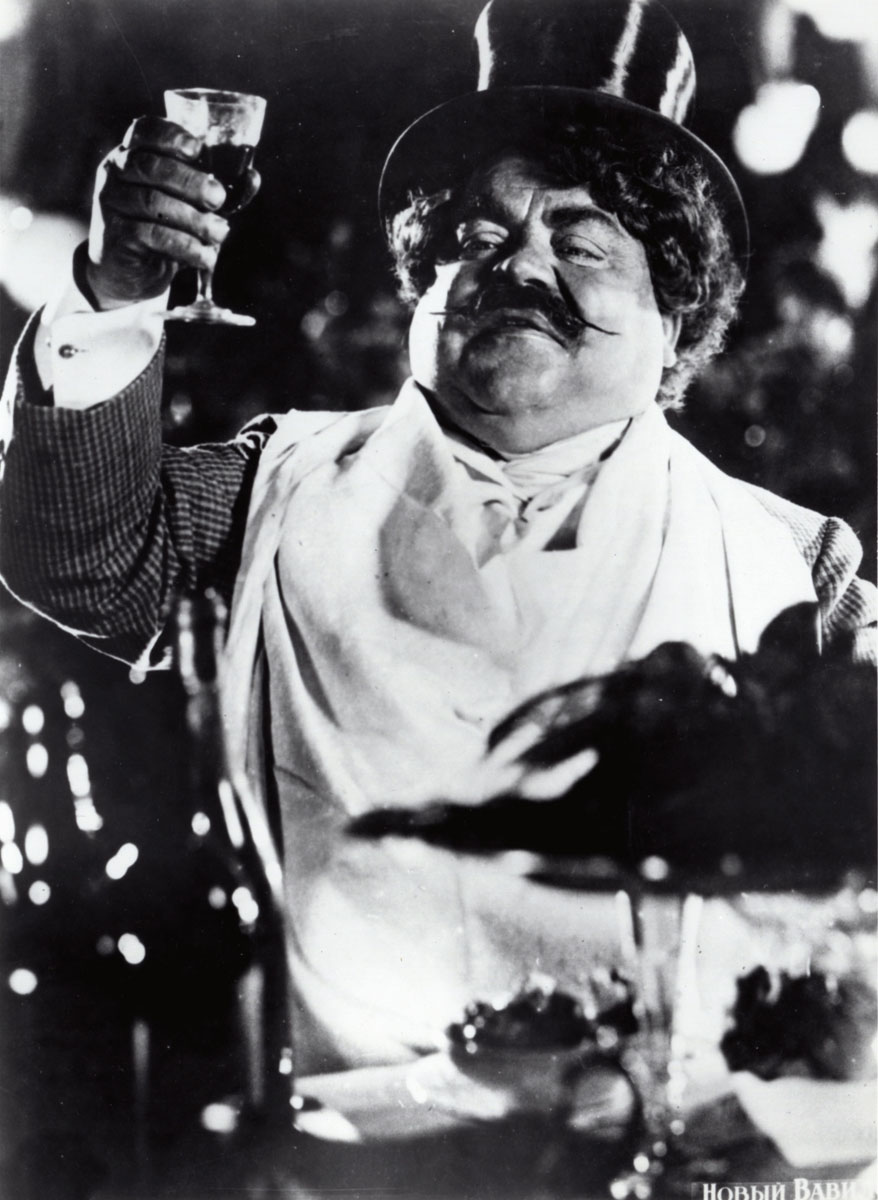
A glass goes up. The toast is perfectly clear, yet conviviality does not exhaust the gesture. A top-hatted reveler angles his wrist, inspects the drink, and fills the low-angle frame with moustache, white waistcoat, and appetite. In the still above, taken from Grigori Kozintsev and Leonid Trauberg's The New Babylon (1929), acting becomes a hard black shape cut against pale space. The body does not disappear into the role. It announces the act of performing.
That raised arm is a useful entrance to FEKS, the Factory of the Eccentric Actor. The name can sound like a minor workshop filed somewhere behind the great monuments of Soviet silent cinema. Its method was more unruly. FEKS pulled energy from circus, music hall, puppetry, acrobatics, popular print, American comedy, and the modern street, then made those forms collide with Gogol, the Decembrist revolt, and the Paris Commune.[1][4][5] It did not simply make serious history funny. It asked what happens to a monument when the people inside it refuse to stand still—or stand so strangely that the pose itself becomes the subject.
The group's deepest invention was not a catalog of visual quirks. It was a way of moving the center. A clerk can become less human than his overcoat. A revolutionary epic can keep interrupting itself with shop-window spectacle and dance music. A historical villain can occupy the frame with the magnetic ease of a stage magician. FEKS made meaning by throwing bodies, objects, genres, and rhythms into irregular orbit around one another.
Image context: the lead image is an archival still from The New Babylon, not a later recreation. The raised glass captures the FEKS approach in miniature: a performer conveys an intelligible action while also making the viewer notice posture, costume, contrast, scale, and the constructed frame.[8]
A factory for borrowed energy
The 1922 Eccentric Manifesto was written by Leonid Trauberg, Grigori Kozintsev, Sergei Yutkevich, and Georgii Kryzhitskii. A Cambridge study places its short aphorisms inside a culture of dynamic, absurd “chance” associated with circuses, cabarets, racetracks, and American dance.[2] The manifesto attacked solemn cultural authority with the tone and compression of advertising. Art was not to descend from a pedestal. It had to compete with the street for attention.
That competition shaped the workshop that opened in July 1922. Its students practiced acrobatics, dance, and juggling alongside acting; the group's theatrical program treated movement, the stunt, and turned-inside-out psychology as basic materials.[3] “Factory” therefore meant more than a fashionable industrial metaphor. FEKS wanted repeatable training for unrepeated effects: control strong enough to produce imbalance on purpose.
The sources it borrowed were deliberately impure. Circus and music hall supplied abrupt entrances, risky bodies, and the logic of the attraction. American silent comedy supplied objects that fight back and performers whose thinking is visible as movement. Posters and popular entertainment supplied an image that had to seize attention before it could request contemplation. Russian Formalist collaborators supplied another crucial pressure: familiar things should be made difficult enough to be seen again.[1][3]
Maria Corrigan's recent history of FEKS describes eccentricity through the geometry of a warped orbit—an irregular circle that forces the center to be reconsidered. That formulation prevents the group from becoming merely the zany wing of Soviet montage. Eccentricity was not a mood. It was a relation in which no element could remain the natural measure of the others.[1]
The Devil's Wheel turns an attraction into a world
FEKS's first surviving feature-length breakthrough, The Devil's Wheel (1926), begins with sailors on shore leave in a Leningrad amusement park. One of them is pulled away from naval order and into a criminal underworld. A conventional melodrama could treat the park as colorful scenery on the way to the plot. Kozintsev and Trauberg let it contaminate the plot's logic.
Archive curator Jan-Christopher Horak describes the opening as an example of the filmmakers' pursuit of “extreme pictorial photography”: bodies in motion alternate with a surrounding cacophony of light, while the nightlife below fills with frenetic dancers and figures that seem recruited from a circus.[4] The wheel in the title is therefore more than a ride or a symbol of fate. It is a production principle. Light, crowd, machinery, and performance keep changing which part of the image appears to control the scene.
This is where FEKS begins to separate the stunt from a simple gag. In slapstick, a machine may humiliate a body and then release it into the next joke. In The Devil's Wheel, the whole environment behaves like unstable machinery. The sailor's loss of direction is not just narrated; it is built into a visual field that refuses calm orientation.
The film also reveals why “eccentric” should not be reduced to fast cutting. Speed matters, but only because it can collide with stoppage, darkness, or a sharply posed figure. The effect comes from a broken expectation about what should carry the scene. Sometimes the actor does. Sometimes the light does. Sometimes a fairground device seems to have more agency than either.
The Overcoat discovers the eccentricity of stillness
Made in the same year, The Overcoat appears at first to reverse that velocity. FEKS brought its mixture of circus, music hall, puppet theater, and American silent comedy to Gogol's story of the minor clerk Bashmachkin.[5] Yet the result is no carefree parade of tricks. Looming shadows, oblique angles, distorted architecture, and gestures bordering on dance make bureaucratic life feel both rigid and feverish.
Horak singles out heavy, fur-lined coats marching through winter darkness and the clerk's endless copying of official documents.[4] Those images change the scale of the human world. Clothing acquires the authority of a procession; handwriting becomes an immobilizing physical routine. Bashmachkin is not simply a psychologically complete person oppressed by an external institution. His bent body, desk, pen, paper, and coveted coat form a mechanism in which person and object keep exchanging importance.
Here FEKS proves that eccentricity can freeze. The oddness lies in a relation pushed off center: a sleeve overwhelms an arm, a corridor overwhelms a destination, a repeated motion drains action of progress. The actor's physical discipline does not advertise virtuosity. It makes submission visible as choreography.
That distinction matters to the movement's afterlife. If FEKS is remembered only for youthful noise, The Overcoat looks like a retreat into expressionist atmosphere. Seen through eccentricity, it is an expansion. The group learned that estrangement could arrive through arrested movement as powerfully as through a somersault.
S.V.D. gives history to the trickster
S.V.D.—The Club of the Great Deed (1927) moves the experiment into overt historical material. Its setting is the Decembrist revolt of 1825, but it does not offer the uprising as an orderly chain of causes, leaders, and consequences. Horak notes that the filmmakers reduce the historical action to a contest between an amoral gambler-conspirator and a romantic young lieutenant. Nearly the entire film was shot at night, with snow, smoke, and shafts of light turning historical space into an unstable stage.[4]
The reduction is not historical explanation in miniature. It is an argument about the danger of explanation becoming too smooth. A gambler can cross political positions with the ease of changing a costume. A lieutenant can join history without fully grasping the roles already being assigned. Actors freeze into tableaux where a more continuous adventure film would hurry forward.[4]
Corrigan's account treats the trickster as central to FEKS's way of approaching monumental history.[1] The trickster does not merely mock the heroic revolutionary. He occupies the same visual world and disturbs its moral proportions. Charisma no longer guarantees commitment; a magnificent pose no longer guarantees a stable cause. History becomes harder to read precisely because performance is one of its forces.
This is not relativism. FEKS does not claim that every role is ethically equal. It makes a narrower and more useful point: political meaning cannot be secured by costume, posture, or narrative position alone. A historical cinema that notices performance can ask how authority makes itself attractive before it asks the viewer to admire or condemn the person who holds it.
New Babylon makes the epic argue with its own music
By The New Babylon, FEKS had enlarged eccentricity from the actor's body to the scale of a revolutionary epic. The film stages the Paris Commune of 1871 through a department-store saleswoman who joins the Commune and a soldier drawn into the force sent against it. Luxury retail, operetta, military action, labor, and the barricade do not merge into one seamless historical atmosphere. They keep striking sparks from one another.[6]
Dmitri Shostakovich's original score extends that method rather than merely decorating it. Kozintsev later recalled an agreement that the music should follow the inner meaning, cut across events, and oppose the mood of particular scenes.[6] A cheerful popular tune can refuse the emotional instruction apparently offered by an image. Music does not tell the viewer what the picture means; sound and image place competing claims on the same instant.
That counterpoint turns spectacle into evidence. The department store's abundance is seductive because the film lets it move, glitter, and perform. Bourgeois pleasure is not exposed from a safe distance as a lifeless falsehood. It is given rhythm, then placed against hunger, labor, and violence. The Commune is not honored by making its opponents aesthetically inert. The historical struggle reaches the viewer as a fight over sensation as well as power.
The lead still carries that pressure even without motion or music. The toast is readable, but not exhausted by its function. It belongs to a story and remains a shape: glass, wrist, brim, moustache, and waistcoat arranged into an advertisement for appetite. FEKS asks the viewer to follow the drama while noticing the machine that makes drama legible: actor, costume, light, framing, cut, score.
The surviving film is itself an unstable object. Realityfilm's 2006 centenary reconstruction added 510 metres—about 25 percent more footage than earlier available prints—and aligned that longer form with Shostakovich's full score.[7] That is not a neutral recovery. Giornate's program history records Trauberg's insistence that a longer German export print contained explanatory shots he and Kozintsev had deliberately removed; later restorers disputed whether censorship, hurried re-editing, or export requirements best explained the competing material.[6] The formal claims here concern FEKS methods visible across circulating versions, not the authority of every reinserted shot.
That history of loss, rival cuts, and reconstruction fits FEKS almost too neatly. A film that refused smooth continuity reached later audiences in competing forms, then made archivists decide which pieces belonged together. Relation mattered as much as individual survival.
Not a footnote to the montage canon
FEKS is easy to approach by comparison: less systematic than Eisenstein, less documentary-minded than Vertov, more theatrical than either. The comparisons help locate the group, but they can also restore the very center that eccentricity tried to move. Horak's rediscovery of the films stresses how different their distressed prints felt from the familiar image of Soviet montage cinema.[4] Corrigan goes further, treating FEKS as a foundational collective whose work reorients the cultural monuments around it.[1]
What comes into view is not an alternative recipe for montage. It is a cinema in which no craft remains subordinate for long. Acting can turn into graphic design. Design can become historical interpretation. A prop can reorganize a body. Music can dispute an image. Popular entertainment can carry theory without ceasing to be popular.
That is why the movement still feels fresh. Much historical cinema makes the past stable enough to visit: coherent rooms, credible costumes, motivated characters, a score that confirms the proper emotional route. FEKS makes the visit less comfortable. It lets the room tilt, the costume seize power, the character become a pose, and the score open a second argument.
History does not lose meaning in this process. It loses the right to occupy one immovable position. The monument remains in the square, but FEKS has nudged its center of gravity—and taught the people around it how to move.
Sources
- Maria Corrigan, Monuments Askew: An Elliptical History of the Factory of the Eccentric Actor. Rutgers University Press, 2025 — scholarly-book record for FEKS, eccentricity as an irregular orbit, the collective's transnational method, and its approach to monumental history.
- Cameron Asplund, “Valentin Kruchinin and the Queen of Mars: Early Musical Traces of Soviet Sci-Fi.” Twentieth-Century Music (Cambridge University Press), 2024 — FEKS's 1922 manifesto, its four authors, and eccentricity's links to chance, circus, cabaret, racetrack, and American dance.
- Saint Petersburg Encyclopaedia, “Factory of Eccentricity” — workshop chronology, physical actor training, manifesto principles, theatrical productions, and Russian Formalist collaboration.
- Jan-Christopher Horak, “Russians at the Giornate del cinema muto.” UCLA Film & Television Archive, October 21, 2011 — archival viewing notes on The Devil's Wheel, The Overcoat, and S.V.D., including lighting, performance, design, and historical treatment.
- San Francisco Silent Film Festival, “The Overcoat” — archival program essay on FEKS's theatrical and cinematic influences, the group's film workshop, and the film's off-kilter posture, gesture, architecture, and night photography.
- Le Giornate del Cinema Muto, “Novyi Vavilon” — competing-cut and score history for The New Babylon, including Kozintsev's account of music designed to cut across the image and Trauberg's objection to explanatory material in a longer German export print.
- Realityfilm, “The 2006 Centenary Original Leningrad Synchronised Restoration Print” — the reconstruction's documentation of its 2,580-metre version, 510 metres of added footage, full score, and production credits.
- BAMPFA, archival still from The New Babylon (1929) — original-resolution source file for the lead image.