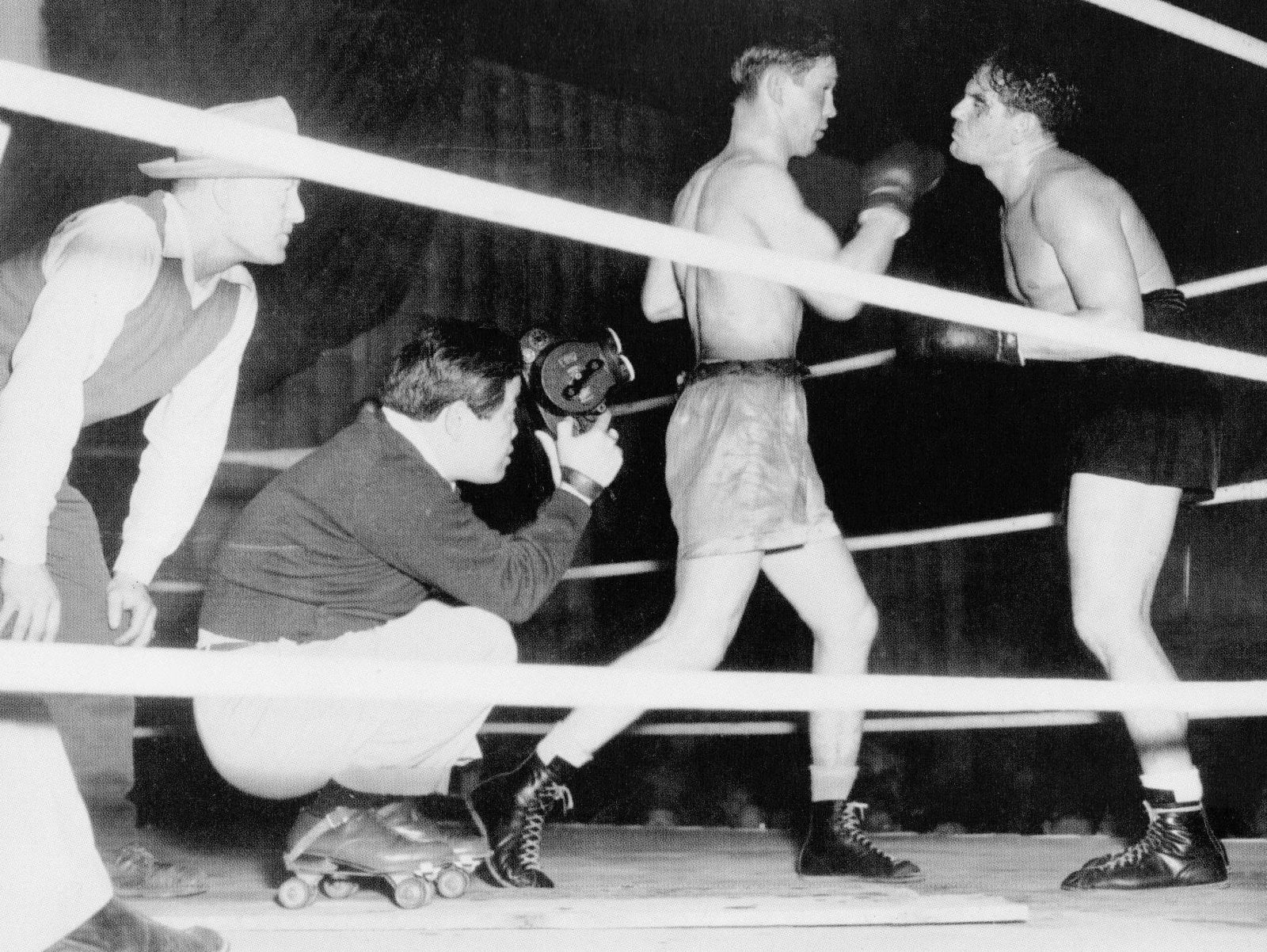
James Wong Howe is already inside the boxing ring. One knee nearly touches the canvas. Eight small wheels sit beneath his two shoes. Between his hands rests a compact camera, while a grip waits to push him through the fighters' space. This is not a candid news photograph. It is the production of Body and Soul in 1947, and Howe is turning a prizefight into a moving point of view.[1]
The roller skates get remembered because they are wonderfully improvised. The more consequential object is the Bell & Howell Eyemo. A conventional studio camera and dolly could move with great control, but the ropes, fighters, operator and changing direction of a bout made that control a form of distance. Howe wanted to be closer and faster. The Eyemo let the camera travel with his body.[1]
That is the machine's real place in film history. The Eyemo did not make a complete production camera smaller. It made a particular bargain portable: professional 35 mm photography, mechanically powered and available at short notice, in exchange for a short load and fewer comforts. News crews, combat units and feature filmmakers could put that bargain where a larger camera system would be slow, conspicuous, impractical or too cumbersome to send. The result was not simply handheld cinema. It was a new kind of production decision—the short shot for which proximity mattered more than duration.
A 35 mm camera built around a short run
Bell & Howell introduced the Eyemo in 1925, adapting ideas from its smaller-gauge Filmo line to a compact 35 mm body. A surviving Eyemo in the Ingenium collection is described as a rapidly prepared newsreel camera that could work in the hand or on a tripod. Its standard magazine held 100 feet of film, though larger magazines could replace it.[2] The Museu del Cinema's 71-L adds the other half of the design: a wind-up motor, trigger operation, a footage indicator and controls arranged so an operator could adjust the camera while holding it.[3]
The standard load imposed a severe clock. Kodak's current reference for conventional four-perforation 35 mm gives 4 minutes 26 seconds for 400 feet at 24 frames per second. A 100-foot load therefore yields only about 67 seconds at that speed.[4] The exact usable duration also depends on threading, leader and running speed, but the scale is what matters: an internal load holds a shot, not a scene without limits.
That minute shaped the work around the camera. The operator had to choose when to spend film. A crew had to reload. An action could outrun the remaining footage. Yet the small spool was also what kept the camera self-contained. There was no 400- or 1,000-foot magazine rising above the body, no cable leading to external power, and no full dolly system governing where the lens could go.
Calling those absences deficiencies misses the design logic. The Eyemo concentrated enough machinery to expose the same 35 mm medium that organized professional laboratories, editorial rooms and theatrical release. It did not ask a feature production to accept a visibly smaller acquisition format merely to gain an unusual angle. What it reduced was not the negative width but the amount of infrastructure that had to accompany one take.
Every accessory moved the boundary
There was never only one immutable Eyemo. The base machine's compactness created a platform, and users kept negotiating how much of that compactness to surrender. The standard 100-foot magazine could give way to a larger one.[2] The 71-L in Girona has three lenses and variable speed, letting an operator change focal length without rebuilding the front of the camera.[3] A larger magazine bought time; more lenses bought choice. Both added mass or complexity.
Wartime modification made the exchange especially explicit. The Australian War Memorial preserves an Eyemo used by Royal Australian Air Force Flight Sergeant Robert Buckland to film from a Lancaster over Europe in 1944 and 1945. Its clockwork mechanism had been replaced by a drive powered from the aircraft's electrical system, while separate 1.5-volt batteries illuminated a reflector viewfinder. The camera was bolted to an aircraft mount rather than held by the operator.[5] The field problem had changed: inside a Lancaster, remote electrical operation and a fixed installation were worth the extra components.
That example prevents a tidy story in which spring power automatically defeats electricity. The Eyemo's durable idea was configurability around a rugged core. A crew could keep the spring and short internal load when independence mattered, or add motors and magazines when run time and operating conditions demanded them. Each configuration solved one constraint by accepting another.
The same caution applies to danger. Ingenium identifies the Eyemo as a front-line camera of the Canadian Army Film Unit during the Second World War.[2] Compact equipment did not make combat safe, and it certainly did not make the operator expendable. It reduced the apparatus that a person had to carry into an unsafe place. That distinction matters: a camera can change the logistics of witnessing without changing the human cost of being there.
Newsreel motion entered the fiction feature
Howe understood that audiences had already learned to read this logistics as style. American Cinematographer's account of Body and Soul notes his 1944 observation that wartime newsreels had taught viewers to associate unstable camera movement with authenticity. The technically immaculate Hollywood image could begin to feel less believable precisely because it looked protected from contingency.[1]
For Body and Soul, Howe did not imitate newsreel roughness from the safety of a conventional setup. He borrowed its working condition. With a handheld Eyemo and roller skates, pushed by a grip, he could move inside the ring and keep the lens near John Garfield and the other fighters. The camera's limited scale altered the choreography among operator, actor and equipment: instead of a dolly describing the ring from outside, a human camera platform reacted from within it.[1]
The photograph above makes the bargain visible. Howe has gained proximity, but not stability without labor. His crouch lowers the viewpoint. The skates reduce the friction of lateral movement while making balance a shared responsibility. The grip becomes part of the camera support. The Eyemo has not abolished the production apparatus; it has redistributed that apparatus across several bodies.
This is why “handheld” is too thin a description. The shot depends on a small 35 mm camera, but also on rehearsed fighters, a smooth ring, an operator who can frame while moving, and another person controlling his travel. Portability is not the absence of a system. It is a system whose pieces can enter the action.
Military surplus became a film-production resource
After the war, the Eyemo's military life fed back into screen production in a more literal way. The Smithsonian's National Air and Space Museum holds a 35 mm Eyemo from aerial cinematographer and stunt pilot Art Scholl's collection. Its account says Scholl used surplus military cameras while photographing aerial material for productions including The Great Waldo Pepper, Capricorn One, Top Gun and the IMAX film Flyers.[6]
An aerial camera has to solve a different set of problems from a boxing camera, but the attraction is related. The apparatus must tolerate vibration, fit inside or onto another moving machine, and make a usable negative where a conventional studio package would become an obstacle. Surplus matters here as more than price. Equipment already designed for field deployment entered a second working life as specialized feature-film hardware.
The Eyemo thus survived not by remaining the best general-purpose camera, but by becoming available for jobs that did not need a general-purpose camera. A production could treat it as a distinct unit: choose the lens, load a minute of film, rig or carry it for one angle, then return to the main camera for dialogue, long takes and precise viewing. Its constraint made the assignment legible.
The Conversation turned clockwork into a moving mount
By 1974, spring drive could look less like a historical survival than a rigging advantage. A production photograph for Francis Ford Coppola's The Conversation shows cinematographer Bill Butler fitting a spring-wound Eyemo to a platform for a “walking closeup” of Gene Hackman.[7] The camera is no longer being celebrated as a small all-rounder. It is one component in a purpose-built relation between lens and actor.
That shift is subtle but important. If the camera and performer travel together, the background can lurch and slide while the face remains at a nearly fixed distance. A cable, tall magazine or heavy support would complicate the attachment. The Eyemo's mechanical independence and compact load are valuable because they let the production place 35 mm capture inside a moving structure.
The platform changes what “camera movement” means. The lens is not independently following Harry Caul through space; it is temporarily bound to the actor who embodies him. A 1925 news camera has become, through rigging, a way to make subjectivity mechanical.
Moonraker found the point where small was still too large
Endurance should not be mistaken for supremacy. During preparations for Moonraker's 1979 free-fall sequence, aerial cameraman Rande DeLuca tested an Eyemo on a helmet. He put the camera at roughly 6½ to 7 pounds without a lens, already near the maximum he wanted to jump once film and optics were added. Mounted above his head, it effectively made him a foot taller inside a cramped Cessna. The spherical test lens also forced a later crop for the film's wide frame, while DeLuca wanted higher frame rates and a more robust pressure plate.[8]
The production chose a newer purpose-built camera: about 4½ pounds without a lens, with the same compact 100-foot daylight-load concept but reliable operation at 48 frames per second.[8] This is the strongest counterargument to easy Eyemo nostalgia. A tool can define a production category and still lose the job when that category becomes more demanding.
Yet the replacement also shows what the Eyemo had normalized. The desired free-fall camera still used a very short 35 mm load. It still traded long duration for lightness. It still isolated a dangerous, specialized angle from the main production package. The newer machine did not reject the bargain; it refined it.
A seventy-five-year-old shell became a body camera
For Requiem for a Dream in 2000, cinematographer Matthew Libatique used another heavily modified Eyemo on a body rig. American Cinematographer describes a modular vest hidden beneath the actors' clothes, an Eyemo altered for different running speeds and a Canon mount, and a 14 mm lens. The resulting relationship keeps the actor fixed while the surrounding world moves with an unnerving lack of independence.[9]
Nothing about that configuration is standard 1925 equipment except the lineage of the body inside it. New mount, new lens interface, new rig and altered speeds turned the camera into a substrate for technicians. Its value lay partly in being understood well enough to modify and robust enough to carry the modification.
Placed beside Howe's roller skates, the body rig reveals a long reversal. In Body and Soul, the operator's body carries the camera toward the actor. In Requiem for a Dream, the actor's body carries the camera and cannot escape its gaze. Both effects begin with the same industrial permission: a 35 mm mechanism compact enough to join the performance rather than observe it from a protected station.
The invention was a kind of shot
The Eyemo lasted because its limitations were clear. A 100-foot load created a hard deadline. A spring drive reduced dependence on power. A compact metal body could be held, mounted, adapted or assigned to a risky position. Larger magazines, multiple lenses and electric motors could extend the machine, but every extension renegotiated the feature that made it useful in the first place.[2][3][5]
That is more instructive than saying the Eyemo made cameras portable. Other cameras became lighter, quieter, more precise and more comfortable. The Eyemo's deeper contribution was organizational. It let a production separate one difficult image from the needs of the whole movie. The main unit did not have to become a combat crew, enter a boxing ring on skates, ride an actor's chest or jump from an aircraft. A small 35 mm unit could be configured for that one piece of evidence.
In wartime, the person carrying the camera faced far greater danger than the machine. In controlled production, the compact unit still changed the threshold at which a shot became attemptable. Its minute of film was not much time. It was enough time to go somewhere cinema's larger apparatus could not follow—and come back with the image.
Sources
- David E. Williams, “Wrap Shot: Body and Soul.” American Cinematographer, October 27, 2016 — James Wong Howe's handheld Eyemo and roller-skate method, wartime-newsreel influence, and source page for the article image.
- Ingenium – Canada's Museums of Science and Innovation, “Camera, circa 1926,” artifact 1987.0092 — 100-foot standard magazine, larger-magazine option, handheld/tripod operation, rapid preparation and Canadian Army Film Unit use.
- Museu del Cinema, “Film camera: Bell & Howell Eyemo 71-L” — 1925 introduction, wind-up trigger drive, operator controls, three-lens 71-L and wartime reporting context.
- Kodak, Motion Picture Products US, effective April 10, 2026, p. 10 — four-perforation 35 mm running-time reference of 400 feet at 24 fps equaling 4 minutes 26 seconds.
- Michael Kelly, “The restoration of the Buckland Camera.” Australian War Memorial, August 2, 2023 — Robert Buckland's 1944–45 Lancaster Eyemo, its conversion from clockwork to aircraft electrical drive, and its battery-lit reflector viewfinder.
- Smithsonian National Air and Space Museum, “Camera, Motion Picture, Bell & Howell, Eyemo, 35mm” — Art Scholl collection record and the use of surplus military cameras for aerial film production.
- Herb A. Lightman, “Bill Butler, ASC on His Transition From Tape to Film to ‘Jaws.’” American Cinematographer, originally February 1977 — production photograph and caption identifying the spring-wound Eyemo rig for Gene Hackman's walking close-up in The Conversation.
- Rande DeLuca, “The Freefall Filmmaking of Moonraker.” American Cinematographer, originally November 1979 — Eyemo helmet test, weight and format constraints, and the lighter 48 fps camera selected for the sequence.
- Jay Holben, “Requiem for a Dream: Downward Spiral.” American Cinematographer, December 2000 — Matthew Libatique's modified Eyemo, Canon mount, 14 mm lens and actor-worn body rig.