Larisa Shepitko's films tend to meet their protagonists after society has already found a noun for them. Abakir in Heat is the formidable farm worker. Nadezhda Petrukhina in Wings is the decorated veteran and school principal. Pyotr in You and I is the brilliant surgeon. Rybak and Sotnikov in The Ascent are partisans, a word that seems to arrive with courage built in. Each identity looks ready for a plaque, a newspaper profile, or a speech.
Then the film begins.
The label does not turn out to be false so much as radically incomplete. Work can become domination. Wartime distinction can harden into peacetime estrangement. Talent can coexist with evasion. The stronger soldier can fail the harder test. Across four features made between 1963 and 1977, Shepitko repeatedly takes a public image that appears finished and returns it to time, the body, other people, and choice.[1][2][4] Her cinema does not tear down heroism for sport. It asks whether heroism can survive after admiration stops doing the thinking.
Spoiler note: This profile discusses major choices and endings in Wings, You and I, and The Ascent.
The role arrives before the person
Shepitko was born in eastern Ukraine in 1938 and entered Moscow's Gerasimov Institute of Cinematography while still a teenager. She studied with Alexander Dovzhenko, graduated with Heat, and completed only three more features—Wings, You and I, and The Ascent—alongside shorts and television work before her death in 1979.[1][4] That compact filmography makes it tempting to describe a clean ascent toward a final masterpiece. The films resist that shape. They keep breaking clean shapes themselves.
The useful connection among them is not a single visual signature. Heat has the rough immediacy of a graduation production; Wings moves between provincial routines and aerial memory; You and I is Shepitko's only color feature and her most visibly fractured narrative; The Ascent pares its world down to faces, snow, wood, breath, and black interiors.[1][5] What persists is a dramatic suspicion: a person praised as exemplary may be most difficult to see at precisely the moment praise becomes automatic.
Shepitko therefore begins many scenes with an imbalance between role and life. Institutions know what the protagonist represents. The protagonist may even believe the official account. But another person, a remembered intimacy, an exhausted body, or an unwanted decision interrupts it. The interruption is where character enters.
Heat: the exemplary worker blocks the future
In Heat, adapted from a story by Chingiz Aitmatov, the young graduate Kemel reaches a collective farm in the Central Asian steppe and encounters Abakir, an experienced tractor driver whose labor has made him a local authority. The obvious conflict would pit naïve theory against practical knowledge and let the veteran teach the newcomer how the world works. Shepitko makes the relation less consoling. Abakir's competence is inseparable from his need to command; the qualities that made him indispensable also make disagreement feel like insubordination.[1][2]
This is Shepitko's first dismantling of the finished hero. She does not expose Abakir as a secret fraud. His strength, endurance, and knowledge are real. That is why his obstruction matters. A hollow official would be easy to reject; a productive man whose virtues have fused with entitlement is harder. Kemel cannot simply defeat him without also confronting what the community genuinely owes him.
The film's harsh location keeps that dispute from becoming an abstract debate between generations. Production itself was beset by extreme heat and Shepitko's hepatitis, at times forcing her to direct from a stretcher.[1][4] It would be crude to turn her illness into a master key for the finished film. What matters on screen is that labor never becomes a clean emblem. It belongs to tired bodies, resistant ground, machinery, hierarchy, and dependence. Heat asks what happens when a model worker starts treating past usefulness as permanent moral jurisdiction.
Wings: a medal cannot tell a veteran how to live
Three years later, Wings gives the problem to a protagonist whose heroic record is beyond dispute. Nadezhda Petrukhina, played by Maya Bulgakova, flew as a fighter pilot during the Second World War. In peacetime she runs a technical school, sits on a local council, appears in a museum display, and tries to maintain authority with students and family. The town can commemorate her. It cannot return the conditions under which her gifts, love, danger, and purpose once formed a single life.[2][3][5]
The film's most famous contrast sets dense civic interiors against remembered sky. On the ground, Nadya is continuously assigned a position: principal, mother, veteran, official guest. The roles confer status but require a performance of completion. In the air, memory is not simply happier. It is open, dangerous, and bound to a lost lover. Flight represents a vocation whose cost and exhilaration cannot be translated into the respectful routines offered to her afterward.[3][4]
This could have become a flattering story about an exceptional woman trapped by ordinary people. Shepitko refuses that finish too. Nadya is wounded by the younger generation's distance, but she also uses institutional firmness when intimacy fails her. She can be awkward, punitive, generous, lonely, and proud in the same passage. The achievement of Bulgakova's performance is that the veteran does not disappear beneath either critique or reverence.
When Nadya returns to an airfield near the end and climbs into a cockpit, the action is powerful because it cannot be reduced to recovery. The image reunites her with the instrument of her calling, but it does not repair her life below. Wings lets the desire to fly remain both lucid and perilous. A conventional heroic portrait would ask the veteran to stand still long enough to be honored. Shepitko lets her move out of the portrait.
You and I: talent becomes an alibi for postponement
If Wings studies a social role that has outlived its world, You and I studies prestige without inward direction. Pyotr and Sasha begin as gifted neurosurgeons. Pyotr leaves for Sweden, later returns to Moscow, and keeps changing the geography of his life as though distance might settle a professional and ethical dissatisfaction he has not named. The film eventually carries him toward remote Siberia, but it refuses to present relocation as instant purification.[1][5]
The protagonist is not a fallen celebrity in the usual sense. He has not been unmasked as untalented. His problem is that talent offers too many ways to narrate delay as possibility. A brilliant person can call departure independence, return self-correction, and another departure renewal. Shepitko's elliptical structure—shifting across relationships, memory, travel, professional aspiration, and disillusion—denies Pyotr the smooth causal story he might prefer.[5]
Color makes this film look unlike Wings and The Ascent, yet its moral method is continuous with both. Shepitko separates accomplishment from vocation. A surgeon may possess extraordinary capacity and still fail to decide whom that capacity is for. The question is not whether Pyotr can perform the work; it is whether he can stop using his exceptional status to imagine that a more authentic life is always waiting at the next address.
That distinction keeps You and I from becoming a simple denunciation of ambition or emigration. The film is harder on the fantasy of the untouched alternative. Every route carries relationships and prior choices with it. Pyotr's public identity promises mastery, but the narrative keeps returning him to consequences he cannot operate on from a safe distance.
The Ascent: strength and courage part company
In The Ascent, adapted from Vasil Bykov's Sotnikov and set in Nazi-occupied Belorussia in 1942, Shepitko gives the heroic type its most severe trial. Two partisans leave their unit to find food. Rybak initially appears made for survival: healthy, capable, practical, able to pull his ailing companion through snow. Sotnikov is feverish, wounded, and dependent. If the film were choosing a hero by silhouette, the decision would already be over.[4][5]
Instead, capture splits physical capacity from moral courage. Rybak's flexibility, so useful in the open landscape, becomes dangerous under interrogation because every adjustment can be extended into another. Sotnikov's weakness does not magically vanish; his refusal acquires force while his body is failing. Shepitko does not argue that frailty is virtue or competence a vice. She shows that neither predicts the choice a person will make when survival is offered at someone else's expense.[4]
The film's religious imagery can make Sotnikov look like the completed icon missing from the earlier work. But Shepitko earns that image by delaying it. We first encounter an ill man who slows the mission, not a saint announced by light. Rybak first cares for him, not as a traitor waiting for his cue. Their later opposition retains the memory of those inconvenient beginnings. Moral judgment becomes sharper, not softer, because the types do not arrive preassigned.
That is the crucial difference between an icon and a finished hero. An icon in The Ascent is an image produced through ordeal and watched alongside human fear; the finished hero is a social conclusion applied in advance. The film accepts the first only after destroying the second.
Judgment without the shortcut
Shepitko's refusal of heroic polish is sometimes described as ambiguity. The word is useful only if it does not imply indecision. These films judge. Heat recognizes domination, Wings recognizes the damage of forcing a life into commemoration, You and I recognizes evasion, and The Ascent recognizes betrayal. What Shepitko withholds is the shortcut by which a social category makes judgment unnecessary.
Her faces are central to this method. Bulgakova's Nadya cannot be summarized by the uniform in a museum photograph. Pyotr's intelligence does not organize his scattered desire into a legible plan. Rybak's vigor does not protect him from terror, and Sotnikov's suffering does not begin as a noble pose. Shepitko stays close enough for thought to remain physical—an averted look, a tightened mouth, the strain of waiting—without pretending that the face supplies a simple confession.[3][4]
She also keeps returning the individual to a collective that both sustains and misreads them. A farm needs experienced workers. A school needs a principal. Medicine needs expertise. A partisan unit needs people who can find food and carry the wounded. The group is not merely an oppressive backdrop, and individual authenticity is not an automatic cure. The drama comes from reciprocal claims: what the person owes the group, what the group permits the person to become, and when duty turns into a language for control or escape.
That is why the familiar story of Shepitko as an overlooked woman director, though necessary, is not sufficient. Wings matters as a film by a young woman about a middle-aged woman's experience, and contemporary accounts rightly emphasize how boldly it shifted the old-soldier story.[3] But Shepitko's correction is larger than replacing a male hero with a female one. She changes the terms on which anyone becomes visible. Nadya is not valuable because she offers a flawless alternative icon. She is valuable because the film allows her contradictions to survive the demand for one.
A career kept open
The Ascent won the Golden Bear at the 1977 Berlin Film Festival. Two years later, Shepitko died at forty-one in a car crash while scouting an adaptation of Valentin Rasputin's Farewell to Matyora; four members of the production team also died. Elem Klimov later made the short tribute Larisa and completed a substantially reworked Farewell.[1][5] The biographical arc can look brutally finished: four features, international recognition, sudden death.
The afterlife of the work has been less final. Complete and partial retrospectives have kept reorganizing the films rather than treating The Ascent as a solitary monument. In August and September 2026, São Paulo's Instituto Moreira Salles programmed restored presentations of Wings, You and I, and The Ascent with shorts, Klimov's tribute, and Farewell.[5] That arrangement restores the questions between the films: how a public role hardens, how vocation goes missing, how the strong become frightened, and how moral action emerges without the guarantee of a heroic type.
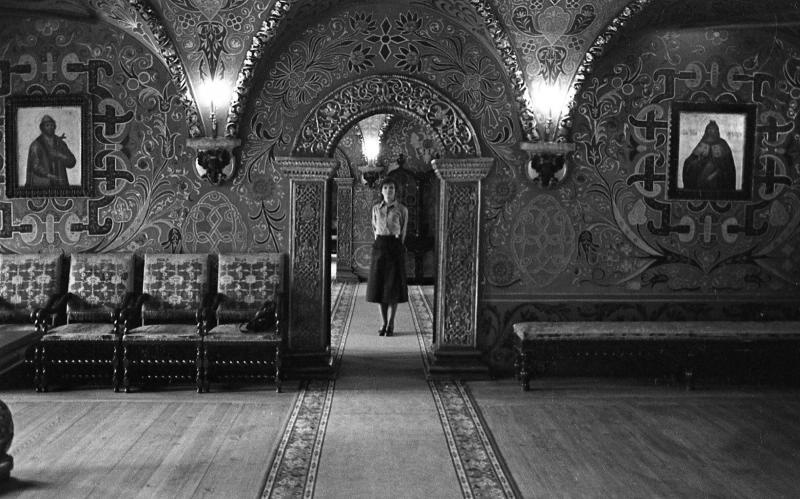
The 1976 portrait above catches Shepitko inside the ornate Terem Palace during a congress of Soviet filmmakers.[6] It would be easy to read the setting as a ready-made emblem—artist inside institution, future prizewinner framed by inherited splendor. Her films teach a more cautious way of looking. A role, a building, and a historical moment can identify a person without completing her.
Larisa Shepitko never trusted the finished hero because completion is where attention stops. She began again at the point after the medal, title, reputation, or uniform had delivered its verdict. There, with the exemplary image no longer sufficient, a person still had to choose.
Sources
- Queensland Art Gallery | Gallery of Modern Art, “Larisa Shepitko” — complete-retrospective overview covering Shepitko's training, four features, censorship history, awards, final project, and legacy.
- Michael Koresky, “Eclipse Series 11: Larisa Shepitko.” The Criterion Collection, August 11, 2008 — career essay and production context for Heat, Wings, You and I, and The Ascent.
- Kate Muir, “Wings,” in “The female gaze: 100 overlooked films by women.” Sight and Sound / British Film Institute, November 6, 2020 — Nadya's postwar role, the film's sky-and-ground contrast, and Maya Bulgakova's performance.
- Fanny Howe, “The Ascent: Out in the Cold.” The Criterion Collection, January 26, 2021 — biography, filmography, production conditions, adaptation background, and analysis of bodies, faces, landscape, and moral choice.
- Instituto Moreira Salles, “O cinema de Larisa Shepitko,” 2026 — restored-retrospective notes, film synopses, Wings interview context, You and I's form, The Ascent's award history, and the fate of Farewell.
- Russia in Photo, “Лариса Шепитько” — Yuri Sadovnikov's May 11–13, 1976 portrait at the Terem Palace, from the MAMM/MDF collection; source page for the cover image.