Oleksandr Dovzhenko's Earth is easy to misfile as either propaganda or anti-propaganda. The subject points one way: a Ukrainian village faces collectivization, a tractor arrives, old property boundaries are broken, and a young activist becomes a martyr. The images point somewhere larger and stranger. BFI calls the film a visual masterpiece in which the plot is secondary to wheatfields, fruit, sky, and weathered faces.[2] That is not a polite way of saying the story is thin. It is the key to how the movie works.
Earth turns a policy into a climate. Collectivization does not arrive as a simple argument that one character can deliver and another can refute. It arrives through machines, generational conflict, ritual, ridicule, desire, grief, and land that keeps seeming older than any slogan spoken over it. Dovzhenko Center's record places the film inside late-1920s Ukraine, where the creation of collective farms and class antagonism were the stated narrative frame, while also noting the film's "lyric pantheism" and its controversial afterlife.[1] The tension is the film's engine: Earth is about a political project, but it keeps asking whether politics can ever fully master the world it claims to reorganize.
Wheat Is Not Background
The San Francisco Silent Film Festival essay says wheat is a central character in the film, and that is exactly right.[3] Dovzhenko does not treat fields as scenery behind human decisions. Wheat bends, fills the horizon, catches light, and holds the frame with a patience that makes the people seem temporary. Before the tractor can be a symbol of progress, the crop has already established another scale of time.
That scale matters because the film's argument is never only "old village versus new machine." If it were, the tractor would simply defeat superstition and private ownership, and the film would close like a demonstration. Instead, the landscape keeps absorbing the demonstration. Faces stare out of frame. Bodies pause in ritual attitudes. Fruit and earth are handled with a seriousness that can feel religious even when the film is officially aligned with an atheist modern order. The result is not political neutrality. It is political instability rendered as style.
Dovzhenko's camera makes the land feel at once intimate and impersonal. The apple eaten before death, the sunflower face, the rippling grain, the fields crossed by mourners: these images are not detachable poetic ornaments. They make the collectivization story answer to biological and seasonal rhythms that no committee can abolish. That is why the film's most memorable passages often feel less like scenes than like weather fronts passing through human life.
The Tractor Is A Guest And An Intruder
The tractor's arrival should be the cleanest modernizing moment in the film. Metrograph summarizes the central conflict as a clash between landowning kulaks and modernizing peasants bringing the first tractor to their Ukrainian countryside.[4] In a conventional progress narrative, that machine would organize the frame. It would appear, work, and settle the argument.
But Earth makes the tractor awkward before it makes it triumphant. The famous overheating-radiator gag, described by SFSFF as one of the film's bursts of physical humor, reduces industrial modernity to bodily improvisation.[3] The machine is powerful, but it is not pure. It needs handling, fluids, laughter, embarrassment, and a crowd willing to treat technology as part of village life rather than as an abstract emblem.
That awkwardness is important. Dovzhenko is not simply mocking the tractor. He is refusing to let machinery float above the bodies that use it. The tractor can break old boundaries, but it cannot remove dependence on weather, appetite, fatigue, repair, and grief. Its wheels enter a world already dense with custom and feeling. The machine changes the village, yet the village also metabolizes the machine.
This is why Earth feels less doctrinaire than its plot outline suggests. The new order can be filmed with energy and even joy, but it never becomes frictionless. Modernization arrives as a noisy visitor at a feast already underway, not as an engineer's diagram laid over empty ground.
Faces Carry The Argument That Speech Cannot
Silent cinema often makes faces do explanatory work, but Dovzhenko uses them differently. The face in Earth is not only a substitute for dialogue. It is a site where historical pressure becomes visible before it becomes legible. BFI singles out weatherbeaten faces as part of the film's extraordinary visual power.[2] The phrase matters because these faces do not read like character psychology alone. They read like surfaces shaped by labor, sun, age, and inherited ways of seeing.
This is where the film's politics become hardest to simplify. The old peasants are not merely obstacles. The young activists are not merely icons. The bereaved are not merely private sufferers. Their faces keep producing meanings that exceed function. A look can seem comic, devotional, suspicious, ecstatic, or empty, sometimes in a single passage. Dovzhenko's montage does not always clarify those looks. It often lets them remain charged.
That charged ambiguity explains part of the film's troubled reception. Dovzhenko Center notes that Earth was banned only nine days after its cinema release and later inspired sharply different interpretations.[1] SFSFF's essay similarly says censors attacked it for "biologism" and "naturalism," because the film's natural processes seemed to compete with its political program.[3] The accusation reveals the film's strength. Earth makes class struggle visible, but it also makes birth, death, sex, crops, weather, and mourning too powerful to serve as simple decorations for class struggle.
The Funeral Refuses Closure
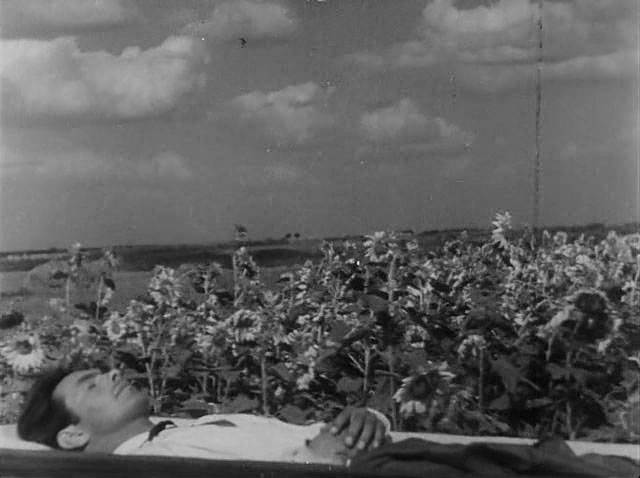
The cover image comes from Vasyl's funeral procession through sunflower fields.[5] It is the right image for this article because the funeral is where Earth most clearly refuses to separate political martyrdom from older communal forms. A body is carried through the landscape. The procession has public meaning, but it also has weight, path, rhythm, and exposure. The dead activist becomes a sign for the collective future, yet the image will not let him stop being a body among crops.
Funeral imagery usually promises closure: grief is organized, the dead are placed, the living continue. In Earth, the funeral does something more volatile. It gathers competing claims around the same body: family grief, village ritual, political meaning, religious residue, collective resolve, and the mute persistence of the fields. No single register wins cleanly. That is why the scene can feel grand and unsettled at once.
Metrograph's note captures the lasting debate around the film: whether it is a collectivization paean or, as censors suspected, a covert celebration of Ukrainian folk culture and soil-bound life threatened by erasure.[4] The most persuasive answer is that the film survives because it cannot be reduced to either side. It stages the collision so intensely that the collision becomes the subject.
That makes Earth a different kind of political film from one built around speeches, programs, or clear villains. Its deepest drama is not whether the tractor will arrive. It is whether any historical program can claim total ownership over land, bodies, memory, and death. Dovzhenko's answer is not a thesis sentence. It is a field of wheat, a machine that overheats, a face turned toward something we cannot see, and a funeral moving through sunflowers.
Why It Still Moves
Earth remains powerful because it treats cinema as the place where incompatible scales can occupy the same frame. The tractor belongs to policy time. Wheat belongs to seasonal time. Faces belong to biographical time. Funerals belong to ritual time. The state wants one story; the film keeps finding several.
That multiplicity is why calling Earth a masterpiece should not make it harmless. Dovzhenko Center calls it the most well-known Ukrainian film and a work whose images became part of world cinema's visual vocabulary.[1] The honorific is deserved, but the film should not be embalmed by it. Its images still disturb because they keep asking what happens when a political future tries to pass through a landscape full of older claims.
The answer is beautiful, comic, frightening, and unresolved. Earth makes collectivization feel like a weather system because Dovzhenko understood that historical change is never only an idea moving through people. It is pressure moving through crops, tools, faces, houses, rituals, and the dead.
Sources
- Dovzhenko Centre, "Earth / Zemlia" - film record with year, studio, credits, plot frame, censorship note, and cultural context.
- BFI, "Earth (1930)" - film page emphasizing the film's visual force, collectivization commission, Ukrainian steppe imagery, and Dovzhenko's later reception.
- Susan Gerhard, "Earth," San Francisco Silent Film Festival - program essay on wheat, the tractor sequence, VUFKU context, censorship, and the film's contested meanings.
- Metrograph, "Earth featuring an Original Score by DakhaBrakha" - screening note on the film's tractor conflict, silent-cinema status, debate over collectivization, and Dovzhenko Center DCP.
- Wikimedia Commons, "File:Earth Dovzhenko 2.jpg" - 1930 archival frame from Earth depicting Vasyl's funeral procession through sunflower fields, used as the article image.