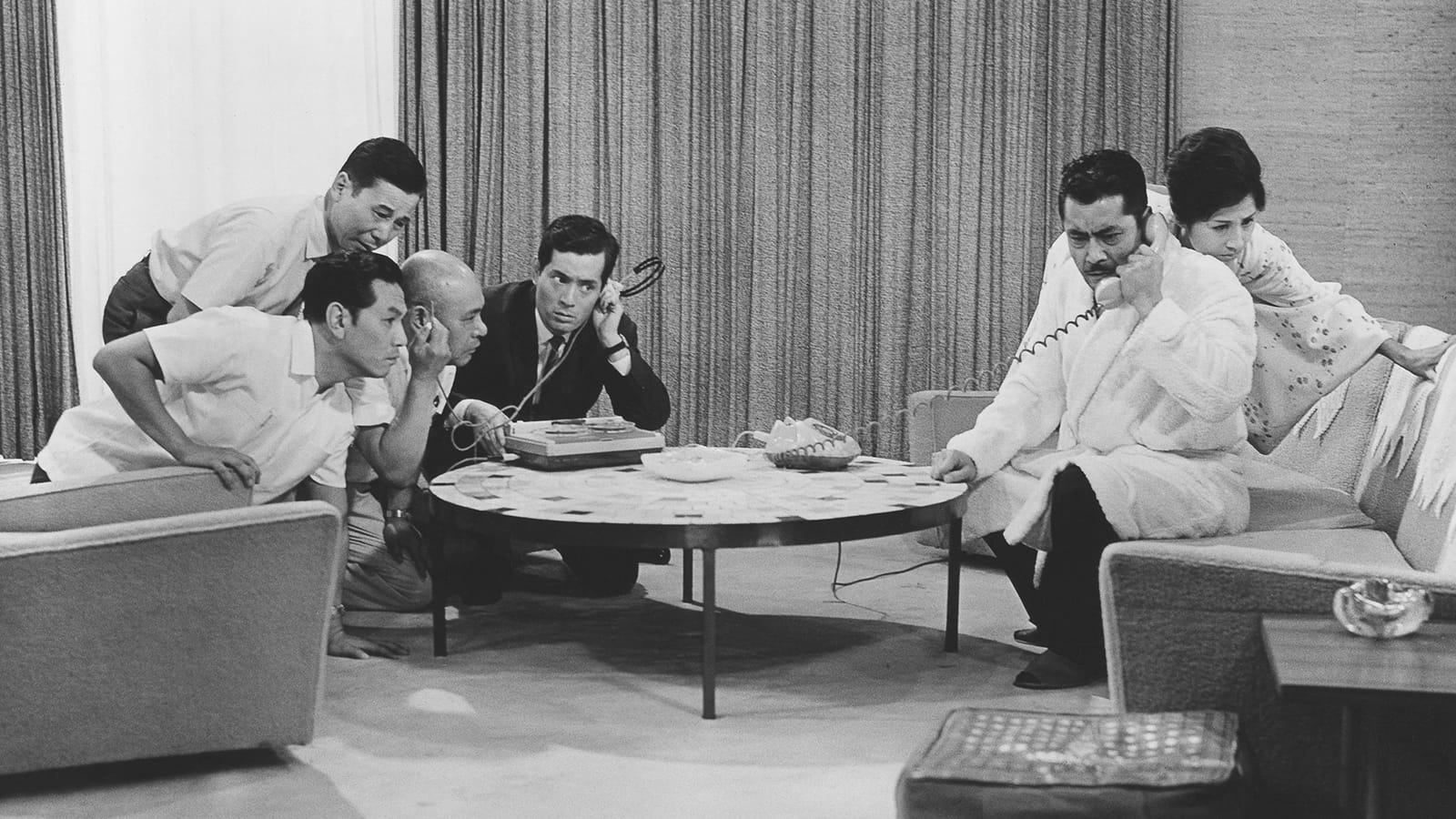
Akira Kurosawa's High and Low begins as if space itself were already guilty. Kingo Gondo's living room sits above Yokohama, furnished like a command post: broad windows, low sofas, a round table, telephones, curtains, a view that seems to promise control. Then a kidnapper calls, and the room stops being a sign of mastery. It becomes a listening device, a moral trap, and a stage on which every body has to declare where it stands.[1][3]
That is why the film's craft still feels so sharp. High and Low is often praised as a thriller, a police procedural, and a class drama, all accurately.[1][4] But its deeper achievement is spatial. Kurosawa turns the TohoScope frame into a pressure instrument: people are not simply arranged attractively in widescreen; they are sorted by obligation, shame, money, fear, and knowledge.[2][3] The plot begins with a mistaken kidnapping, adapted from Ed McBain's King's Ransom, yet the movie's real suspense comes from watching a whole social map form around a voice on the telephone.[1][2][4]
The room is edited before the cuts arrive
The first hour of High and Low is famous for holding much of the action inside Gondo's mansion, but the confinement is never static. Reverse Shot's essay notes that the film was shot in TohoScope, widening the frame while leaving the social drama organized around height: the mansion above, the city below.[3] That width matters because Kurosawa uses it as a field of changing alliances rather than as a decorative panorama. Gondo stands, sits, paces, turns away, and answers the phone while detectives and family members occupy different moral distances around him. The room becomes a diagram that keeps redrawing itself.
The production history summarized in Wikipedia's film article notes the first half's long takes, Toho Studios work, long-distance lenses, and multiple-camera method.[2] That helps explain why the scenes feel both theatrical and exactingly cinematic. The actors are not chopped into isolated reaction shots from the start. They have room to listen. A man can lean forward at the edge of the frame while another man absorbs the call from across the table. The audience reads pressure not only in close-up but in spacing.
This is the film's first major craft lesson: suspense can be built by moving attention across a group before any physical chase begins. The wide frame lets Kurosawa show several kinds of time at once. Gondo is racing the ransom demand. The police are calculating procedure. The chauffeur Aoki is living the agony of a father whose child has been taken by mistake. Gondo's wife Reiko watches the ethical cost before the men can fully convert it into strategy. The phone call does not enter an empty room. It reveals the room's hidden hierarchy.
The telephone makes distance physical
The kidnapper's voice is terrifying because it changes the mansion's architecture. From below, he can look up. From his unseen position, he can command the movements of people who thought height gave them safety. Reverse Shot is especially useful on this point because it argues that Kurosawa's widescreen compositions test the vertical binary embedded in the Japanese title: heaven and hell, high and low.[3]
The telephone is the hinge between those worlds. It does not merely deliver information. It collapses distance without removing separation. The kidnapper can enter the room as sound, but not as a body. Gondo can hear the threat, but not see the place from which it comes. The police can crouch and hide from the kidnapper's line of sight, but their expertise depends on admitting that the supposedly private interior is already visible from outside.
That is why the early mansion scenes are so different from ordinary rich-house melodrama. The room is not just a symbol of class. It is an exposed surface. Every curtain, window, and telephone line belongs to the suspense mechanism. Kurosawa turns domestic luxury into vulnerability by making the high place readable from the low place. The film's title stops being a metaphor and becomes a camera problem.
The train sequence turns procedure into motion
Once the ransom exchange moves to the bullet train, High and Low changes grammar without changing subject. The mansion made space moral by holding people in relation to one another. The train makes space moral by forcing timing to become exact. Gondo has to throw the money from a moving train through a bathroom window while police try to document what happens outside. The film's production history records the exchange as an unusually demanding multi-camera shoot, while the Guardian's 2025 review singles out the cash handover as the tense hinge between the mansion and the police investigation.[2][4]
The key point is not simply that the sequence is exciting. It is exciting because Kurosawa shifts the viewer from group pressure to procedural precision. The briefcases have been prepared. The detectives have assignments. The train's speed and windows define what is physically possible. The camera no longer studies a room full of people waiting around a phone; it studies a moving system in which a missed second could destroy the plan.
This is where High and Low earns its procedural reputation. The police work is not presented as generic competence. It is visualized as collective attention under constraint: who watches which window, who films which angle, who can interpret a glimpse, who can convert a child's memory into a route. The film's craft respects procedure because procedure is how scattered space becomes legible.
Pink smoke is the hinge between worlds
The famous burst of pink smoke is one of the great shocks in black-and-white cinema because it is not a flourish pasted onto the film. The film's production record notes that Kurosawa used color for the first time in his career in this sequence, while otherwise continuing in black and white.[2] The smoke is the moment the film descends from above to below, a visible signal that evidence has burned and the city beneath the mansion must now be entered.
The effect works because Kurosawa has spent the film training us to think spatially. The smoke is evidence, but it is also a flare from another social layer. In a lesser thriller, color might announce spectacle. Here it announces connection. The money has moved from Gondo's room to the train to the kidnapper's route to a place of disposal. The pink plume tells the police, and the viewer, that the city can finally be followed.
After that pivot, the film becomes hotter, denser, and more mobile. The investigation moves through streets, alleys, bars, medical settings, and crowded night spaces. The Guardian's account stresses the shift from Gondo's luxury home into police work and the city's lower spaces, while BFI's film record anchors the basic production identity: 1963 Japan, Kurosawa directing, Toshiro Mifune among the featured cast.[1][4] Yokohama is not background. It is the second half's main instrument, a network of surfaces where the consequences of the ransom demand become visible.
The final glass refuses explanation
Kurosawa's final confrontation between Gondo and Takeuchi strips the film down after all that movement. The room is no longer Gondo's mansion, the train, or the city. It is a prison interview space divided by glass. The production history records that Kurosawa had filmed material after the prison confrontation but cut it, leaving the ending harder and less explanatory.[2]
That restraint matters to the film's craft. High and Low has spent more than two hours making space intelligible. It has shown where people stand, where they look, how they travel, what they can see from above or below, and how evidence moves through a city. Yet the last scene refuses to convert that spatial intelligence into a neat psychological key. The glass lets the two men face each other, even reflect each other, but it does not make them knowable in the same way a route or a room can be known.[2][3]
The ending is therefore not a failure of explanation. It is the final tightening of the film's method. Kurosawa can map a city, choreograph a ransom, organize a room, and make a plume of smoke carry an entire class relation. What he will not do is pretend that one criminal motive can solve the moral pressure the film has exposed. Gondo's height, Takeuchi's resentment, the police procedure, the postwar city, the corporate plot, the child's mistaken abduction: all of these remain connected without becoming simple.
That is why High and Low still plays like a modern machine. Its suspense is not only about whether the child will live or whether the kidnapper will be caught. It is about how cinema can make relations visible: bodies around a table, a voice across a wire, money thrown from a train, smoke rising from below, faces divided by glass. The phone call fills the room, then the train, then the city. By the end, the whole film has become an anatomy of distance under pressure.
Sources
- BFI, "High and Low (1963)" film page - basic credits, cast, running time, and BFI Player listing.
- Wikipedia, "High and Low (1963 film)" - production, filming, editing, color-use, and release-context overview with citations.
- Reverse Shot, "High and Low," 2014 - TohoScope, horizontal composition, and class-geography analysis.
- Peter Bradshaw, "Stray Dog/High and Low review - Kurosawa lifts crime drama to astonishing new peaks," The Guardian, January 22, 2025.
- The Criterion Collection production image for Geoffrey O'Brien's "High and Low: Between Heaven and Hell" essay - source of the article still.