Dorothy Arzner is often introduced through the headline fact first: for much of the 1930s, she was the only woman directing feature-length studio films in Hollywood.[2][3] That matters, but it is not the most interesting thing about the work. Plenty of pioneers remain historically important without remaining cinematically alive. Arzner is different. Her films still feel active because they keep asking a hard question inside glossy genres: once a woman is visible in public, who gets to control the terms of that visibility?
The question runs through her career in different keys. In The Wild Party the issue is movement and voice; in Christopher Strong it becomes the cost of female exception; in Merrily We Go to Hell it becomes the hypocrisy of modern marriage; in Dance, Girl, Dance it becomes performance for an audience that assumes the performer exists for its appetite.[2][3][5][6] The settings change from college dormitories to drawing rooms to backstage corridors and burlesque houses, yet the structural pressure keeps returning. Arzner looks at rooms designed to discipline women, then studies what happens when women talk, work, desire, or improvise too vividly inside them.
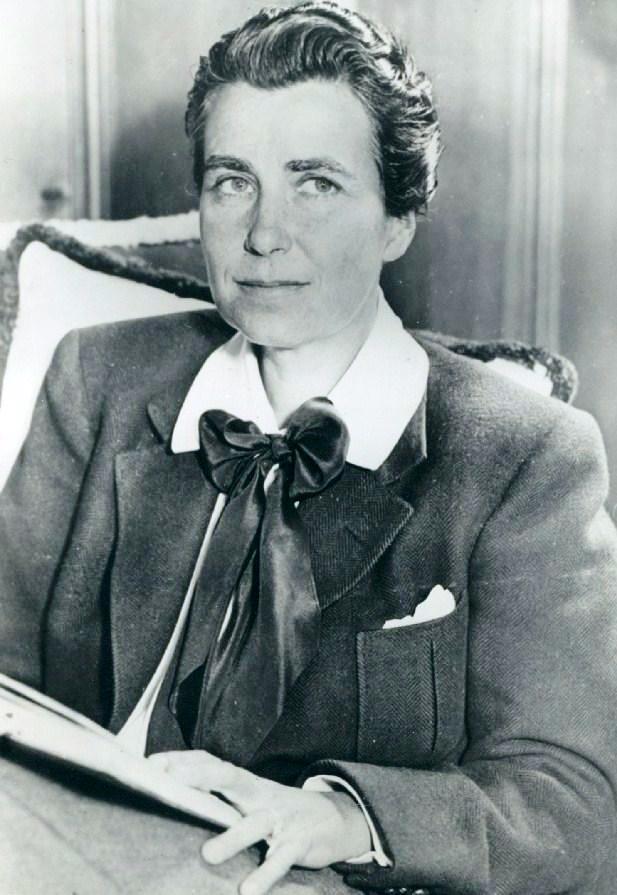
Image context: the lead image uses a 1934 publicity portrait of Arzner from Wikimedia Commons. It fits this essay because a director profile about Arzner should show an actual archival image of the filmmaker herself, not a symbolic substitute. The portrait catches the poise that her films keep redistributing to actresses: not softness, not spectacle, but command under observation.[1]
She came up through editing, which is why her authority always looks earned
One reason Arzner's films feel so unsentimental is that she did not arrive in the director's chair through genteel myth. She came up through work. Senses of Cinema and Britannica both trace her path from typist to screenwriter and editor at Paramount, with Blood and Sand marked as an early demonstration of technical ingenuity and practical value.[3][4] BFI makes the same point in shorter form: her editing on Blood and Sand established a reputation for efficiency and economy before she forced the studio to let her direct.[2]
That trajectory matters because Arzner's movies rarely romanticize inspiration. They are unusually alert to labor, leverage, and the small forms of competence that change who has room to maneuver. Even when the plots are melodramatic, the deeper texture is procedural. Somebody must hold the household together, command the stage, survive the party, keep the relationship legible, or continue working while the social terms turn unstable. Arzner understood systems from the inside, and her characters often look like people learning exactly how much freedom a system will grant before it calls that freedom improper.
This is also why her career should not be reduced to an anecdote about exceptional access. Senses of Cinema argues that her body of work remains central to several film histories at once: the studio system, genre filmmaking, sound technology, stardom, and the representation of women in mainstream Hollywood.[4] That seems right. The point is not merely that she "made it" in a hostile industry. The point is that she left formal fingerprints across several of the industry's key operating languages.
The microphone matters because Arzner wanted women to move like people, not furniture
The most famous example is technical, but it matters because the technical decision reshaped performance. When Paramount moved into sound, Arzner directed The Wild Party and had a microphone rigged to a fishing rod so Clara Bow could move more freely, a solution widely credited as the first boom mike.[2][3][4] The anecdote survives because it is charmingly ingenious, but it is more than a trivia item. It reveals Arzner's instinct in one stroke.
Early sound threatened to make actors static. Arzner's answer was not to accept stiffness as the price of technological progress. It was to alter the technology so that performance could breathe again.[2][3] In practical terms, that gave Bow mobility. In artistic terms, it aligned perfectly with Arzner's larger interest in women who need room to exceed the script written for them. BFI's reading of The Wild Party is especially useful here: the film takes a conventional flapper setup and shifts emphasis toward women's friendships, freedom, and the social pressures around them rather than treating heterosexual romance as the only real story.[2]
That pattern would hold. Arzner's films do not simply place women at the center and stop there. They keep testing the machinery around that centrality. Who speaks first? Who is interrupted? Who is being watched? Who must become legible to men in order to survive, and who tries to invent another audience?
Her rooms are pressure chambers where female autonomy gets negotiated in public
Arzner's reputation sometimes gets flattened into a simple label like "feminist pioneer," which is true but not sufficient. What gives the films their bite is that they almost never imagine liberation as pure escape. They are fascinated by structures that women still have to inhabit. Criterion's essay on Dance, Girl, Dance notes that Arzner's cinema repeatedly returns to grim views of marriage and complex female friendships, while its Merrily We Go to Hell page describes that film as a frank, early-feminist commentary on modern marriage, female sexual liberation, and the petty cruelties under high-society elegance.[5][6]
That combination is characteristic. Arzner does not oppose respectable domestic life with a simple fantasy of freedom elsewhere. She keeps showing how the room itself is already political. Marriage, rehearsal, stardom, and romance all arrive as staging problems. A woman is given a position, a costume, a script, a household duty, an audience, a lover, or a social role. Then Arzner watches how she inhabits it: compliantly, strategically, bitterly, theatrically, or with some unstable mixture of all four.
Britannica's capsule on Christopher Strong gets at one important branch of this pattern by calling it a visually absorbing portrait of a woman living outside societal conventions.[3] That phrase helps because Arzner rarely treats unconventional women as abstract symbols of progress. They remain burdened by class, desire, work, spectacle, and consequence. Their independence is real, but so is the scrutiny that follows it.
In Arzner's films, women are not just looked at; they know they are being looked at
This may be Arzner's most modern trait. She does not merely depict women as objects of attention. She keeps dramatizing their consciousness of attention. Criterion's essay on Dance, Girl, Dance describes Judy's famous speech to the burlesque audience as a moment that exposes the dirty secret of looking itself: the looked-at know what is happening, and they may have their own feelings about the exchange.[5] That observation could stand as a compact theory of Arzner's cinema.
Her women are often performers in the broadest sense. Some are literal entertainers; others perform marriage, competence, glamour, propriety, or emotional steadiness. Arzner is interested in the strain of maintaining such performances under unequal conditions. The men in these films are not always monsters, and the institutions are not always crudely villainous. That restraint is part of what makes the work sharper. Power is often exercised through expectation, arrangement, and ordinary social grammar rather than through melodramatic proclamation.
The female relationships matter here too. Criterion points out that Dance, Girl, Dance became even more woman-centered when Arzner turned the troupe leader into the female figure of Madame, pushing the story further away from romance as the only organizing line.[5] Senses of Cinema similarly reads Dance, Girl, Dance as paradigmatic of Arzner's larger preoccupation with women, performance, class mobility, and the tension between opposite-sex and same-sex relational worlds.[4] Arzner's films keep asking whether women can build a usable social space with one another inside institutions designed to rank them, sell them, or divide them.
Why Arzner still feels contemporary
Arzner's afterlife is not just a matter of justice, though justice is part of it. It is also a matter of recognition. BFI calls her a technical and thematic visionary whose legacy remains embedded in filmmaking fundamentals, while Senses of Cinema stresses how long she was ignored by standard histories despite the range of her achievement.[2][4] When her films feel contemporary now, it is because they anticipated several arguments that later criticism would make more explicit: that the camera is implicated in social power, that female labor and female friendship deserve narrative seriousness, and that public performance can be both a route to agency and a mechanism of capture.
What lasts, finally, is her refusal to confuse visibility with freedom. Arzner knew that entering the frame was only the beginning.[2][4][5][6] The real struggle came after that: how to move, how to speak, how to hold dignity, and how to alter the room before the room closed over you again. That is why her career matters beyond the milestone language. Dorothy Arzner did not only prove that a woman could direct in classical Hollywood. She showed that the talking picture could become a place where women heard themselves think in public.
Sources
- Wikimedia Commons, "File:Dorothy Arzner.jpg" - 1934 publicity portrait file page and metadata.
- Caroline Cassin, "Where to begin with Dorothy Arzner," BFI, January 29, 2024.
- Britannica Editors, "Dorothy Arzner," Encyclopaedia Britannica.
- Theresa L. Geller, "Arzner, Dorothy," Senses of Cinema, May 2003.
- Christina Newland, "Dance, Girl, Dance: Gotta Dance," The Criterion Collection, June 16, 2020.
- The Criterion Collection, "Merrily We Go to Hell (1932)" - film page and essay links.