Spoiler note: this article discusses the film's ending.
Ousmane Sembène's Black Girl is only about an hour long, but it feels larger than many epics because it understands captivity as an arrangement of rooms, objects, names, and glances.[1][2][4] The plot can be stated very simply: Diouana, a young Senegalese woman from Dakar, travels to the French Riviera to work for the white French family that previously employed her in Senegal; the promised new life contracts into housework, humiliation, isolation, and death.[2][3] The film's force comes from the way Sembène refuses to let that simplicity become thin. Every object in the apartment acquires political weight. Every polite sentence carries a history of ownership. Every silence is divided between what is imposed on Diouana and what she withholds.
That is why a close reading of Black Girl has to begin with its surfaces.[3][4] Sembène, already a novelist before turning to film, made cinema into a tool that could reach viewers beyond the literate public of books.[5] In his first feature, he does not announce that mission through speechmaking. He places a mask on a wall, an apron over a dress, and a young woman inside a Riviera apartment that looks comfortable to its owners and carceral to her. The film's politics are not hidden under the images. They are arranged through the images.
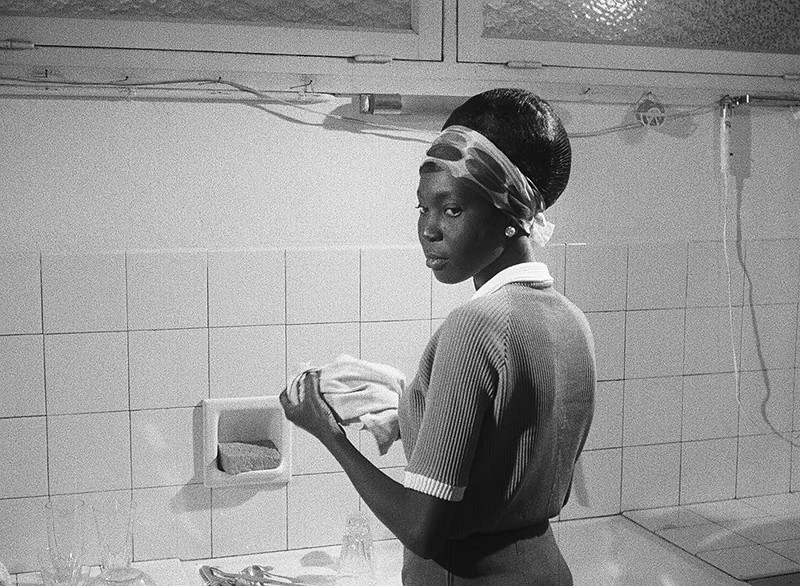
Image context: the cover uses a still of Mbissine Thérèse Diop as Diouana from Black Girl. It fits this essay because Diop's face and dress carry the film's central tension: Diouana is constantly looked at, renamed, ordered, dressed down, and enclosed, yet the image keeps her opacity intact. She never becomes only the role her employers assign her.[3][6]
The title already contains the trap
The English title Black Girl is blunt, but the French title, La Noire de..., is even more disturbing because it leaves a hinge open.[3][4] BFI's Sarah Jilani notes that the phrase points toward the language of domestic service, while Ashley Clark's Criterion essay stresses the ambiguity of the preposition: Diouana can be read as the Black girl "from" somewhere, or as the Black girl "of" someone.[3][4] That ellipsis is not a decorative flourish. It is the grammar of the whole film.
Diouana's tragedy begins in that grammar. In Dakar, the job seems like a route outward. She is young, stylish, alert to the social meaning of being chosen by a French household, and alive to the envy and excitement that the job can produce around her.[3] The film does not flatten that hope into naivete. Sembène allows Diouana's desire for travel, modernity, clothes, and recognition to remain vivid. The damage arrives because the arrangement already contains a concealed claim of possession. Once she reaches France, the "from" is stripped away and the "of" takes over.
The apartment makes that transfer spatial. In Dakar, Diouana moves through streets, courtyards, and social relations. In Antibes, she is reduced to an interior function.[2][3] The Riviera outside the windows becomes almost insulting: brightness, leisure, and sea air exist nearby, but they do not become access. The promise of France shrinks to a kitchen, a table, a bedroom, and a door she does not meaningfully control.
The apron is a small costume with a large violence
One of the film's sharpest objects is the apron. Madame does not merely ask Diouana to work; she insists on covering Diouana's self-presentation. The dress matters because Criterion's production notes point out that many of Diouana's clothes were Diop's own, made by the actor herself while she was studying dressmaking.[5] That fact gives the screen costumes unusual force. They are not generic prettiness. They belong to the character's claim on herself, and to the actor's labor as well as her image.
When the apron is placed over the dress, class and race are made visible in a single gesture.[3] Diouana's employers want service, but they also want a certain kind of service: legible, quiet, and visually subordinated. The apron says that her body may remain in the room only if the room can define what the body means. It turns a worker into a sign of work, then expects that sign to be grateful.
Sembène's framing keeps this violence plain.[3][4] He does not need a melodramatic confrontation to show the shift. The apartment's surfaces do the explaining. White walls, polished furniture, table settings, doors, and the recurring domestic tasks build a social order that pretends to be private. The home is not outside politics. It is where postcolonial hierarchy finds a smaller, more deniable stage.
That is also why Diop's performance is so devastating.[1][3] BFI's film page singles out the underplayed quality of the performance, and the word matters. Diouana is not written or acted as a continuous cry of pain. She watches, waits, remembers, hardens, and recedes. The less the employers understand her, the more the film's attention belongs to her. Sembène makes misrecognition visible without surrendering Diouana to it.
The voice-over turns silence into divided territory
The film's silence is often discussed as Diouana's imposed condition, and rightly so.[3][4] In the French apartment, she is spoken around, instructed, consumed by dinner guests as an object of racial curiosity, and denied ordinary conversation. Yet Black Girl complicates that silence through voice-over. We hear Diouana's interior life even as the household treats her as mute labor.
This creates one of the film's most painful divisions. The employers occupy the audible space of command, complaint, and patronizing sociability. Diouana's voice occupies memory, reflection, and inward resistance. The film therefore gives viewers access without granting the employers access. Her interior speech does not rescue her materially, but it prevents the household's version of her from becoming the film's version.
Ashley Clark's essay notes the colonial weight of language in the film's French voice-over, a production compromise that gains dramatic meaning because Diouana must articulate inwardness through a language marked by colonial power.[3] The result is not a clean liberation of voice. It is a more unsettled sound design: speech can disclose a self, and it can also bear the pressure of the system that has constrained that self.
The dinner-table scenes sharpen this pressure.[3] Guests discuss Africans in Diouana's presence as though she were furniture with ears, and one man violates her physically under the cover of convivial curiosity. Sembène films these moments with a terrible absence of spectacle. The horror is in the blankness, in how ordinary the room allows itself to feel. The apartment does not need chains to function as captivity. It needs employers, guests, habits, and the social confidence that none of this will be named accurately.
The mask returns the gaze to its owners
The African mask is one of the film's most charged visual objects.[2][3] At first, it seems to sit inside the French apartment as decoration, a sign that the employers can take an African object and convert it into tasteful atmosphere. Like Diouana herself, it is displaced, displayed, and expected to confirm the owners' sophistication. Sembène understands the violence of that display because the mask's meaning has been severed from its social ground.
Yet the mask does not remain obedient. By the end, when it is returned to Dakar and carried by a child, the image changes direction.[2][3] The object that had hung as colonial decor becomes a mobile witness. It follows Monsieur with a quiet severity that the French apartment had tried to suppress. The final pursuit does not operate like revenge in a conventional thriller. It is closer to a reversal of looking. The man who helped turn Diouana into a function must now be seen by the world from which she came.
This is the film's most concise act of form. Sembène lets an object travel through systems of meaning: gift, trophy, decor, evidence, witness, accusation. The mask gathers the film's argument without reducing it to a slogan. It says that possession changes objects, but objects can also expose possession. What the apartment thought it owned returns as a gaze it cannot domesticate.
The smallness is the scale
Part of Black Girl's continuing power lies in its refusal to inflate itself.[1][2] The film runs about 59 or 60 minutes depending on the listing, in black and white, with a 1.37:1 frame and a small central cast.[1][2] Those constraints do not make the work modest in effect. They make it exact. Sembène's cinema begins here by finding the world in a job contract, a dress, a wall object, a table, a voice-over, and a room by the sea.
The broader historical claims around the film are substantial: BFI places it high in the 2022 Sight and Sound critics' poll, Criterion presents it as an essential 1960s film, and BFI's introduction to Sembène situates it at the dawn of post-independence African cinema after colonial restrictions on filmmaking.[1][2][4] Those claims matter, but the film itself earns them through intimacy. It does not ask viewers to admire importance from a distance. It makes importance unbearably near.
That nearness is why the ending still hurts. Diouana's death is not framed as an abstract symbol first. It is the last movement of a person whose available spaces have been narrowed until the self has nowhere livable to stand.[3][5] The film's final images then refuse to let the employers keep the story sealed inside their apartment. The mask moves. The child follows. The gaze returns. In Sembène's hands, a small film becomes a system of moral pressure, and every surface that once seemed domestic begins to testify.[2][3][4]
Sources
- BFI, "Black Girl (1965)" film page, including credits, running time, poll context, and critical notes.
- The Criterion Collection, "Black Girl (1966)" film page, including restoration notes, credits, aspect ratio, language, and edition context.
- Ashley Clark, "Black Girl: Self, Possessed," The Criterion Collection, January 24, 2017.
- Tega Okiti, "Where to begin with Ousmane Sembène," BFI, August 8, 2023.
- Curtis Tsui, "10 Things I Learned: Black Girl," The Criterion Collection, January 25, 2017.
- Wikimedia Commons, "Mbissine Thérèse Diop as Diouana.jpg," source file and image metadata.