Sergei Parajanov's The Color of Pomegranates is easiest to misread when it is treated as a difficult biopic with the connecting tissue removed. The film does follow the eighteenth-century Armenian ashugh Sayat-Nova from childhood toward artistic, erotic, monastic, and mortal thresholds, but it does not behave like a life story arranged around incidents.[1][3][5] Its real subject is more radical: what if a poet's biography could be built from the materials that made poetry possible, from books, cloth, fruit, water, stone, ritual, costume, and repeated faces?
That is why the film's strangeness feels so disciplined. Criterion describes it as a set of tableaux that revive Armenian culture through iconographic compositions instead of traditional narrative, while BFI notes that Parajanov rejected a conventional telling in favor of visualizing Sayat-Nova's poetry through ritual, surreal happenings, and medieval allegory.[1][3] The plot has not vanished. It has been converted into objects. The viewer is not asked to chase causality from scene to scene so much as to watch meaning gather around things until they begin to carry emotional history.
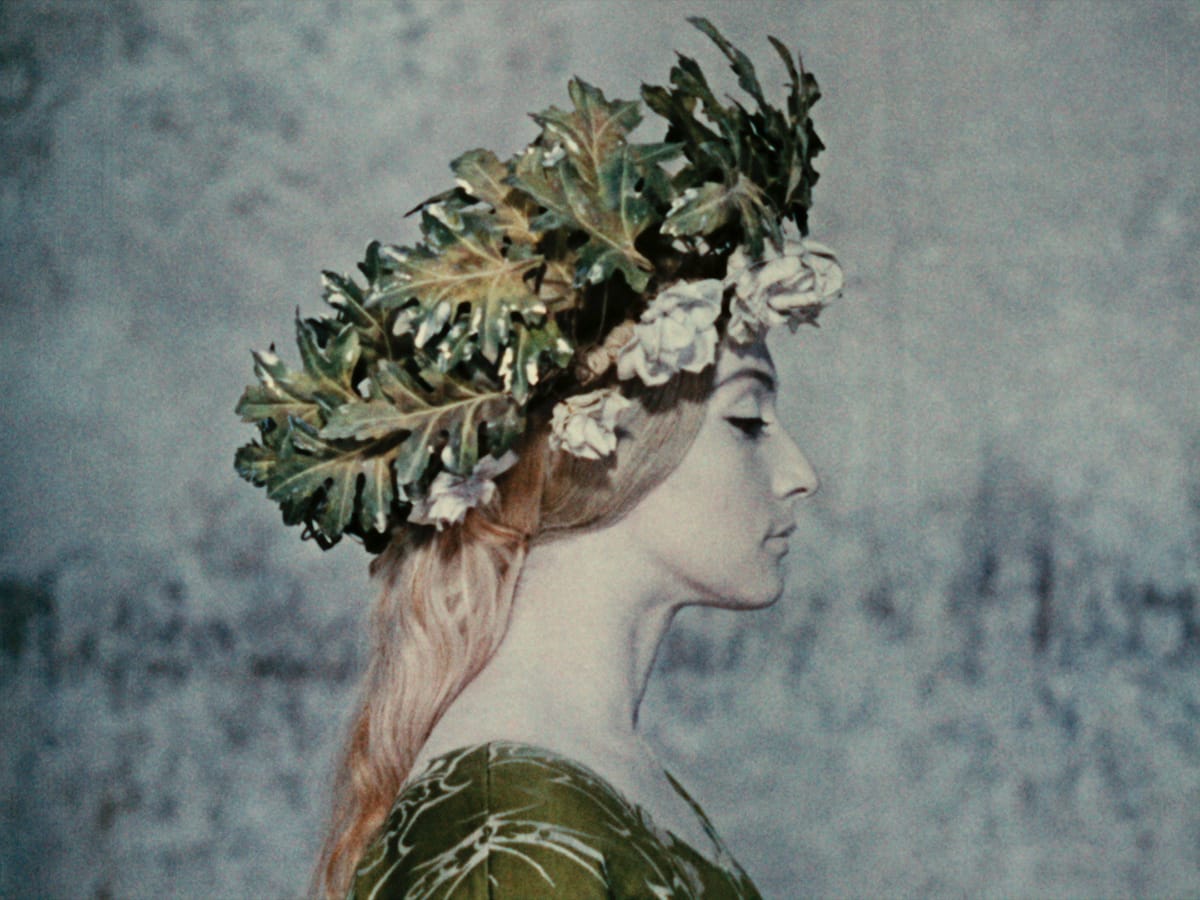
Image context: the lead image uses a Criterion official still from the film. It is the right recognition image because the article's argument depends on the film's exact visual grammar: a face held in profile, costume treated as symbolic material, and the frame organized like a devotional object rather than like a window onto action.[1]
The pomegranate is not a symbol to decode once
The title object sets the terms of attention. Pomegranates in the film are never merely decorative, and they are never reduced to one clean meaning.[2][5] Ian Christie's Criterion essay begins with the opening's ancient book, translated verse, and pomegranates staining white cloth, then places those images inside Parajanov's attempt to explore the poet's inner world rather than narrate his career from the outside.[2] That distinction matters. A conventional biopic uses objects to illustrate a person. Parajanov uses objects to create the conditions in which a person can be felt.
The pomegranate therefore behaves less like a clue than like a pressure source. It is fruit, blood, color, fertility, wound, Armenia, poetry, and screen surface at once. If the viewer tries to settle it into one definition, the film keeps moving. Cloth absorbs juice; books are washed, stacked, and aired; bodies appear among materials as if people were another kind of crafted surface.[2][3] The result is an art of saturation. Meaning does not arrive through explanation. It accumulates through recurrence.
This is also why the film remains vivid even when a viewer misses particular Armenian or Christian references. The references matter, but Parajanov's method does not collapse without instant decoding. The film teaches a slower mode of looking: notice how weight, color, texture, and gesture repeat; notice how an object returns altered by context; notice how a pomegranate can be both itself and a whole field of feeling.
Frontal tableaux turn time into arrangement
The film's frontal compositions are sometimes described as static, but that word can make them sound inert. They are better understood as arrangements under pressure.[1][3][4] Criterion lists the film's 1.37:1 frame, color format, and central cast, but the important craft fact is how insistently Parajanov turns that frame into a shallow stage for symbolic relation.[1] People do not simply enter rooms and act out scenes. They are placed beside textiles, books, animals, musical instruments, walls, thresholds, and church spaces until the frame itself becomes the unit of thought.
BFI's account of the film's production history helps explain the boldness of that choice. After Shadows of Our Forgotten Ancestors, Parajanov was commissioned by Armenfilm to make a film about Sayat-Nova, but the finished work moved so far from Soviet realist expectation that authorities recut and restricted it.[3] The formal confrontation is visible on-screen. This is a film about a cultural figure that refuses the expected state-approved grammar of legible progress, public achievement, and explanatory psychology. It answers with icon, ritual, and texture.
The stillness is therefore active. It asks the viewer to compare elements inside the frame rather than wait for a cut to explain them. A book is not background to a reader; it is a body being handled. Cloth is not costume alone; it is history worn, folded, washed, and displayed. A face is not only character; it is a surface where gender, role, memory, and spiritual state can pass through one actor's changing presence.
Sofiko Chiaureli makes identity multiple without making it vague
Sofiko Chiaureli's multiple roles are one of the film's strongest ways of refusing ordinary biographical certainty. Criterion's cast listing identifies her not as one stable character but as the poet as a young man, the beloved, the nun in white lace, the angel of ascension, and the mimes.[1] Christie's essay makes the same point critically, noting how Parajanov's use of Chiaureli in several androgynous roles gives the film a strange anticipatory power.[2]
That casting choice is not a puzzle box. It is the film's theory of poetic selfhood. The poet is not isolated from the figures he loves, imagines, fears, or sanctifies. They return through the same face because the film is less interested in separating biography from image than in showing how an artist's inner world is populated. Desire, devotion, memory, and artistic identity are not neatly assigned to different people. They overlap, exchange costumes, and reappear under new ritual pressure.
This is where The Color of Pomegranates becomes more emotionally direct than its reputation suggests. The film may withhold ordinary dramatic explanation, but it is not cold. It simply locates feeling somewhere else. A face held still can carry more instability than a speech. A costume change can matter like a psychological turn. A repeated profile can make the poet's life feel less like a line and more like a chamber where images keep answering one another.
Restoration matters because the film thinks in surfaces
The restoration history is not a side issue for this film. Criterion notes that the edition features the cut closest to Parajanov's original vision and a 4K restoration by The Film Foundation's World Cinema Project and Cineteca di Bologna, with Armenian and Russian source elements involved.[1] The Film Foundation's World Cinema Project gives the technical frame more fully: the restoration used the original camera negative preserved at Gosfilmofond, a 35mm dupe negative held by the National Cinema Centre of Armenia, original magnetic track materials, an Armenian reference print, and a vintage Harvard Film Archive print as a color-grading reference.[5]
That matters because The Color of Pomegranates thinks in surfaces. If color weakens, if texture flattens, if the relation between fabric, skin, fruit, stone, and painted wall becomes muddy, the film loses not polish but grammar. Its meanings are carried by exactly the things restoration protects. This is not a case where a damaged image merely makes a story harder to see. Here, the image is the story's method.
Parajanov's great invention was to make biography less like a record and more like a set of charged materials held in ritual order.[2][3][5] The film does not tell us that Sayat-Nova became a poet by moving through a sequence of explanatory incidents. It lets us feel a poetic life forming around contact: the wet book, the stained cloth, the crown of leaves, the instrument, the stone cell, the repeated face. The ordinary biopic asks what happened next. The Color of Pomegranates asks what kind of image could make a life inwardly true.
Sources
- The Criterion Collection, "The Color of Pomegranates" film page, with film data, cast/credits, official stills, edition notes, and restoration summary.
- Ian Christie, "The Color of Pomegranates: Parajanov Unbound," The Criterion Collection (2018).
- BFI, "The Colour of Pomegranates (1968)" film page, with production context, synopsis, poll placement, and release history note.
- Carmen Gray, "Where to begin with Sergei Parajanov," BFI (2018).
- The Film Foundation, World Cinema Project listing for Sayat Nova / The Color of Pomegranates, with restoration notes and production details.