Steadicam is often remembered through a handful of famous images: Rocky climbing the Philadelphia Museum of Art steps, David Carradine moving through a Depression-era crowd in Bound for Glory, Danny Torrance pedaling through the Overlook Hotel, a camera gliding at child height where a dolly could not comfortably live.[1][3][4] Those moments are useful entry points, but they can make the invention sound like a bag of memorable shots. Its deeper importance is industrial. Garrett Brown did not simply invent a smoother handheld look. He gave production a new category between handheld, dolly, crane, and vehicle mount.
That category changed what a director could ask of a set. Before Steadicam, smooth camera movement usually needed infrastructure: track, floor preparation, cranes, dollies, grips, time, and a path that equipment could physically occupy. Handheld shooting could go almost anywhere, but it carried the tremor and urgency of a body holding a camera directly. Brown's invention separated those two properties. A shot could now walk like a person while looking as if it had been engineered by a machine.[1][3] The important word is not only "smooth." It is "portable."
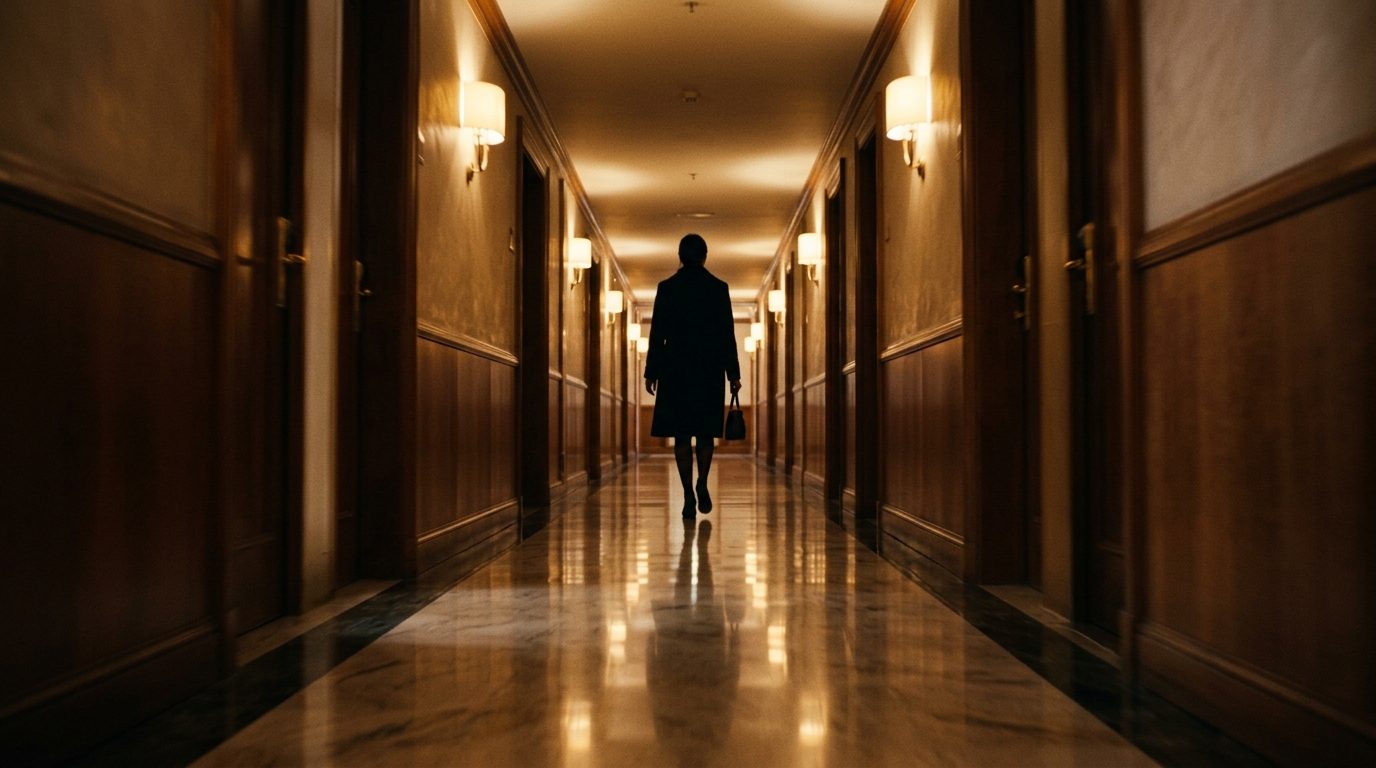
Image context: the corridor image favors felt motion over equipment documentation. That is appropriate for a technology report whose argument is that Steadicam changed how viewers move through rooms, thresholds, and bodies in space, not merely how a rig looks on set.[1]
The rig solved a production problem before it became a style
Tiffen's history of the device describes Brown's early-1970s problem plainly: he wanted the clarity of a moving camera without the restrictions of track, crane, or car.[1] That origin matters because it keeps the Steadicam from being reduced to a romantic auteur tool. It began as a practical answer to a physical contradiction. Filmmakers wanted movement through real spaces; cameras were heavy; bodies shake; track takes time; and not every location can be rebuilt around equipment.
The solution was not to eliminate the operator, but to redesign the operator's relation to the camera. The vest moved weight from arms to torso. The articulated arm absorbed shocks and supported the load. The sled separated lens, monitor, battery, and counterweight into a balanced system. A gimbal allowed small guiding movements while isolating the camera from the operator's steps. The result let the camera move with a person while refusing to reproduce every bump of that person's body.[1][3]
This is why Brown's later institutional recognition is more than a line in an honors list. The National Inventors Hall of Fame profile identifies Steadicam with U.S. Patent No. 4,017,168, notes Brown's 2013 induction, and records his 1978 Academy Award of Merit for the device.[2] The pattern is useful because it treats the achievement as both concept and engineering. Brown's idea needed industrial conversion: buildable hardware, repeatable operation, camera compatibility, and enough reliability for productions with money and schedules on the line.
The early uptake shows how quickly filmmakers understood the difference. Tiffen notes that Steadicam made its feature debut on Bound for Glory, rose to prominence with Rocky and The Shining, and became tied to shots that would have been difficult to imagine with ordinary equipment paths.[1] The technology's first lesson was not that every shot should float. It was that movement could be planned around dramatic behavior rather than around where track could be hidden.
The body became infrastructure
The most radical part of Steadicam is that it does not pretend the human operator has disappeared. It disciplines the body instead. In a dolly shot, the body often sits outside the visible grammar, pushing or riding the machine. In handheld work, the body announces itself through vibration, reaction, and limited endurance. With Steadicam, the body becomes a moving platform whose traces are filtered rather than erased.
That distinction helps explain why the device changed so many kinds of scenes. A corridor can become a psychological tunnel because the camera can travel at walking speed while keeping a controlled line. A crowd can be entered without turning into newsreel shake. A stairway can become an athletic and emotional ascent without making the camera's motion look as strained as the runner's body.[1] The camera gains access to human-scale routes, but it keeps the authority of a designed shot.
The USPTO's 2020 interview page ties Brown's famous The Shining work to patent number 4,017,168, a reminder that the cinema language here grew from a concrete mechanical invention.[3] That matters because Steadicam often gets discussed as if it were a mood. It is really a negotiated piece of engineering. The shot can feel ghostly, jubilant, predatory, intimate, or documentary-like depending on blocking, lens height, speed, and framing discipline. The rig supplies a possibility, not a meaning.
The possibility was especially strong in spaces that could not be solved cleanly by old support systems. Hotel corridors, apartment halls, market aisles, backstage passages, sidewalks, hospital wards, and stadium tunnels all gained a new film grammar. They no longer had to be broken into static coverage or made artificially dolly-friendly. They could be traversed.
The Shining turned a support tool into architectural psychology
If Rocky made Steadicam feel liberating, The Shining made it feel diagnostic. BFI's film page treats the Steadicam glides as part of the film's new way of seeing, not as a detachable technical flourish.[5] That summary is brief, but it points to the central reason the device mattered there: the hotel is not just a setting. It is a system the camera has to test by moving through it.
The American Society of Cinematographers' republication of Brown's account is even more revealing. Brown explains that Kubrick had seen a 1974 demonstration film of the prototype and that the Overlook sets were designed with Steadicam possibilities in mind; he also notes that the hedge maze could not have been photographed as Kubrick wanted by any other means.[4] This is the moment when Steadicam stops being a clever add-on and becomes a planning principle. A set can be designed differently because the camera can move differently.
Low-mode operation sharpened that change. Tiffen's account of Brown's Shining work describes how Kubrick's questions helped push the Model II setup toward a configuration that could place the lens closer to the floor.[4] The result is not only technical novelty. It lets the camera share Danny's scale without becoming childish or chaotic. The tricycle shots are terrifying because they combine innocence of height with unnatural steadiness. The image moves like a child; the framing watches like something else.
That double feeling is the signature Steadicam paradox. The camera is embodied and disembodied at once. It can follow a character closely without fully belonging to that character's subjectivity. It can glide through a space without the social bulk of a dolly. In The Shining, that makes the hotel feel less explored than patrolled. The camera does not simply accompany fear. It gives fear an operating method.[4][5]
Freedom created a new discipline
New camera tools often get sold as liberation, but their best use usually depends on restraint. Steadicam is a perfect example. Because it can move through so many spaces, it tempts filmmakers toward empty glide: the shot that advertises access without adding dramatic information. The strongest uses do the opposite. They make movement accountable to a room, a body, a decision, or a pressure that could not be carried as well by a static setup.
That is why the early examples remain so instructive. In Bound for Glory, the crane-to-ground movement does not merely show off a continuous path; it changes social scale, descending into a crowd and then joining a human route through it.[1] In Rocky, the stair movement is athletic but also civic, turning a city landmark into a measure of bodily effort.[1] In The Shining, the corridor glide converts architecture into threat.[4][5] The common denominator is not smoothness. It is that smoothness is put under narrative obligation.
The technology also created a labor identity. A Steadicam shot is not only a camera choice; it is an operator performance, with posture, timing, horizon control, framing correction, focus coordination, and endurance built into the result. Brown's later importance as teacher and practitioner follows naturally from that fact.[1][4] The rig made the operator more visible inside the production process, even when the best shot makes the apparatus vanish from the audience's conscious attention.
That labor dimension is one reason Steadicam still matters in a world crowded with gimbals, drones, stabilized sensors, remote heads, and virtual production tools. Modern devices can make smooth motion cheap and small. They do not automatically reproduce the Steadicam contract: a heavy camera system carried by a trained body that can improvise through a real space while preserving a composed frame. The older tool remains valuable because it gives movement mass, intention, and human timing.
The lasting change was grammatical
The film-industry story of Steadicam is therefore not a simple replacement story. It did not make dollies obsolete, kill handheld work, or turn every moving shot into a floating shot. It widened the grammar. A director could now choose whether a scene needed track-bound certainty, handheld shock, crane-like reveal, or a walking system that could move with bodies while retaining composure.
That choice changed how films imagine space. Corridors became routes rather than connectors. Stairs became shootable transitions rather than logistical irritants. Crowds became enterable fields. Large sets could be designed around camera travel instead of merely photographed from approved angles.[4] The invention's real legacy lies in that planning freedom: the camera path could now be conceived as a bodily action and an engineered line at the same time.
The best Steadicam shots still feel slightly uncanny because they preserve that contradiction. They move as if a person is present, but not quite as a person sees. They float, but with weight. They enter rooms, but do not ask the room to flatten itself for machinery. Brown's invention made walking into a cinematography system, and cinema has been borrowing that gait ever since.
Sources
- The Tiffen Company, "The History of Steadicam," covering Garrett Brown's invention, early prototype work, Bound for Glory, Rocky, and later film uses.
- National Inventors Hall of Fame, "Garrett W. Brown," inductee profile for the Steadicam camera stabilizer, patent number, film examples, and awards.
- United States Patent and Trademark Office, "The Shining and the Steadicam: an interview with inventor Garrett Brown," patent and interview page.
- American Society of Cinematographers, "The Steadicam and The Shining Revisited," revised Garrett Brown account originally published in American Cinematographer.
- British Film Institute, "The Shining (1980)" film page, including Sight and Sound poll notes on the film's Steadicam glides and atmosphere.