Night of the Living Dead is often treated as the point where the modern zombie movie begins, but its sharper achievement is more formal than taxonomic. George A. Romero did not simply add flesh-eating ghouls to horror. He made horror feel as if it had crossed over into local television, emergency management, domestic argument, and public violence while the viewer was still trying to classify what kind of movie this was.[1][2][3] The result is a genre transition that happens in real time.
The film begins with enough old-horror residue to look almost familiar. A brother and sister arrive at a cemetery; Johnny teases Barbra in a mock-spooky voice; a strange man approaches from the background.[3] Then the movie sheds that familiarity with brutal speed. Barbra's flight from the graveyard to the farmhouse is not just a movement across Pennsylvania terrain. It is a movement out of inherited Gothic play and into a harsher modern system: boarded windows, improvised tools, arguments over authority, radio bulletins, television updates, and no stable explanation that can make the night manageable.[3][5]
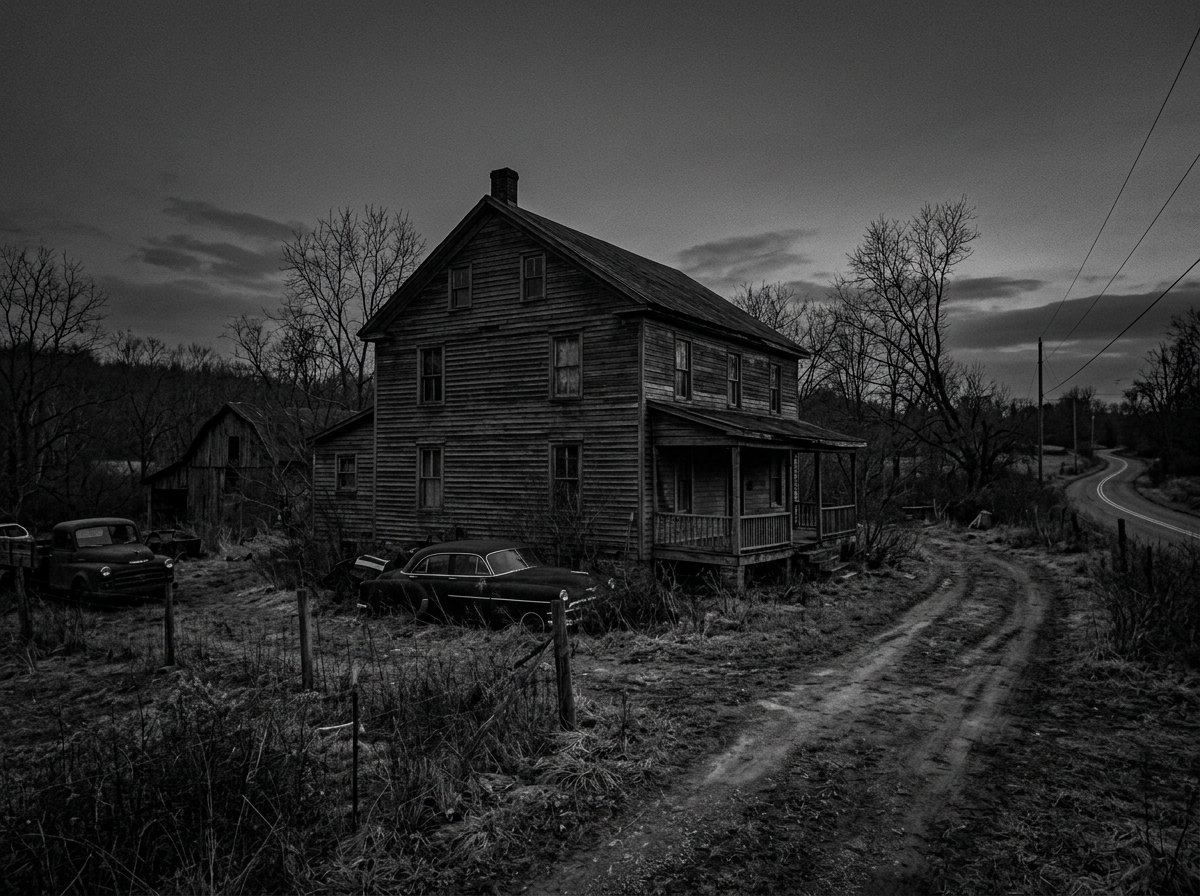
That is why the farmhouse matters so much. It is not a haunted house in the classic sense. It is a crisis room that happens to be built from poor rural wood, furniture, nails, and basement doors. Criterion's edition notes the film's shoestring Pittsburgh origins, its independent production story, its 96-minute black-and-white form, and its later 4K restoration from original materials supervised by Romero and key collaborators.[1] Those facts support a larger reading: the film's roughness is not a defect to smooth away. It is the condition that lets apocalypse feel close to the ground.
The monster arrives as a public event
Older horror often gives the monster a privileged place: castle, laboratory, crypt, jungle, forbidden room. Romero's ghouls do not belong to one privileged site.[1][3] They arrive in a cemetery, move through fields, gather around a farmhouse, appear in broadcast descriptions, and finally become part of a countryside cleanup operation. The monster has become a public event, and public events require media.
The television and radio material is therefore not decorative exposition. It changes the film's genre texture. The survivors do not learn the situation from a wise specialist who enters the story and restores order. They receive updates in fragments, with officials offering provisional theories and practical instructions while the evidence keeps outrunning language.[2][5] The Library of Congress National Film Registry essay is useful here because it stresses the film's refusal of settled vocabulary: the attackers are not comfortably named "zombies" inside the film's world, and the common language of "things" and "ghouls" shows people trying to name a reality that is arriving faster than comprehension.[5]
That naming failure gives the film its newsreel charge. The catastrophe is not mythic at first. It is procedural and baffling. What is happening? Where is it happening? Who is in charge? What should ordinary people do next? Every broadcast seems to promise that the event is being made legible, then proves how thin that promise is. By the time the explanation points toward space-probe radiation, the cause hardly matters. The important fact is that official language has become another unstable object inside the room.[2][5]
The farmhouse is a political machine before it is a shelter
The boarded-up house looks practical, but it quickly becomes a machine for producing social conflict. Ben wants to secure the main floor and maintain mobility. Harry Cooper wants the cellar. Barbra is nearly immobilized by shock. Tom and Judy are pulled between optimism, loyalty, and bad timing. The siege does not unify them for long because the house keeps turning survival into jurisdiction.[1][2][5]
That conflict is why the film's casting of Duane Jones as Ben still changes the temperature of every room. Criterion emphasizes the film's importance in quietly breaking ground by placing a Black actor in the lead role, while BFI notes Romero's account that Jones was not chosen to make an explicit racial thesis; he was the strongest actor for the part.[1][3] The distinction matters. The movie does not need characters to discuss race for racial pressure to enter the frame. A Black man takes command in a white rural household while social order outside is collapsing, and the film lets that situation remain charged without converting it into explanatory dialogue.
This is also why Ben's competence cannot save the film from despair. In another survival picture, his practical intelligence would anchor the group and earn final recognition. Romero withholds that genre comfort. Ben becomes the person most capable of reading the immediate crisis, yet the larger social system still misreads him when it matters most.[2][5] The ending is not powerful because it suddenly adds politics to a neutral monster movie. It is powerful because the film has already trained us to see recognition itself as broken: people misrecognize the dead, misrecognize the living, misrecognize authority, and misrecognize what kind of story they are inside.
Modern horror starts when explanation stops helping
BFI's "big-bang" reading is persuasive because it sees the opening as a passage from classic horror into modern horror, not merely as an example of a new monster design.[3] The cemetery still carries the traces of old genre ritual. The farmhouse absorbs influences from survival drama, domestic melodrama, social-problem film, science fiction, and television disaster coverage.[2][3] The film's innovation is the way these modes fail to stabilize one another.
That failure is the real modernizing force. Horror no longer depends on a hidden monster being revealed. The monster is visible early, often awkwardly visible, and sometimes almost mundane. What becomes terrifying is the collapse of interpretive systems around it. Family roles do not hold. Civil-defense language does not hold. Scientific explanation does not hold. The armed posse at the end can destroy bodies, but it cannot restore moral clarity.[2][5]
The Film Foundation's restoration article makes a useful preservation point that doubles as a formal point: the restored version does not make the movie slick; it recovers the sharp black-and-white contrasts and documentary-style realism that poor public-domain copies often blurred or crushed.[4] That matters because Night of the Living Dead needs its grain, glare, smoke, and low-budget bluntness. A cleaner-looking object is not the same as a more polished one. The film's power depends on the sense that the camera is close to an event nobody has had time to aestheticize fully.
The ghouls are frightening, but the deeper movement is from theatrical fright to social panic. Romero's rural night makes horror portable. It can enter through the cemetery, the field, the kitchen, the basement, the broadcast signal, the news conference, the rescue line, and the final photographic stills. That portability is what later zombie cinema inherited most forcefully: not just the walking dead, but the idea that catastrophe becomes modern when it travels through systems people trust to explain, protect, and record them.[1][2][3][4][5]
Sources
- The Criterion Collection, "Night of the Living Dead" film page, with film data, cast/credits, official stills, restoration notes, and edition details.
- Stuart Klawans, "Night of the Living Dead: Mere Anarchy Is Loosed," The Criterion Collection (2018).
- Jon Towlson, "Why Night of the Living Dead was a big-bang moment for horror movies," BFI (2018).
- Glenn Kenny, "'Night of the Living Dead': Zombies Restored to Their Full Beauty," The Film Foundation (2018), on the MoMA/Film Foundation restoration.
- Jim Trombetta, "Night of the Living Dead," Library of Congress National Film Registry essay PDF.