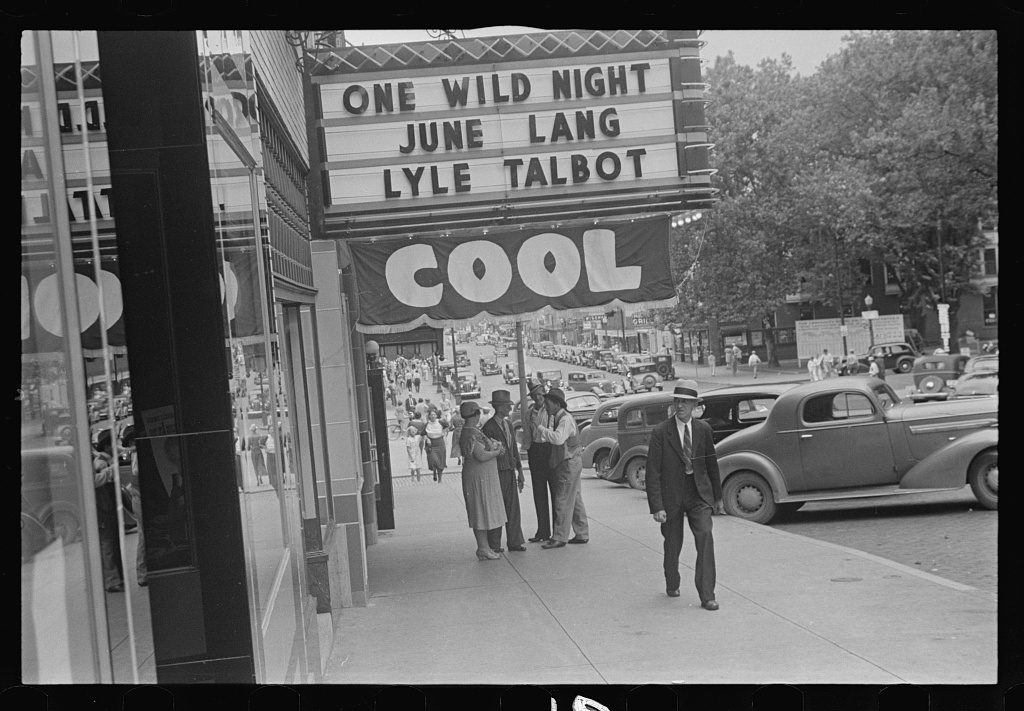
The marquee says ONE WILD NIGHT. Below it are the names June Lang and Lyle Talbot; below that, a fabric banner promises COOL. Cars edge around the curb while pedestrians pass under the sign. In Ben Shahn's 1938 photograph, probably made near Lancaster, Ohio, the business of movies has been compressed into one visible offer: this picture, these stars, this air-conditioned room.[7]
The contract behind the offer could be much less singular. A theater that wanted one desirable feature might license it inside a block of pictures from the same distributor, sometimes before every title in the block had been completed or inspected. The film on the marquee had its own cast, audience and playdate. On paper, however, it could be carrying part of a season.
That is the industrial intelligence—and the competitive danger—of block booking. It gave theaters a steady supply of rapidly changing programs and let distributors sell an annual output without negotiating every title from zero. It also let a company use demand for one picture to secure a market for others. The practice was neither merely a warehouse trick for dumping bad movies nor an innocent volume discount. It was a distribution system that solved a real coordination problem by deciding who would bear uncertainty, and who possessed enough leverage to make the decision stick.[1][3][4]
A theater bought time before it bought titles
Film distribution did not move cleanly from chaos to a single studio-era method. Historian Derek Long describes an unstable field of pricing, packaging, local marketing and playdate control. Around 1918, distributors moved away from yearlong programs toward selling films individually; the resulting strain helped produce a hybrid. Studios could market and price pictures as distinct attractions while still selling their output wholesale through blocks.[1]
The quantity problem was genuine. A theater that changed its bill every few days could consume an extraordinary number of films. Economist F. Andrew Hanssen estimates that some exhibitors needed 200 or more pictures a year and argues that bulk contracts could reduce direct selling costs while securing a predictable flow of product.[3] A distributor, meanwhile, needed outlets not only for the exceptional production that justified a giant marquee but for the ordinary pictures that kept stages, crews, exchanges and release calendars moving.
The block converted those complementary needs into one contract. Instead of repeatedly searching, pitching and bargaining, a distributor could place a substantial part of its line; an exhibitor could fill weeks of screen time. This is why the practice cannot be understood only from the viewpoint of an audience choosing a movie. The industrial customer was choosing inventory and dates under uncertainty.
Three terms are easy to collapse and should be kept apart. A double bill is what an audience sees: two features on one program. Blind selling means committing before a film can be inspected, often because it is unfinished. Block booking is the licensing condition that joins multiple films. A block could later furnish a double bill, and it could be sold blind, but neither feature defines it. The crucial question is whether access to one title depends on accepting another.[2][4]
The hit became collateral for the line
Imagine a distributor announcing a season around a star vehicle, an expensive prestige production or a sequel with an audience already waiting. The desired picture gives the sales conversation urgency. Once it anchors a block, some of that demand spreads contractually to films whose appeal is unknown or plainly weaker. The hit has become collateral for the line.
That leverage was especially powerful inside classical Hollywood's vertically integrated structure. Five defendants in the Paramount litigation—Paramount, Loew's, RKO, Warner Bros. and Twentieth Century-Fox—combined production and distribution with theater ownership or control; Columbia and Universal produced and distributed without comparable exhibition arms, while United Artists distributed.[4] A major could therefore coordinate a slate from lot to exchange to affiliated screen. An independent exhibitor bargaining for first-run attractions met not just a supplier of individual artworks but an organized pipeline.
The later federal-court account of the system notes that, in the 1930s and 1940s, block clauses appeared in many theatrical licenses and first-run houses were often asked to take a distributor's entire seasonal output.[5] That did not mean every theater signed the same rigid deal. Long explicitly warns against treating block booking as one monolithic arrangement, and the surviving record shows negotiation inside the package.[1]
A proposed industry policy reproduced in the Federal Trade Commission's 1928 annual report is revealing. It would have let an exhibitor reject as much as 10 percent of a block by paying half the allocated price for each rejected picture; if the distributor resold one of those films, part of the resale proceeds could be credited back. It also separated reissues, newsreels and shorts from new-feature blocks.[2] Those provisions are not evidence that power was equal. They are evidence that both sides understood the pressure points: unwanted inventory, unseen content and the cost of escape.
The most accurate picture is therefore a contract with two faces. From the production side, it stabilized volume and lowered sales friction. From the theater side, it could guarantee supply and reduce search. But when a must-have film was available only inside the package, the efficiency claim changed character. The bundle no longer merely served a buyer who wanted quantity; it constrained a buyer who wanted to compare titles one by one.[3][4]
The Supreme Court separated grouping from coercion
The United States filed its antitrust case in 1938. A decade later, the Supreme Court defined block booking as licensing one feature or group on condition that the exhibitor also license another. It upheld the restriction on that practice in United States v. Paramount Pictures.[4]
The Court's reasoning treated each copyrighted film as a distinct product whose reward should follow its own appeal. If a coveted picture could be licensed only with an inferior one, the weaker title borrowed market power from the stronger. Even a package of equally attractive films expanded the market for each title by making the others conditions of access. That prevented exhibitors from bidding on individual pictures on their individual merits.[4]
Just as important is what the opinion did not say. It did not prohibit every multi-film license. Voluntary blocks and groups could continue. The illegal boundary was a distributor's refusal to license one or more films unless the exhibitor accepted another. In practical terms, the Court separated quantity from coercion: “I want twenty titles under one agreement” was not the same transaction as “you cannot have this title unless you take nineteen more.”[4]
Block booking was only one part of the Paramount case. The litigation also addressed price fixing, circuit-wide licensing, discriminatory terms, clearances and the power created when major producers and distributors controlled theaters. The resulting decrees forced structural separation for the integrated defendants and imposed film-by-film, theater-by-theater rules on the companies they covered.[4][5] The familiar story that the decision simply “broke up the studios” is directionally useful but industrially incomplete. It changed the contract as well as the ownership chart.
The package survived the movie palace
The legal issue did not end when Hollywood sold its theater chains. In 1962, United States v. Loew's applied the block-booking principle to packages of older feature films licensed for television. Broadcasters seeking particular titles had been required to take other films from the same libraries. The Supreme Court treated that condition as the same vice in a new delivery system.[6]
That afterlife clarifies what the doctrine was about. The problem was not the architecture of a single-screen palace, nor the presence of a physical print traveling from exchange to booth. It was the use of one work's demand to force acceptance of another. Change the downstream buyer from an exhibitor to a television station and the contract could still perform the same transfer of leverage.[6]
The comparison also keeps us from confusing block booking with any modern catalog. A streaming subscription, for example, is a bundle offered to a viewer, while classical block booking governed licenses between a distributor and an exhibitor. The markets, bargaining positions and legal tests differ. What persists is a strategic question that Long calls the tension between idiosyncratic and programmatic distribution: should individual hits be sold as individual events, or should their appeal support a larger group of works?[1]
The decrees ended; the distinction did not
On August 7, 2020, a federal district court terminated the Paramount decrees, leaving their block-booking and circuit-dealing provisions in place for a two-year transition. Those decree-specific provisions expired on August 7, 2022. The order pointed to a transformed market: multiplexes, many viewing platforms, different theater ownership and antitrust doctrine that no longer treated every such restraint through the same automatic rule.[5]
That expiration did not announce that future block booking would necessarily be lawful. It removed a perpetual, defendant-specific categorical ban; subsequent conduct falls under general, fact-specific antitrust analysis. The court said the government and courts retained tools to examine competitive threats as they arose. The end of the decrees did not turn every possible package into a safe harbor.[5]
This is where the history remains useful. “Bundles are efficient” and “bundles can carry market power” are not rival slogans from which one must be chosen. Both can be true in the same contract. The revealing questions are narrower: Did the buyer want volume? Could it reject titles? Were films available individually on workable terms? Did one scarce attraction determine access to screens? Who absorbed the cost when a forecast failed?
Return to Shahn's photograph. The marquee makes cinema look beautifully particular. One title occupies the street; two actors' names hang above the sidewalk; a passerby can decide whether to enter. Block booking belonged to the less visible calendar behind that moment. It treated movies simultaneously as singular attractions and as a season's inventory.
That double identity made the system productive. It also made the hit carry more than its own audience. The antitrust line drawn in 1948 was not that films must never travel together. It was that one film should not become the tollgate through which all the others are forced.
Sources
- Derek Long, “Q&A with Playing the Percentages author Derek Long.” University of Texas Press, March 29, 2024 — distribution as pricing, packaging and booking; the shift from yearlong programs; block booking as a wholesale hybrid; and the individual-versus-programmatic tension.
- Federal Trade Commission, Annual Report of the Federal Trade Commission for the Fiscal Year Ended June 30, 1928, pp. 7–8 — proposed block-contract safeguards, the 10 percent rejection provision and separation of feature, reissue, newsreel and short-subject blocks.
- F. Andrew Hanssen, “The Block Booking of Films Reexamined.” Journal of Law and Economics 43, no. 2 (2000), pp. 395–426 — quantity demand, selling-cost rationale, contract flexibility and the economic debate over block booking; open manuscript hosted by NYU Stern.
- Supreme Court of the United States, United States v. Paramount Pictures, Inc., 334 U.S. 131 (1948) — defendant structure, definition of block booking, copyright-tying analysis, distinction between voluntary groups and conditional licensing, and related distribution practices.
- U.S. District Court for the Southern District of New York, “Order Terminating Antitrust Judgments,” United States v. Paramount Pictures, Inc. and Loew's Incorporated, August 7, 2020 — historical licensing system, changed market and legal framework, decree termination, and two-year sunset for block booking and circuit dealing.
- Supreme Court of the United States, United States v. Loew's Inc., 371 U.S. 38 (1962) — application of the block-booking rule to packages of pre-1948 feature films licensed for television.
- Wikimedia Commons, “Street scene showing movie theater, probably in the vicinity of Lancaster, Ohio” — 1938 Ben Shahn photograph from the U.S. Farm Security Administration / Library of Congress, and source record for the article image.