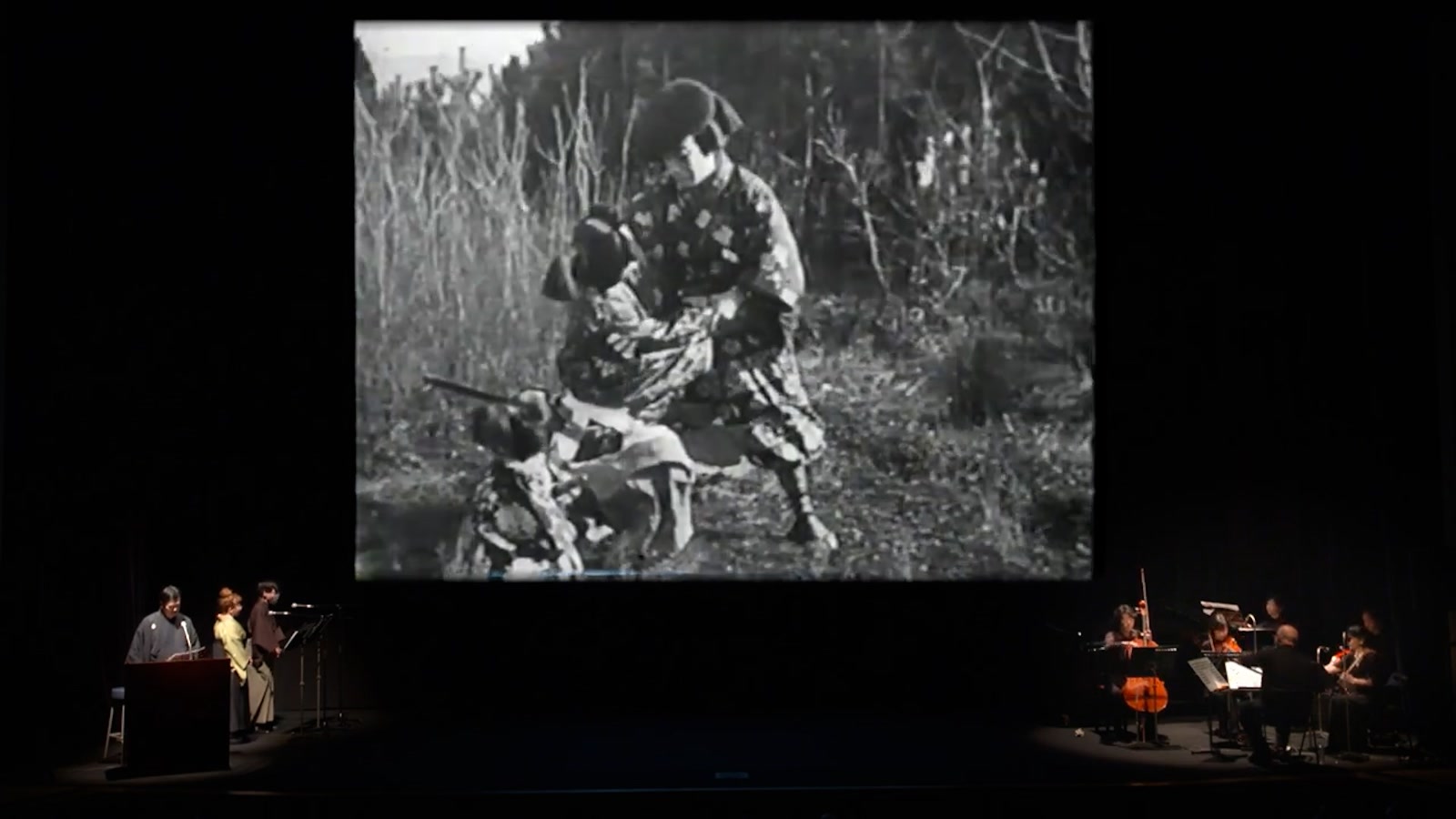
At a Japanese picture house in the late 1920s, the screen was not the only place from which a movie spoke. A performer stood near it, giving the action a pulse, lending distinct voices to characters, explaining a foreign custom, or deciding how long a silence should remain open. Musicians listened as carefully as spectators did. This performer was the benshi, and a popular benshi could be a reason to choose one theater over another even when several venues were showing the same film.[1][3]
Calling the benshi a “narrator” is accurate but too modest. Narration sounds like a service added after the important creative choices have been made. The benshi could instead become the most immediate authorial presence in the room: named in publicity, reviewed as a performer, followed by fans, and trusted to turn photographed gestures into motive, dialogue, mood, and argument. The film supplied images; the benshi claimed the right to say what those images were doing.
That divided authority is the form's most revealing legacy. The benshi was not simply an ingenious solution to cinema before recorded dialogue. Benshi culture exposed a question that synchronized sound would later make easier to ignore: does a movie's meaning belong to the object on the reel, or to the encounter in which an audience receives it?
Before the film could speak for itself
Motion pictures arrived in Japan in 1896 as both attraction and puzzle. In the medium's first decade, performers often gave a maesetsu, an introduction delivered before projection. Foreign imports required more than plot summary; images of unfamiliar places, manners, and objects could be explained as part of the show. As films grew longer and more narrative, explanation moved into the screening itself and developed into setsumei, the benshi's art of live interpretation.[1]
There was no single fixed method. Some Japanese productions used kowairo setsumei, with several performers positioned offstage and voicing separate characters—a kind of live dubbing before a recording carried speech. Foreign films were more often handled by a solo benshi, who moved among exposition, commentary, and character voices. These approaches influenced one another until solo performance became dominant.[1]
The working conditions make clear that this was neither casual improvisation nor genteel accompaniment. Dym's history describes large theaters, often seating about a thousand people, in which benshi projected without microphones. A performer might work four or five shows a day while a program changed every week. Music had to yield space to speech, then return without making the show feel mechanically divided.[1] The resulting authority was physical before it was intellectual: a voice had to command a dark room.
That voice also gave spectators a conspicuous human point of entry. The camera might have photographed an event years earlier and an ocean away, but the benshi occupied the audience's time and language. Cinema's industrial object met a local body. The star beside the screen could be more present than the stars inside it.
A co-author, not an audio track
It is tempting to compare the benshi with a soundtrack because both provide words and vocal character. The comparison conceals the crucial difference. A soundtrack cannot notice the room. It cannot acquire a reputation independent of the print, adjust emphasis through performance, or make the same succession of images feel comic at one theater and solemn at another. A benshi could.
This did not mean unlimited freedom. Performers worked within house styles, scripts, genre conventions, musical coordination, commercial schedules, and eventually state rules. Yet constraint does not cancel authorship. Actors follow scripts; editors work with footage they did not shoot. The benshi's creative material was the relation among image, language, and audience.
Tokugawa Musei became one of the era's emblematic stars because that relation could produce a recognizable personal art. UCLA's archival account describes leading benshi as highly paid celebrities with distinctive performance styles, while film journals and advertisements made their names part of the attraction.[3] The billing quietly redrew the movie's borders. Authorship no longer ended with the director, studio, or finished reel; it extended to the person who publicly interpreted the work each night.
This is why the benshi should not be romanticized as a naturally democratic voice rescuing spectators from a fixed text. Interpretive power can open meaning, but it can also steer it. During the Russo-Japanese War, benshi accompanied actualities and staged battle recreations with fiercely nationalist commentary.[1] In 1917, authorities introduced licensing and sought to turn benshi into supervised public educators.[3] The same proximity that allowed a performer to make an imported image intelligible also made the voice beside the screen useful to propaganda and regulation.
Nor was the form contained neatly within Japan. Benshi performed in colonial settings and in Japanese immigrant communities, including Los Angeles, so the spoken mediation of film traveled through unequal imperial circuits as well as diasporic ones.[5] “Local voice” is therefore not a synonym for innocent voice. It names a position of power: the person who can tell a room what an image means.
The struggle to put authority inside the image
The Pure Film Movement, active roughly from 1915 to 1925, attacked practices its advocates considered obstacles to a modern cinematic art, including theatrical staging, male performers in women's roles, and dependence on benshi. Reformers wanted screenplays, editing, performance, and camera placement to make the film intelligible without an external speaker. In that view, needing a benshi was evidence that the film had failed to become fully cinematic.[1][2]
But the conflict was not simply Western technology defeating Japanese tradition. Aaron Gerow's study of the debate shows that defining the benshi was bound up with a larger effort to define the film text, its author, its audience, and the institutions entitled to regulate them.[2] To demand that a movie “speak for itself” is also to decide where legitimate speech may originate.
The reform campaign's outcome was correspondingly untidy. It helped erode the long prefatory maesetsu and group kowairo practice, yet solo setsumei survived and entered its celebrated late-1920s form.[1] The attack on benshi did not immediately remove the speaking body from the theater. It reorganized that body, narrowing the acceptable performance while cinema's industries strengthened the idea of a coherent work authored before exhibition.
This paradox matters because it prevents an easy technological fable. A medium does not become mature merely by discarding live explanation. It becomes institutionally different when it moves control over explanation from one place to another.
What the talkie fixed
Recorded sound did more than add audible dialogue. It relocated the authoritative voice. Speech could now be synchronized by producers, carried with the film, repeated across venues, and preserved as part of the work. The gain was enormous: precise relations among voice, gesture, music, noise, and cut no longer depended on recreating them at every performance. The tradeoff was that one of cinema's most visible acts of interpretation disappeared into the object.
Benshi resisted that transition, and the practice continued with diminishing frequency into the sound era.[3] Their decline should not be told as a contest in which voice lost to voice. One kind of voice lost jurisdiction to another. The spoken word moved from beside the screen to inside the film's technical and legal boundaries.
That transfer also changed spectatorship. A patron listening to a famous benshi knew that interpretation had a face and could compare one performer's choices with another's. Recorded dialogue makes its own mediation feel natural: this is simply what the character said; this is simply how the scene sounds. The benshi made the labor of assigning meaning impossible to miss.
The voice returns, without pretending to restore the past
The art survives through performers trained in lineages that reach back toward the silent era, and through institutions that treat performance materials as part of film history rather than as disposable atmosphere.[3] Hamilton College's digital benshi archive gathers scripts, theater programs, fan-ranking charts, and synchronized examples of historical and contemporary narration.[4] Those materials preserve evidence of authorship that a surviving print alone cannot contain.
Contemporary presentations make the distinction tangible. A 2019 UCLA program and a larger 2024 tour placed benshi and musicians before restored Japanese and American silent films, sometimes reviving the multi-voice kowairo form.[3][5] The photograph above matters because it refuses the visual hierarchy of a conventional screening: the performers are not hidden equipment. They stand under the projected image as an alternate source of attention.
No revival can reproduce a particular audience, theater economy, political climate, or performer's authority from 1928. That is not its task. A new performance demonstrates the historical principle without claiming to recover an unrecoverable event: a film can be finished as an industrial object and still remain incomplete as an encounter.
The benshi made film authorship audible because they stood where interpretation could be seen. Their rise showed that images did not automatically command a room; their regulation showed why institutions wanted to control the voice that did; and their decline helped make a movie seem like a self-contained work whose authority traveled inside it. The screen did not become silent when the benshi disappeared. It became better at hiding who was speaking.
Sources
- Jeffrey A. Dym, Benshi, Japanese Silent Film Narrators, and Their Forgotten Narrative Art of Setsumei (Edwin Mellen Press, 2003) — book-length history of maesetsu, setsumei, performance styles, labor conditions, stardom, reform, and wartime commentary.
- Aaron Andrew Gerow, “The Benshi's New Face: Defining Cinema in Taishō Japan,” Iconics 3 (1994), pp. 69–86 — scholarly analysis of how debates over benshi helped define cinematic authorship, textual authority, and institutional power.
- UCLA Film & Television Archive, “The Art of the Benshi” (2019) — institutional history of benshi performance, celebrity, licensing, resistance to recorded sound, and contemporary apprenticeship.
- Hamilton College Library & Information Technology Services, “Benshi: Silent Film Narrators in Japan” — overview of the digital archive's scripts, programs, fan ephemera, audio-video records, and theater reconstruction.
- Sean Brenner, “‘Art of the Benshi’ tour will showcase century-old Japanese film tradition,” UCLA Humanities (February 1, 2024) — history of the form's geographic reach, modern tour, multi-voice performance, and source page for the 2019 Los Angeles photograph.