Gillo Pontecorvo's The Battle of Algiers is often praised for looking like history caught in the act.[1][2][3] That description is useful, but it can also be too flattering in the wrong way, as if the film's achievement were simply that it resembles documentary evidence. The deeper achievement is more engineered. Pontecorvo does not merely imitate the visual authority of newsreels; he builds a pressure system out of crowds, checkpoints, stairways, raids, and percussion until the city itself seems to think tactically.[1][2][4]
That is why the film still feels so urgent nearly sixty years after its 1966 release.[1][3][5] Its grainy black-and-white surfaces, nonprofessional performers, and original locations are not there to provide neutral realism. They are there to make every movement look provisional, overheard, and exposed. A body crossing a street does not feel like scenic background. It feels like information in transit. A crowd does not feel like scale for its own sake. It feels like a population being routed, searched, recruited, or watched.
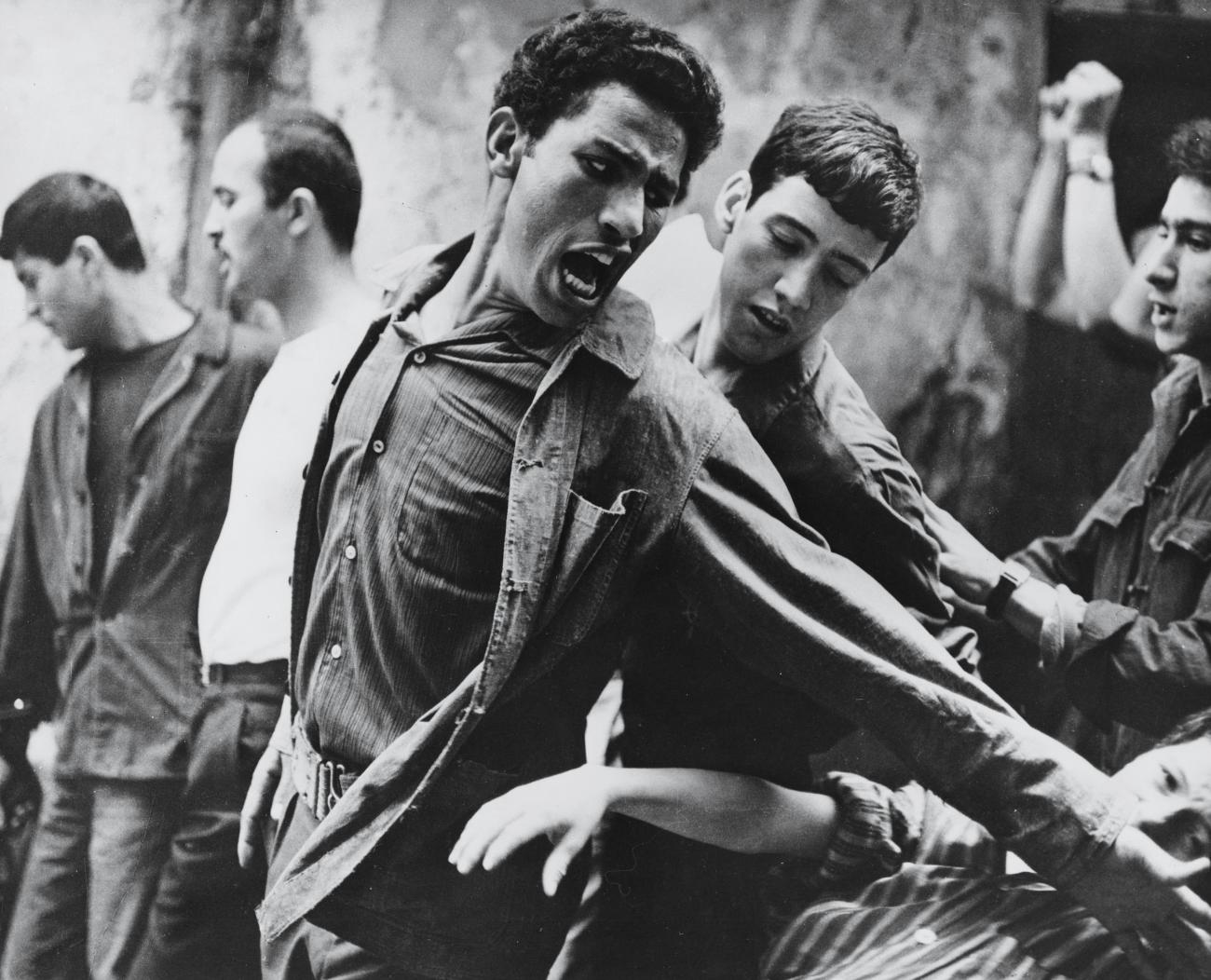
Image context: the cover uses a BFI still from The Battle of Algiers showing a Casbah crowd turning through a constricted street. That is the right recognition image for this essay because Pontecorvo's central formal insight is collective rather than individual: even when Ali La Pointe or Colonel Mathieu dominates a scene, the movie keeps making walls, alleys, queues, and human flow do as much dramatic work as any single face.[1][2]
The false-newsreel look works because it is a production method, not a filter
Pontecorvo's famous "documentary" surface came from deliberate craft choices rather than spontaneous roughness.[2][3][4] BFI notes that he tested cinematographers for a month, used multiple cameras to enlarge the apparent scale of street action, marked pavements with chalk to guide movement in riot scenes, and pushed performers through repeated takes so fatigue would register on their bodies.[2] Yale's notes place that method inside Pontecorvo's broader formation: resistance experience during World War II, photojournalism afterward, and a neorealist inheritance that valued location, social friction, and the texture of nonprofessional presence.[3]
Seen from that angle, the film's realism stops looking passive. It becomes logistical. Pontecorvo and screenwriter Franco Solinas abandoned an earlier, more star-centered treatment and worked with Saadi Yacef and Algeria's Casbah Films on a version that would speak to both Algerian and Western audiences.[3][4] Senses of Cinema is especially helpful here, because it describes Pontecorvo's stated "dictatorship of truth" as both an aesthetic ambition and a political claim: the film imitates newsreels and television reportage precisely because those forms arrive preloaded with authority.[4] The rough surface is persuasive because it already feels like public evidence.
The casting strategy sharpens that effect. Yale records that Pontecorvo largely used nonprofessional actors, with Brahim Hadjadj cast as Ali La Pointe after being spotted in a market, while Jean Martin was the only professional actor in the principal cast.[3] That imbalance matters on screen. Most faces in The Battle of Algiers seem to come from the street rather than from film performance, which gives the movie its extraordinary sense that action is being absorbed by a population rather than staged for a camera. When Jean Martin enters as Mathieu, his crisp theatrical precision lands differently because the surrounding world feels less performed.[1][3]
Crowd routing is the film's real special effect
What makes the movie feel overwhelming is not spectacle in the blockbuster sense. It is crowd intelligence.[1][2][4] Pontecorvo keeps arranging people into flows: market traffic, police sweeps, funeral marches, curfew lines, strike absences, rooftop witnesses, children passing messages, women crossing from the Casbah into the European quarter. The film understands that colonial control and anti-colonial resistance are both routing problems before they become rhetorical ones.[1][4]
This is where the Casbah stops being setting and becomes mechanism. Narrow passages compress sightlines; stairways turn vertical movement into suspense; open squares become temporary theaters of force. The French paratroopers search, surround, and segment space with terrifying efficiency, while FLN cells rely on local familiarity, disguise, and quick directional change.[1][3] You do not need a lecture on counterinsurgency to feel what is happening. The built environment teaches it. Each raid, checkpoint, and retreat shows how power depends on whether bodies can be sorted faster than they can disperse.
BFI's film page gets at the result when it says the grainy cinematography makes the movie look like a newsreel even though it is anything but dry reportage.[1] The movie's set-pieces are gripping because Pontecorvo shoots motion as a social condition. A chase is never just a chase. It is a test of whether a district still belongs to the people who know its shortcuts, or to the army that can seal its exits.
The women's bombing sequence is edited around ordinary looking
The film's most discussed sequence remains the operation in which three women alter their appearance, move into French-controlled civic spaces, and place bombs in ordinary public venues.[1][4] The scene stays unforgettable because Pontecorvo refuses melodramatic overstatement. He builds it out of scanning, waiting, and social camouflage. Cosmetics, handbags, hair, and dress are not decorative details here; they are access technologies.[4]
Once the women move through the European quarter, the suspense comes from watching public normality continue while the viewer already knows it is about to be broken.[1][2] A cafe, an airport area, a dance venue: these are not militarized spaces in visual terms. They are spaces of routine pleasure. Pontecorvo shoots them with enough observational calm that the viewer is forced to notice tables, customers, counters, glances, and pauses rather than a single arrow-straight path toward explosion. The sequence becomes unbearable because the camera makes ordinary civility legible at the same time that the bomb plot makes it temporary.
Senses of Cinema is sharp on the gendered structure inside this scene, noting how the women's Western disguise and silent obedience expose the revolution's own internal hierarchies even while the operation expands the FLN's tactical reach.[4] That complication matters. The sequence is thrilling, but not triumphant. Pontecorvo's craft refuses the ease of pure identification. He keeps the viewer aware that tactical brilliance, moral cost, and ideological pressure are arriving together.
Morricone's percussion does not glorify violence; it tightens the vise
BFI's feature on the film at fifty-five describes Ennio Morricone's contribution as one of his most urgent scores, and that urgency is exactly the point.[2] Co-credited with Pontecorvo on the music, Morricone does not give the film a lush emotional blanket.[2][5] The score behaves more like a tightening mechanism: drums, repeated figures, alarm-like pulses, and funereal weight appear when the city seems to be shifting from one tactical phase to another.
What is striking is how often the music refuses clean partisanship. Senses of Cinema notes that the aftermath of bombings on both sides is tied together by the same mourning register, even if the film's political commitments are not neutral.[4] That is a useful distinction. The score is not telling the viewer that all parties are morally interchangeable. It is doing something colder and more cinematic: forcing each act of violence to register as a change in atmospheric pressure across the whole city.
This is why The Battle of Algiers feels so different from films that treat politics as speech and violence as punctuation. Here, politics is already embedded in tempo. Drums and street movement keep pushing the narrative away from individual psychology and toward collective escalation. The soundtrack is not illustrating events after the fact. It is making them feel like phases in a shared urban rhythm.[1][2]
Colonel Mathieu matters because he gives state violence a clean interface
Jean Martin's Colonel Mathieu is one of the great strategic performances in political cinema because he is played with such unnerving order.[1][3][4] Yale notes that Mathieu is a composite of several French officers, and BFI emphasizes the film's moral ambiguity in giving both sides space to speak and act.[1][3] Pontecorvo uses Martin's professionalism almost architecturally. Against the more porous, street-sourced energy of the Casbah scenes, Mathieu arrives as concentrated system logic: articulate, composed, technically competent, and fully prepared to justify torture as a method.[1][3]
That contrast is central to the film's design. Because most of the movie looks almost accidentally captured, Martin's controlled presence feels like a state interface suddenly becoming visible. He explains, categorizes, and organizes. He is terrifying not because he rages, but because he narrates repression as procedure. Pontecorvo does not need to exaggerate him. The performance is effective precisely because it is dry.
The result is a film that premiered at Venice on August 31, 1966, won the Golden Lion, and was later banned in France until 1971 while continuing to gather influence across politics, military study, and cinema itself.[2][3][5] Those afterlives matter, but the lasting force is already on screen. The Battle of Algiers still feels immediate because its craft is built from pressure transfer: from alley to checkpoint, from rumor to raid, from score to heartbeat, from one body to the crowd around it. Pontecorvo made a film that looks like documentary evidence. More importantly, he made one that behaves like a city under occupation.[1][2][4]
Sources
- BFI, "The Battle of Algiers (1966)" film page.
- George Bass, "The Battle of Algiers at 55: the revolutionary classic's long arm of influence," BFI.
- Treasures from the Yale Film Archive, "The Battle of Algiers Notes" (PDF).
- Darragh O'Donoghue, "The Battle of Algiers (Gillo Pontecorvo, 1966)," Senses of Cinema.
- Wikipedia, "The Battle of Algiers".