Spoiler note: this article discusses the Kyoto inn scene and the film's ending.
Yasujiro Ozu's Late Spring is often described as a gentle family drama, which is accurate only if one remembers that gentleness can also be a method of pressure.[2][3] The plot is famously simple: a widowed professor, his devoted daughter Noriko, an aunt who insists that twenty-seven is already late for marriage, and a sequence of visits, conversations, and small deceptions that move the daughter toward a wedding she does not actively desire.[2][5] Yet the film's lasting force does not come from argument scenes or melodramatic declarations. It comes from Ozu's decision to push feeling outward, into rooms, objects, thresholds, and pauses.
That is why Late Spring keeps getting under the skin long after its story sounds almost too spare to retell.[2] BFI calls it one of Ozu's great family dramas set against a Japan disrupted by modernity, and that phrase is useful because the film never presents "modernity" as an abstract lecture topic.[2] It arrives in more intimate ways: a daughter who has made a life around care work, relatives who speak the language of practical necessity, a father who lies in order to make a socially approved future seem emotionally possible, and a whole domestic world whose surfaces become harder to inhabit once marriage has been named as destiny. The movie hurts because nearly everybody behaves with some measure of kindness. Ozu does not need a villain. He only needs a room in which affection and custom begin to point in different directions.
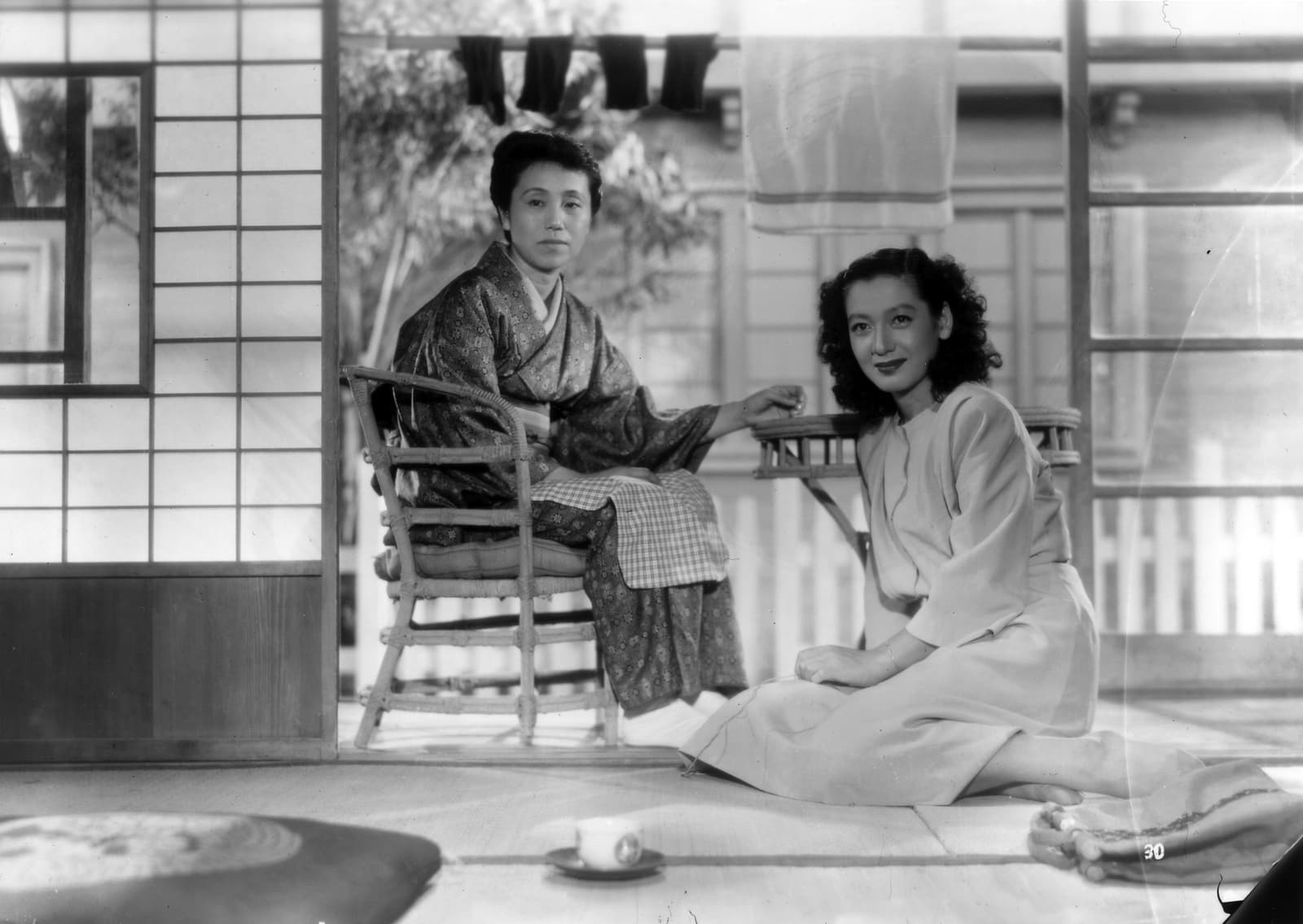
Image context: the cover uses a Shochiku publicity still of Haruko Sugimura and Setsuko Hara from Late Spring. It is the right recognition image for this essay because the film's pressure enters through ordinary domestic proximity. Before the story reaches Kyoto, the vase, or the final apple peel, Ozu has already shown how social persuasion can sit inside one room and wear a familiar face.[1]
Ozu begins by teaching us to read empty space as emotional space
Sam Wigley's BFI note on springtime films is especially sharp about the opening.[3] He points out that Late Spring begins with a run of people-less images: a quiet station sign, the railway, the signal, trees moving in the seasonal breeze above a traditional roof.[3] Those shots are not decorative. They teach the viewer how this film will store emotion. Ozu asks us to look first at infrastructure, weather, and interval. By the time Noriko and her father fully enter the drama, the world around them already feels measured and slightly expectant.
This matters because the movie never treats the home as neutral shelter.[3][5] Shukichi and Noriko's household is calm, orderly, and legible because the two of them know how to move inside it. He reads and receives guests; she cooks, pours sake, mends, serves, and keeps the apartment's rhythm intact.[5] Reverse Shot's reading of the film is helpful here: it emphasizes how Ozu lets a father and daughter build meaning through shared rooms and familiar objects before that meaning starts to crack.[4] The domestic order is not merely background. It is the medium through which their intimacy becomes visible.
Because Ozu gives this order such clarity, marriage never feels like a simple happy next step. It feels like a rearrangement of space before it feels like a moral idea. The aunt's campaign is powerful not because she speaks more forcefully than anyone else, but because she makes the household newly visible as temporary.[5] Once marriage is named, the rooms no longer look like a durable life. They begin to look like a life awaiting transfer.
The Noh scene makes persuasion visible through one glance
One of the cruelest things in Late Spring is how little of its pressure needs to be verbalized. BFI's film page includes Ruth Barton's useful observation that at the Noh performance, one glance by the father toward Mrs Miwa is enough to send a whole swirl of associations through Noriko's mind.[2] That is exactly how the scene works. Ozu does not make it legible through emphatic cutting or explanatory dialogue. He lets the possibility of remarriage enter Noriko's consciousness as an image problem before it becomes a spoken one.
The Noh theatre is the perfect setting for this transfer. The film is already full of patterned behavior, restrained faces, and actions whose meanings cannot be separated from ritual form.[2][5] When Shukichi's glance lands, Noriko does not need evidence. She needs only the smallest visual cue to understand that the household arrangement she has treated as stable may already be under revision. A look becomes a forecast.
This is one of Ozu's deepest strengths. He knows that family pressure often works through inference rather than command. Nobody needs to tell Noriko, in that instant, what her duty is. The social machinery has already been internalized. One smile, one face turned in profile, one shared public event, and the future starts moving. The film's sadness lies partly in that intelligence. Noriko is perceptive enough to read the hint immediately, but not powerful enough to stop the world that the hint implies.
The vase in Kyoto does not explain anything; it holds the pause in which a world is lost
The Kyoto inn scene has become the film's most discussed passage, and with good reason.[4][5] Noriko and her father lie in the same room on separate futons after a day of sightseeing. She speaks about Onodera's remarriage, admits a change of feeling, and then confronts the thought that her own father may remarry as well.[5] He appears to be asleep. She looks upward, her face shifting from composure toward pain. Then Ozu cuts to the vase.
Reverse Shot argues that the vase matters because Ozu trusts objects to hold what the characters cannot fully articulate.[4] That is persuasive, but the shot feels even harsher than a symbol. The vase does not offer interpretation or comfort. It withholds both. It keeps the viewer inside a suspended interval where nothing practical changes and everything emotional does. Noriko has not yet married. She has not yet left. Yet the old life has already become unrecoverable, because the thought of separation has entered the room and can no longer be unthought.
This is why the vase is so much more than a famous "pillow shot."[4][5] It is not simply an Ozu signature, as if the film were pausing for a moment of stylistic self-display. It is the point at which the movie refuses to let dialogue do all the work. If Shukichi answered her directly, or if Noriko cried openly and immediately, the scene would become more conventionally dramatic and less devastating. The vase keeps the pain impersonal without making it abstract. It sits in the room like a witness that cannot intervene.
The effect also clarifies Ozu's moral intelligence. Late Spring is not interested in exposing hidden cruelty behind respectable manners so much as in showing how manners themselves can become the delivery system of loss. The vase neither accuses nor redeems. It simply outlasts the momentary expression on Noriko's face, and in doing so it reveals how quickly a daughter can become historical to her own life.
The final apple peel is smaller than a speech, which is why it lands harder
After the wedding, which Ozu refuses to show, the film returns not to consummation or celebration but to aftermath.[5] Shukichi comes home alone. He sits, he peels an apple, the peel breaks, and the room grows immeasurably larger around him.[5] By any ordinary screenwriting logic, this should be too little. The film has spent more than a hundred minutes preparing a major family transition, and the emotional release arrives through a domestic task so minor it could be overlooked on first description.
Yet that is precisely Ozu's final stroke. The movie has been training the viewer from the first station shots onward to understand that small actions are where time becomes visible.[3][5] The apple peel is the ending because it is labor without function now that the person for whom care structured the day is gone. Earlier, Noriko's work held the household together. Here, Shukichi performs a fragment of ordinary action inside a home whose rhythm has been stripped of its reciprocal partner. What breaks is not merely the peel. It is the illusion that tactful sacrifice can preserve feeling while changing form.
BFI's springtime note says that Ozu traces time passing, situations changing, and the losses that come with growing older.[3] That is true, but Late Spring is even more exact than that summary suggests. It shows that time passes unevenly. Sometimes it moves through a train line or a seasonal breeze; sometimes it enters through a glance at the Noh theatre; sometimes it waits inside a vase; sometimes it announces itself through a piece of apple skin that will not stay in one continuous strip. Ozu's genius is to make these tiny material changes feel larger than rhetoric.
So the film's sadness does not finally reside in the arranged marriage as an institution, though it certainly feels its pressure.[5] It resides in Ozu's recognition that love can collaborate with separation when the people involved are too decent to make open war of it. Late Spring moves persuasion out of speeches and into arrangement, and then turns arrangement into fate. The result is one of cinema's most delicate tragedies: a movie in which almost nobody says the wrong thing, and yet the silence around the right things is what leaves the deepest wound.[2][3][4]
Sources
- Wikimedia Commons, "File: Haruko Sugimura and Setsuko Hara in Late Spring, 1949.jpg" - Shochiku publicity still file page and metadata.
- BFI, "Late Spring (1949)" - film page with synopsis, credits, poll context, and critical capsule.
- Sam Wigley, "10 great films set in the springtime," BFI - entry on Late Spring and its opening seasonal imagery.
- Nadine Zylberberg, "Late Spring," Reverse Shot - essay on Ozu's objects, home space, and the vase scene.
- Wikipedia, "Late Spring" - production background, plot details, and reception overview.