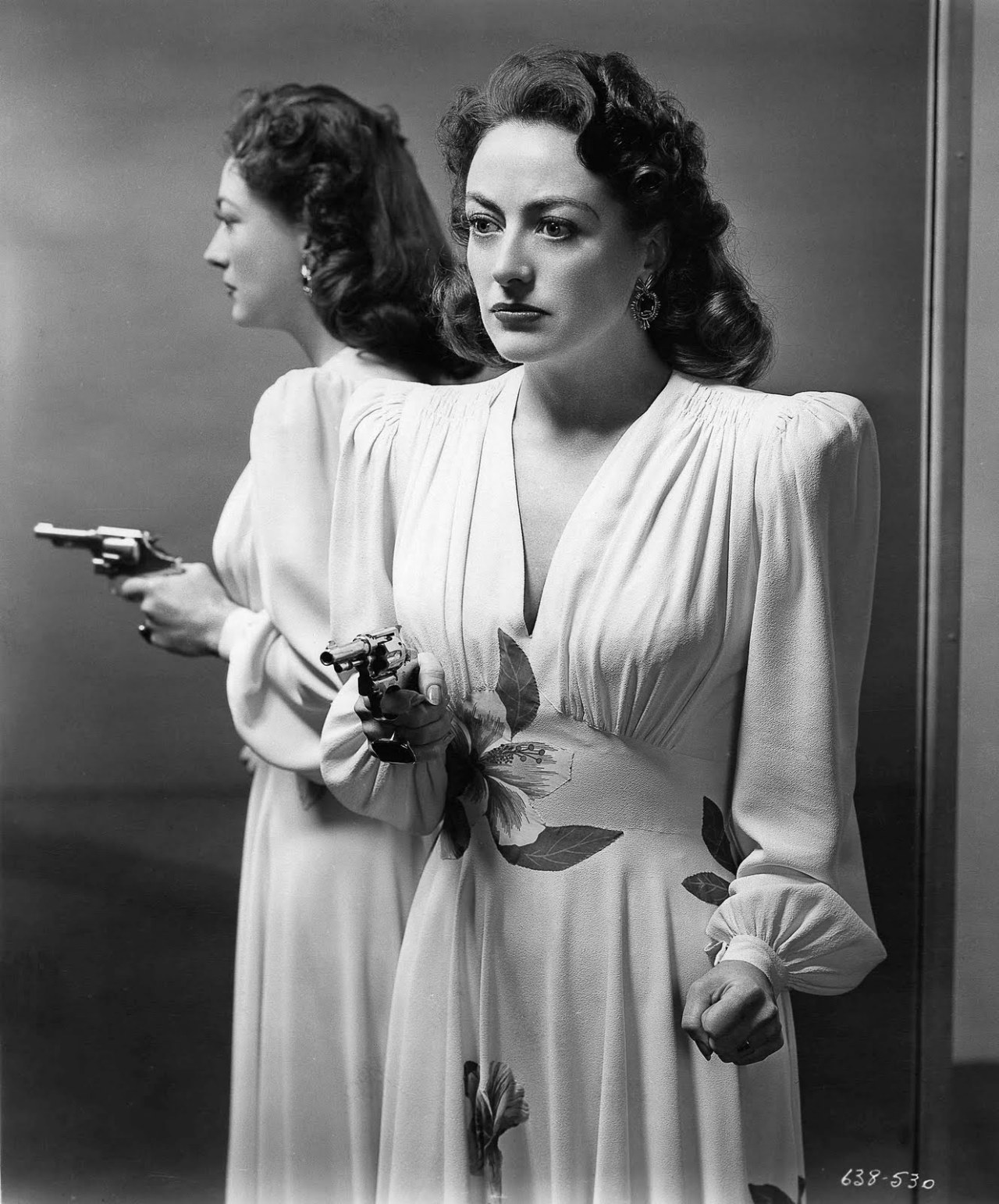
Michael Curtiz's Mildred Pierce (1945) is often filed under film noir, maternal melodrama, or Joan Crawford comeback vehicle, and all three labels fit.[1][2][4] But the film's deepest subject is conversion. It keeps asking how female labor gets converted into class appearance, how class appearance gets converted into daughterly appetite, and how love turns into a business model that cannot stop expanding once it has mistaken consumption for care.[2][3]
That is why the movie still lands so hard. Its images of money are rarely abstract. They are edible, upholstered, and embarrassingly domestic. Pies, chicken dinners, counters, uniforms, beach houses, piano lessons, evening gowns, and restaurant ledgers carry the plot's real pressure.[1][3] Mildred does not dream in theories of mobility. She dreams in things that can be bought, displayed, served, worn, and handed to Veda so the girl will never have to look like the daughter of a failed middle-class household again.
Spoiler note: this essay discusses the murder frame, Veda's role in the ending, and the film's final image.
Image context: the lead image is a real studio publicity still of Joan Crawford in Mildred Pierce. It belongs here because this essay is about the unstable bargain between polish and work: the film lets Crawford look sculpted and expensive, then keeps forcing that glamour back through kitchens, payroll, and shame.[6]
The opening makes paid female work look illicit
One of the smartest things the film does is hide its labor story inside a murder story.[2][3] Curtiz and screenwriter Ranald MacDougall adapt James M. Cain's novel by adding the killing of Monte Beragon and wrapping the narrative in a police-station confession.[2] That noir frame matters not only because it adds suspense. It teaches the audience, from the first minutes, to treat Mildred's climb as something shadowed, almost criminal, before we have seen what her work actually consists of.
Then the flashback begins, and the movie turns astonishingly concrete.[1][3] Mildred is not introduced as a symbolic "strong woman." She is a woman trying to keep a household afloat after her husband's failure, and the film is unusually blunt about how humiliating paid work can look when social class is collapsing in public view. Waitressing is not hard because the tasks are mysterious. It is hard because the people around Mildred read the uniform as a fall in status.[3] The movie understands that class shame is often visual before it is financial.
This is one reason the noir frame works so well. It lets the film ask why ordinary women's work should feel scandalous at all. Mildred's offense is never simply ambition. It is that she refuses to let respectable femininity remain detached from money-making labor. She bakes. She serves. She calculates. She expands. The movie keeps pulling those activities into spaces where postwar respectability would rather not see them.[3]
Mildred's empire is built from repetition, not glamour
Many rise-and-fall movies make success look intoxicating from the start. Mildred Pierce is harsher and more specific.[1][2] What makes Mildred formidable is not genius in the abstract. It is operational stamina. She knows what sells, what customers want back, where margins live, and how to turn one restaurant into several.[3] Even when the film rushes through the business expansion, it preserves the bodily memory of the work beneath it: pie crusts, kitchen heat, long hours, and the discipline of giving people food that feels richer than their day has been.
That attention to repetition is what separates Mildred from the aristocratic fantasy represented by Monte.[1][2] Monte is leisure pretending to be pedigree. Mildred is repetition pretending it can buy pedigree. The beach house, the clothes, the polished interiors, the space around the daughter at the piano: none of it is "luxury" in a neutral sense. It is labor made invisible after the fact.
The film never fully believes in that invisibility, and that is where its bite comes from. Curtiz is too good with surfaces to reject them; he makes restaurants, gowns, and drawing rooms look seductive.[1][2] At the same time, the narrative keeps dragging those surfaces back toward the ledger. Mildred cannot remain inside the fantasy she finances, because she is the one who pays the bill. Her problem is not that she mistakes money for power. Her problem is that she mistakes provision for love.
Veda is the film's pure consumer
If Mildred is the person who converts labor into class display, Veda is the person who consumes the display without wanting any trace of labor attached to it.[1][3] She is often summarized as an ungrateful daughter, which is true and still too mild. Veda is the film's cleanest expression of what happens when aspiration loses memory. She wants the finished surface and recoils from the kitchen, the waitress uniform, the smallness of origin, and any reminder that style had to be produced by somebody's exhausted body.
That is why the mother-daughter relationship in the film feels more cruel than sentimental.[2][3] Mildred thinks she is feeding love into existence by giving Veda access to class-coded objects and environments. Veda receives those gifts as proof that more should arrive. Each concession resets the baseline. A better school, a better dress, a better address, a better man to marry into, a cleaner family story. Appetite becomes the family business.
Seen from this angle, Veda is not an interruption of Mildred's project. She is its most logical product.[3] Mildred builds an emotional economy in which deprivation must never touch the daughter. The result is a daughter who learns to treat every relationship as a delivery system for status. The film is pitiless about this. Maternal devotion becomes complicit with class theater long before the ending turns openly murderous.
The ending feels cold because the film has already stripped romance of innocence
The murder reveal shocks on first viewing, but the film has been preparing its emotional logic for much longer.[2][3] By the time Veda shoots Monte, desire, money, and resentment have already been fused into one circuit. Monte's old-money languor, Mildred's acquisitive devotion, and Veda's hunger for a higher social script all belong to the same poisoned household arrangement.[1][2]
What makes the final movement so severe is that the film does not offer Mildred a heroic self-recognition scene. It offers exhaustion. In one of Imogen Sara Smith's sharpest observations, the picture opens and closes with scrubwomen at the Hall of Justice, turning unseen female labor into the story's harsh bracket.[3] That ending matters because it drains glamour out of the whole ascent narrative. After the restaurants, furs, chandeliers, and pianos, the film returns to women doing necessary work that nobody romanticizes.
This is also why the film's emotional weather feels more bitter than triumphant. Mildred survives, but survival has shed nearly every fantasy she spent the film purchasing. The daughter she tried to raise above labor becomes the agent of total ruin. The man she treated as a passport to class elegance turns out to be another decorative dead end. The system she trusted has no sentimental reward prepared for her.
Why the film still feels modern in 2026
Crawford won the 1946 Best Actress Oscar for the role, and the film also drew nominations for Best Picture, Screenplay, Cinematography, and two supporting performances from Eve Arden and Ann Blyth.[4] It later entered the National Film Registry.[5] Those facts explain the film's status. They do not explain its continued sting.
The sharper answer is that Mildred Pierce understands a pressure modern culture still reproduces: women are praised for competence, sacrifice, and resourcefulness right up to the point where those qualities disturb class fantasy or expose how expensive "good taste" really is.[1][3] Mildred is admirable when she produces comfort, embarrassing when the work becomes visible, and disposable when her labor has already been absorbed into someone else's self-image.
That makes the movie feel uncannily current. It knows that aspiration is not only about wanting more. It is also about wanting the evidence of work to disappear once the desired life comes into view. Mildred Pierce keeps refusing that disappearance. It leaves flour on the counter, resentment in the dining room, and a daughter's appetite sitting where gratitude was supposed to be. That is why the film still hurts: it does not say ambition is vulgar. It says ambition becomes tragic when love is forced to prove itself through endless provisioning.
Sources
- BFI, "Mildred Pierce (1945)" film page.
- The Criterion Collection, "Mildred Pierce" film page.
- Imogen Sara Smith, "Mildred Pierce: A Woman's Work," The Criterion Collection.
- The 18th Academy Awards | 1946, Oscars.org.
- Library of Congress, National Film Registry titles list.
- Wikimedia Commons, "File:Joan Crawford in Mildred Pierce.jpg".