The sleeping soldiers in Cemetery of Splendour are not absent from the world. Their bodies occupy a schoolroom converted into a clinic. Volunteers wash them, feed them when they wake, tend their drips, and sit beside upright light tubes that cycle through saturated colors. Beneath the building, a story says, dead kings are drawing on the soldiers' energy to continue ancient battles. Sleep has made the men available to more than one time.
That image offers a way into Apichatpong Weerasethakul's cinema, but it also exposes the usual mistake made about it. Calling his films “dreamlike” is accurate and insufficient. The word can turn patient duration, abrupt transformations, ghosts, jokes, illness, desire, and political fear into one soft atmosphere. Apichatpong's dreams are less decorative. They alter who may speak, what counts as a memory, and whether a place belongs only to the present.[1]
Across films made in Thailand and, with Memoria, Colombia, he repeatedly loosens the border between one person's interior life and a history shared by others. A story migrates between strangers. A romance returns as a forest fable. One hospital is remembered through another. A noise inside a woman's head acquires the weight of buried experience. Sleep, in this cinema, is not the opposite of public life. It is a public space: unstable, sensuous, sometimes frightening, and crowded with claims that daylight has failed to settle.
A story belongs to whoever continues it
Apichatpong established this principle before sleep became one of his central images. His first feature, Mysterious Object at Noon (2000), carries a film crew from Bangkok through rural Thailand and asks people they meet to continue a tale about a wheelchair-using boy and his teacher. The story passes through speech, sign language, song, dance, radio, and performed scenes. Each contributor inherits something already in motion and changes what the next person receives.[2]
The result is often described through the Surrealist game of exquisite corpse, but the method matters more than the label. Documentary encounters do not sit on one side of the film while fantasy occupies the other. The people, roads, workplaces, gestures, and accidents of the journey become the conditions under which fiction can circulate. Authorship is distributed without becoming anonymous: every new turn has a teller, a setting, and a particular way of carrying the tale.
That debut also makes Apichatpong's later ruptures easier to read. He was trained in architecture at Khon Kaen University before studying film at the School of the Art Institute of Chicago, and he founded the independent production company Kick the Machine in 1999.[3] Yet his structures do not behave like sealed buildings. They are more like neighboring rooms whose connecting door appears only after the viewer has learned the first room's proportions.
In Tropical Malady (2004), an easygoing courtship between soldier Keng and country worker Tong gives way to a nocturnal jungle tale about a soldier tracking a tiger spirit. The second movement does not announce itself as a dream that will eventually return us to safer reality. It carries the intimacy of the first half into another grammar, where lover, prey, animal, and apparition can exchange positions. Syndromes and a Century (2006), inspired by recollections of Apichatpong's doctor parents, similarly restages encounters across rural and urban hospitals rather than using one half to expose the other as false.[1]
These divisions train a distinctive kind of attention. A character need not possess a single continuous identity to remain emotionally present. A place need not choose between ordinary use and remembered life. The cut becomes less a wall than a handoff.
The hospital changes the speed of power
Hospitals recur in Apichatpong's work because they are biographical spaces before they are symbols. He grew up in Khon Kaen, in northeastern Thailand, where both parents were doctors. He called Cemetery of Splendour a home movie: it was shot entirely in the city, largely in the local dialect, with many nonprofessional actors.[3][4] The clinic is therefore neither a generic dream laboratory nor a convenient allegorical set. It carries childhood familiarity, the routines of care, and the estrangement of returning home after political conditions have changed.
The film makes that familiarity uncanny without abandoning its everyday texture. Jenjira, played by Apichatpong's longtime collaborator Jenjira Pongpas, forms a friendship with the intermittently waking soldier Itt. They eat, talk, visit a cinema, and move through spaces where supernatural claims arrive in the same conversational register as gossip or medical advice. Care is practical even when its object belongs to several realities at once.
Apichatpong was explicit about the pressure surrounding the film. In a 2015 Cannes interview, he connected its sleeping disorder to a decade of bloodshed in Thailand, his own urge to sleep as escape, and a fear of waking. He also described government censorship and self-censorship under the military junta, while grounding his inspiration in ordinary life and the struggle for the right to dream.[4] Speaking separately to Film Comment, he described the harder condition underneath the film: not knowing whether one is asleep or awake, wanting to wake, and fearing that expression itself may lead to detention or prosecution.[5]
That context does not reduce every colored light or sleeping body to a code with one political answer. Apichatpong has resisted such closure. The film remains sunny, funny, tender, and open to mixed Hindu, Buddhist, and animist beliefs that he observes without presenting them as his own doctrine.[5] Its political force lies partly in this refusal to let power monopolize reality. A military institution may classify the sleepers as bodies under treatment; friendship, folklore, local memory, and the film's own sounds keep producing other accounts of what those bodies are doing.
Sleep is therefore neither pure resistance nor simple surrender. It can shelter the dreamer, expose the body, suspend agency, or create contact. The uncertainty is the argument.
Dreams are archives with no master catalogue
The same uncertainty connects intimate memory to public history in the Primitive project. While researching in northeastern Thailand, Apichatpong encountered Nabua, a village with a brutal Cold War history. M+ records that the Thai military occupied the village for two decades and that residents endured violence, fled into the forests, and carried memories that official narratives had not safely contained. Apichatpong spent two months there with local teenagers, working with their conversations, songs, and dreams.[6]
The resulting 2009 multichannel installation Primitive and the related feature Uncle Boonmee Who Can Recall His Past Lives do not reconstruct that history as a clean chronology. The Cannes archive identifies Uncle Boonmee as part of the larger project; in the feature, a dying farmer receives his dead wife at the dinner table, meets a long-absent son in the form of a red-eyed monkey spirit, and moves toward a landscape in which past lives cannot be neatly assigned.[3]
This is not history disguised as folklore. It is a challenge to the idea that history becomes serious only when it abandons folklore, bodily memory, fantasy, and place. Nabua's documented violence and its ghost stories occupy different evidentiary registers, but the cinema allows them to remain neighbors. One does not authenticate or cancel the other.
The method also returns us to Mysterious Object at Noon. There, no single speaker owns the invented story. In Primitive, no central archive owns the village's memory. A teenager, a house, a remembered raid, a homemade spaceship, a ghost narrative, and a projected image can each carry part of the past without becoming a complete catalogue. BAMPFA's retrospective notes that Apichatpong's films often emerge from former conflict zones and the shadow of oppressive regimes, obliquely registering how trauma haunts ordinary lives.[1] “Obliquely” does not mean vaguely. It names a route around the false confidence of the official overview.
Sound reaches the room before explanation
Apichatpong's images are patient, but his worlds often arrive through the ear first. In the jungle half of Tropical Malady, darkness makes listening a survival skill: insects, steps, voices, animal calls, and silence continually revise the space beyond the frame. The soundtrack does not merely enrich a visible forest. It produces a forest the eye cannot master.
Memoria (2021) moves that logic into one blunt, unplaceable sound. Jessica, a Scottish visitor in Colombia played by Tilda Swinton, is awakened by a concussive boom that no one else seems to hear. She tries to reproduce it with a sound engineer, turning a private sensation into a technical problem of timbre, duration, and decay. Yet a convincing recording does not settle where the sound belongs.
The film grew partly from Apichatpong's own experience of exploding head syndrome, and it was his first feature made outside Thailand. Discussing its construction with Sight and Sound, he said the complexity of the sound design arose from the film's needs and described treating Spanish, which he did not speak, as sound and music. He also removed explanatory backstory during editing when it supplied too much information.[7] The subtraction is crucial. It prevents the noise from shrinking into a clue that exists only to unlock plot.
Instead, the boom reorganizes a room full of listeners. Jessica hears it inside her experience; the cinema audience hears it through speakers; neither position grants a complete origin. Later encounters connect personal sensation with objects, land, and memories that exceed one lifetime. BAMPFA describes the film as a place where collective trauma reemerges through memory and dream.[1] The claim is not that Thailand and Colombia share one interchangeable history. It is that a displaced filmmaker can recognize how unresolved histories alter perception without pretending to possess them.
This is what makes sound another public space. Public does not mean universally agreed upon. It means jointly exposed: several people can receive the same vibration while disagreeing about its source, ownership, or meaning.
Staying awake is not the only way to pay attention
Apichatpong's pacing is sometimes treated as a test of endurance, as though the ideal viewer proves seriousness by remaining perfectly alert. His films suggest a more generous contract. BAMPFA's curators describe his cinema as an extension of the biological need to dream, one that asks viewers to become attentive to duration, environment, and the spiritual charge of ordinary detail.[1] Attention here can drift without becoming careless.
That distinction helps preserve the films' humor and bodily ease. People nap, eat fruit, flirt, exercise, tend wounds, tell stories badly, and wait for something that may not arrive. These acts are not filler around the metaphysical content. They are how the metaphysical acquires scale. A ghost seated at dinner matters because dinner continues. A mysterious sound matters because it interrupts a morning. A national history matters because it presses on a familiar clinic, a forest path, or a friend's sleeping body.
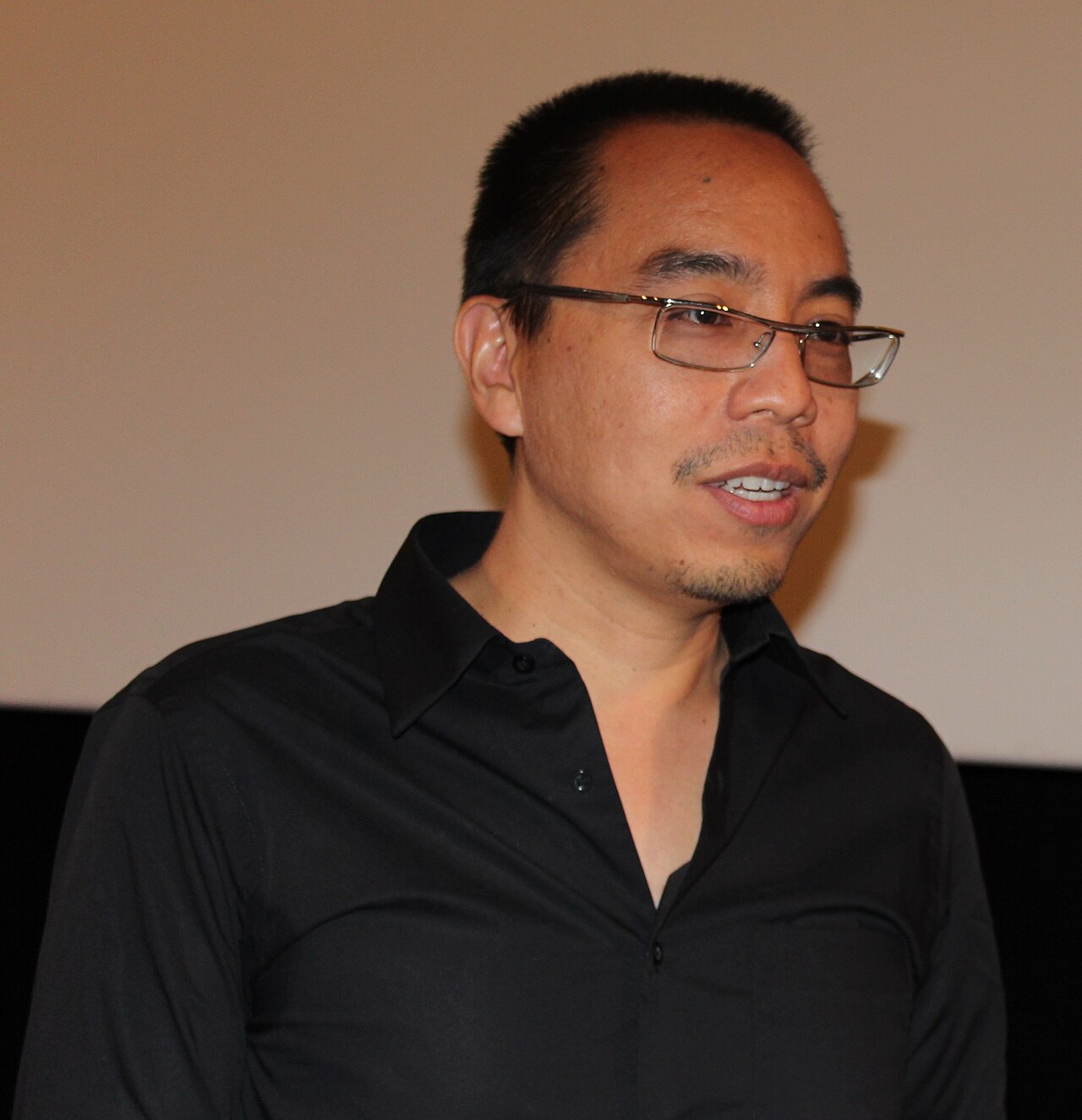
The 2012 festival portrait above shows Apichatpong in an ordinary setting of cinema's public life: a filmmaker facing another camera, present among the institutions and audiences through which work travels.[8] It is a useful counterimage to the myth of the solitary dreamer. His cinema is built with recurring performers, local participants, editors, sound designers, curators, producers, and viewers who lend their own memories to what they see.
To make sleep public is not to claim access to another person's unconscious. It is to construct a form where private sensation can enter shared time without being flattened into consensus. Apichatpong's cuts, ghosts, hospitals, forests, and sounds keep that exchange open. In his films, waking is never the final authority on what happened. It is simply one more state from which the past may be heard.
Sources
- Kate Mackay, “Apichatpong Weerasethakul's Cinema of Now,” Berkeley Art Museum and Pacific Film Archive, 2023 — retrospective overview of dream, duration, recurring film structures, political landscapes, and selected features.
- Jason Sanders, “Mysterious Object at Noon,” Berkeley Art Museum and Pacific Film Archive, 2023 — collective exquisite-corpse narration, transmission methods, route, credits, and film details.
- Festival de Cannes, “Apichatpong Weerasethakul” — official biography, education, independent production history, Primitive connection, filmography, and Cannes awards.
- Festival de Cannes, “Cemetery of Splendour: Interview with Apichatpong Weerasethakul,” May 18, 2015 — sleep and political fear, Khon Kaen production, local dialect, performers, censorship, and the right to dream.
- Nicolas Rapold, “Apichatpong Weerasethakul,” Film Comment, May-June 2015 — self-censorship, detention fears, sleep and waking, Khon Kaen, animist observation, and embedded historical references in Cemetery of Splendour.
- M+ Museum, “Apichatpong Weerasethakul: Dream and Memory” — Nabua's Cold War history, the making and installation of Primitive, and the relationship among teenagers, dreams, and buried memory.
- Tony Rayns, “Apichatpong on Memoria: his odyssey into the soundscapes of Colombia,” Sight and Sound, January 11, 2022 — sound design, exploding head syndrome, language, editing, memory, and production context.
- ZiYouXunLu, “Apichatpong Weerasethakul at Côté Court,” Wikimedia Commons — source photograph, festival setting, date, dimensions, authorship, and CC BY-SA 3.0 license.