

The quickest way to underestimate film costume is to call it clothing. Clothing belongs to a person; a costume belongs simultaneously to a body, a script, a set, a lens, and an audience. It must let an actor breathe, sit, fight, dance, or hesitate. It must survive changes in light and camera distance. It may need to locate a character in a precise historical world—or invent a society that has never existed—before anyone speaks.
That makes costume design a form of direction by material means. A collar can restrict the head. A weighted skirt can slow a turn. A sharp shoulder can enlarge a figure before the performance supplies authority. Wear, repetition, and repair can suggest that a life began before the opening shot. The V&A's account of Hollywood costume describes the designer's central problem as creating character through close work with the director and actor, supported by research whether the film is period, contemporary, or fantasy.[4]
The three videos below approach that problem from different scales. BAFTA's career survey of Sandy Powell shows a designer moving between historical research and the practical intelligence of performers. MUBI's compact Eiko Ishioka essay treats the clothed body as graphic architecture. The Academy's long-form session with Ruth E. Carter expands costume into a cultural system, where research distinguishes communities and gives an imagined future a credible past.[1][2][3]
Watched together, they make a useful argument: a memorable costume is not a picture placed on an actor. It is a scene partner. Its meaning arrives through the body's negotiation with fabric, silhouette, history, and space.
Sandy Powell: history has to become wearable
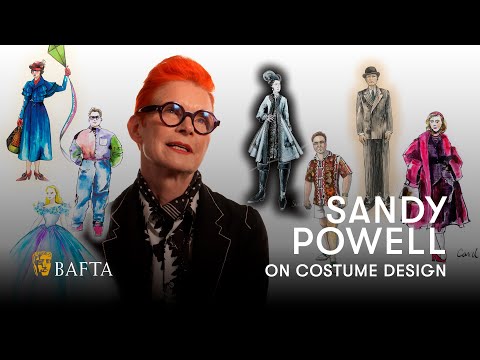
BAFTA's twelve-minute Powell survey spans a career of more than fifty films without reducing that career to an awards reel. It is most revealing as a study in translation. Research, sketches, found references, fittings, and conversation have to become something that can sustain a performance through repeated takes.[1]
Powell's range makes the point. Her first film job was with Derek Jarman on Caravaggio; the path from Orlando and Velvet Goldmine to The Favourite and her repeated work with Martin Scorsese covers period dress, glam invention, court politics, and deliberately unobtrusive gangster clothes.[1][5] Those projects do not share one signature silhouette. What persists is a willingness to find the dramatic rule of each film and then make historical material answer to it.
Accuracy is part of that work, but accuracy alone cannot finish it. On The Irishman, Powell says Robert De Niro had 102 costume changes and as many as fifteen four-hour fittings; the goal was not to copy Frank Sheeran literally but to keep trying clothes until the actor could recognize the character.[5] A meticulously reproduced garment can still be wrong for a scene if it fights the blocking, flattens the role, or reads as museum display under the cinematographer's lighting. Powell has described costume design as storytelling with clothes and the fitting as a dialogue rather than an instruction handed to an actor.[6]
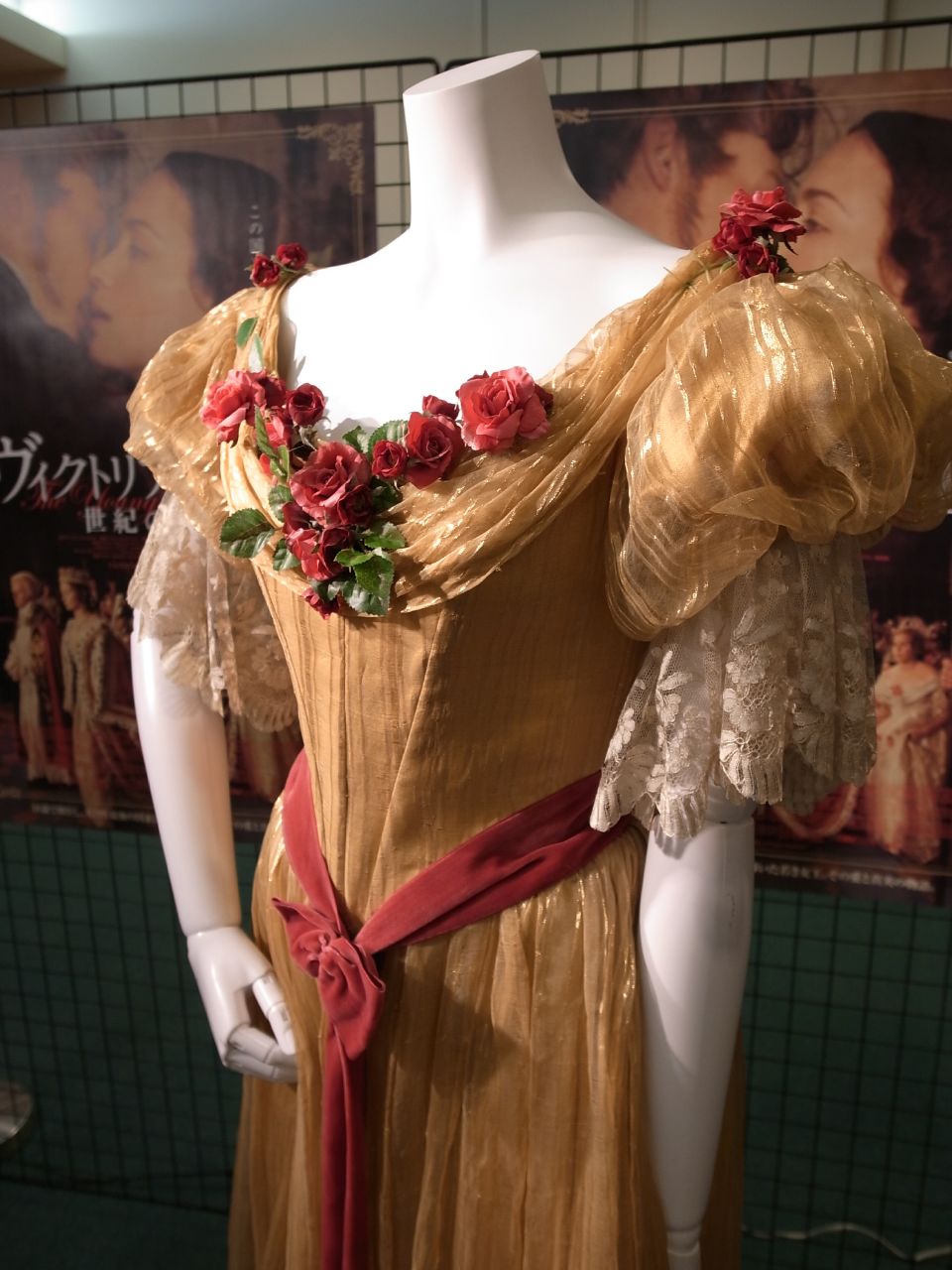
The photograph above offers a useful pause from the moving image. Powell's gown for Emily Blunt in The Young Victoria stands empty on a mannequin, its volume fully visible.[9] The display makes workmanship easier to inspect, but it also reveals what is missing: Blunt's weight, pace, posture, and relation to the room. On screen, the skirt is never just a period outline. It changes how close another character can stand, how quickly Victoria can turn, and how the frame registers the difference between ceremony and privacy.
That is the practical lesson to carry back into Powell's video. Costume does not become cinema when the drawing is approved or the garment is finished. It becomes cinema in the fitting, then again in blocking, light, and editing. The designer builds a set of physical possibilities; the actor chooses among them in time.
Eiko Ishioka: silhouette can rewrite the human figure
MUBI's Eiko Ishioka essay lasts only two minutes and twenty seconds, but its brevity suits the force of her designs. The montage lets one startling outline displace another. Instead of asking whether a garment looks plausible in everyday life, it asks what new kind of body a film can make legible at a glance.[2]
The Academy's account of Ishioka's path to Bram Stoker's Dracula makes her cross-disciplinary method unusually concrete. She designed Japanese posters for Apocalypse Now, served as production designer on Mishima: A Life in Four Chapters, and entered Coppola's Dracula after he decided that costume, rather than conventional scenery, should carry much of the film's world.[7] That graphic and production-design background helps explain why her costumes often behave like moving posters: the silhouette is immediate, but the body keeps complicating the first impression.
In Bram Stoker's Dracula, armor, robes, and bridal forms do not merely locate the story in a historical period. They turn desire, blood, age, and metamorphosis into surfaces the actors must carry: the Academy's examples include a red robe that billows through the castle, flayed-muscle armor, and a wedding collar modeled on a frilled lizard.[7] In her collaborations with Tarsem—among them The Cell, The Fall, and Mirror Mirror—costume can enlarge a person into an emblem, splice human anatomy to animal or floral suggestion, or make a figure compete deliberately with monumental architecture.[2] The designs are spectacular, yet spectacle is not their only job. Their scale creates behavior.
An extreme collar narrows the available gesture. A rigid headpiece changes balance and gaze. Fabric extending beyond the shoulders makes an entrance register before the face can be read. When a costume reorganizes the body's edges, the actor cannot treat it as decoration; performance has to include resistance, weight, and reach. The camera, too, must decide whether to preserve the whole silhouette or move close enough for texture to overtake outline.
This is where Ishioka's work corrects a common opposition between “character” and “visual style.” The visual style is already acting on the character. Her costumes make identity feel constructed, unstable, and capable of transformation because the human figure itself no longer looks fixed.
Ruth E. Carter: research turns wardrobe into a society
The Academy's Ruth E. Carter session is the collection's longest video, giving her process room to expand beyond a few celebrated hero looks. Carter moves through drawing, research, collaboration, and the accumulation of details that may pass quickly on screen but allow a whole cast to appear as though they share—or contest—the same history.[3]
Carter's filmography links very different acts of world-making: the saturated neighborhood argument of Do the Right Thing, the historical span of Malcolm X and Amistad, the movement politics of Selma, and the Afrofuturist societies of Black Panther and Black Panther: Wakanda Forever. In a LACMA conversation, she describes storytelling—not fashion—as the foundation of that practice, then names specific research traditions behind Wakanda's costumes, including Himba color and leatherwork, Turkana beadwork, and Ndebele armor.[8]
The distinction matters. In a film with many communities, costume cannot stop at making each principal actor memorable. Repeated materials, colors, jewelry, armor, craft traditions, and degrees of wear have to tell viewers which people belong together, which institutions command resources, and where an individual bends or refuses the collective code. A background performer may be visible for seconds, yet their costume helps decide whether the world feels populated or merely decorated.
Carter's Black Panther work is especially instructive because Wakanda must read as technologically advanced without appearing to have discarded history. The solution is not a generic mixture of “traditional” motifs and futuristic surfaces. It is a designed network of differences: communities receive distinct visual vocabularies, and those vocabularies recur across ceremonial, military, royal, and everyday bodies.[8] Research supplies specificity; invention supplies continuity. Together they let the audience infer a society larger than the scenes shown.
This also sets a boundary on spectacle. Cultural reference is not raw material to be sampled until a costume looks exotic. It carries makers, geography, politics, and memory. The designer's task includes deciding what can be combined, what must remain distinct, and how collaborators transform reference into a fictional culture without erasing its real sources. Carter's process makes research visible as an ethical discipline as well as a visual one.
The garment has to pass through a body
Powell, Ishioka, and Carter are not three steps in one universal method. Powell's historically alert flexibility, Ishioka's radical silhouette, and Carter's cultural systems answer different cinematic needs. Their videos belong together because each refuses the idea that costume is a finishing layer applied after character and world have already been decided.
Instead, costume works through a chain of tests. Can the actor move in it without losing the intended constraint? Does the silhouette communicate at the distance of the shot? Does the surface hold detail under the chosen light? Can repeated motifs establish relationships across a crowd? Does research deepen a fictional world rather than turn living cultures into shorthand? And after hours of wear, does the garment still carry continuity from take to take?
The answers are visible in performance. A sleeve catches a hand. A skirt delays a turn. Armor redistributes confidence. Beadwork makes affiliation readable before a name is spoken. A worn edge tells the lens that an object has a past. None of these effects belongs to costume alone: actor, director, cinematographer, production designer, hair and makeup teams, dressers, cutters, dyers, textile artists, and editors all complete what the garment begins.[4][6]
That collaborative reality is why the empty gown in the cover photograph feels both revealing and incomplete. It shows construction clearly, but cinema begins when a body enters the structure and the structure pushes back. The finest film costumes do not simply tell us who a character is. They give the character something material to become.
Sources
- BAFTA, “Sandy Powell explores her career as a costume designer on over 50 films,” YouTube video — career survey, mentors, influences, and design practice.
- MUBI, “Like a Butterfly: Eiko Ishioka's Costume Drama,” YouTube video essay — a compact survey of Ishioka's film silhouettes and collaborations.
- Academy of Motion Picture Arts and Sciences, “Ruth Carter's Creative Process,” YouTube video — long-form visiting-artist session on research, drawing, collaboration, and costume storytelling.
- Victoria and Albert Museum, “Designing Hollywood costume” — institutional overview of costume as character design, research, and director-actor collaboration.
- Isabel Stevens, “Costume drama: Sandy Powell on designing the costumes for The Irishman,” BFI Sight and Sound, November 7, 2019 — research, fittings, character differentiation, actor movement, and Powell's career context.
- Sandy Powell, “The 1970s Movies That Shaped Me,” Academy — Powell on visual influences, costume as storytelling rather than fashion, and fittings as dialogue.
- Academy of Motion Picture Arts and Sciences, “How an Apocalypse Now Poster Led to Oscar-Winning Costumes for Bram Stoker's Dracula,” November 4, 2015 — Ishioka's route into the film, sculpted forms, symbolic detail, and costume movement.
- Los Angeles County Museum of Art, “Q&A with Costume Designer Ruth E. Carter,” January 31, 2019 — storytelling, cultural research, collaboration, and the construction of Wakanda's visual identity.
- akaitori, “Costumes from The Young Victoria,” Wikimedia Commons — source photograph, subject identification, display location, authorship, and CC BY-SA 2.0 license.