Spoiler note: this essay discusses the structure and ending of Chris Marker's short film, including the final time-loop revelation.
Chris Marker's La Jetee is usually introduced through its most famous fact: it is a science-fiction film made almost entirely from still photographs. That description is accurate and still too small. The film's force does not come from a novelty restriction, as though Marker merely proved that photographs could substitute for moving footage. Its force comes from making stillness the right form for a story about memory, trauma, love, experiment, and time travel. BFI lists the film as a 28-minute French work from 1962, directed and written by Marker, and describes its photo montage as a meditation on memory after apocalypse.[1] The craft question is why that montage does not feel like an illustrated narration. It feels like cinema stripped to its pressure points.
The answer begins with a simple reversal. Most time-travel films move quickly because plot keeps changing the calendar. La Jetee moves by holding images long enough for time to thicken around them. TCM's film note stresses that the film is built from still photographs, voice-over, sound effects, and music, with only one moving shot, and that its credits identify it as a photo-roman.[4] That form is not a footnote. It is the machine. Each photograph becomes both evidence and prison: a moment preserved because it mattered, but preserved so completely that the characters can never quite escape it.
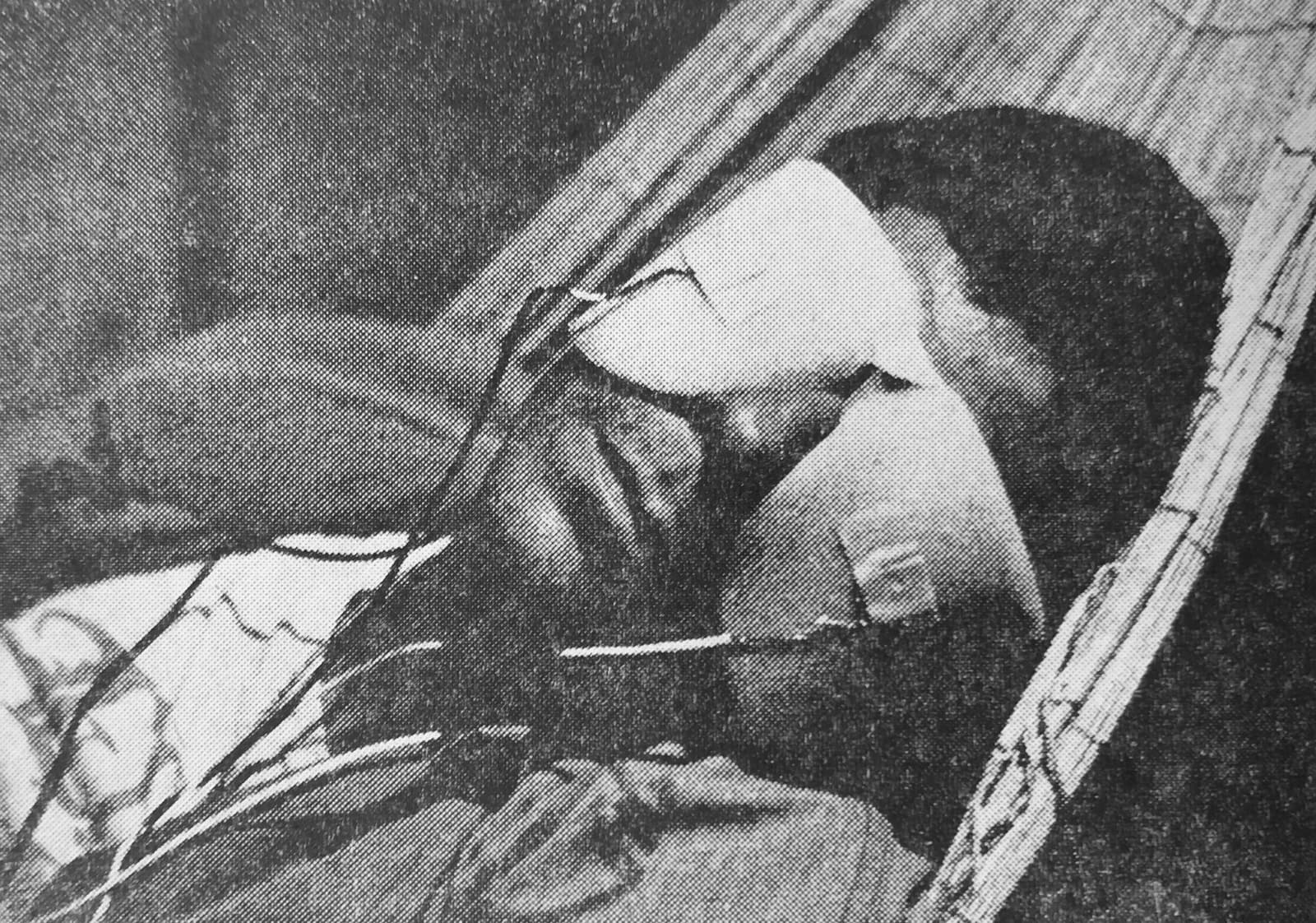
The stills make memory feel physical
The film's premise is lean enough to sound almost schematic. After a future war, survivors live underground in Paris. Scientists choose a prisoner for time-travel experiments because he is marked by a childhood image from the observation deck at Orly Airport: a woman's face, a man's death, and a shock he cannot understand.[1][2][4] The man is sent backward and forward through time, but the journey is less a technical conquest than a forced return to an image that has already organized his life.
That is why still photographs are so exact here. A conventional moving-image treatment would risk making time travel look like transportation: a passage, a device, a spectacle of arrival. Marker makes it look like fixation. The man does not travel because time is open. He travels because one image has never stopped holding him. Harvard Film Archive's program note gets close to that pressure when it describes the film as being told almost entirely with still black-and-white images and asks whether the human being is the author or the victim of memory.[3]
The still image therefore carries two opposite meanings at once. It is proof that a moment existed. It is also proof that the moment is gone. La Jetee builds its emotional structure from that contradiction. The image of the woman at Orly is not merely remembered; it has become an operating system. The future scientists think they are exploiting a subject's unusually strong memory, but the film keeps suggesting something darker: the memory may already be exploiting him.
Voice-over does not explain the images; it gives them a clock
The narration in La Jetee can seem calm, almost documentary, but its calmness is one of the film's sharpest tools. It does not perform character psychology in the usual dramatic manner. It places the photographs into sequence, making them behave like duration. TCM describes the film as the story of a World War III survivor whose vivid memories make him the subject of time-travel experiments.[4] The voice-over turns that plot into a ritual. It tells us enough to move forward, but never so much that the images become redundant.
This is the key craft balance. If the narration were too rich, the photographs would become illustrations. If the photographs were too self-sufficient, the narration would become captioning. Marker finds a colder and more powerful middle. The voice gives each image a temporal edge: before, after, once, later, again. The photographs supply bodies and surfaces. The sound supplies pressure.
The soundtrack also prevents the stills from becoming inert. Music, murmurs, airport sound, and experimental-room unease keep entering around the images. TCM's account is useful here because it treats voice-over narration, sound effects, and music as part of the same deceptively simple apparatus as the photographs.[4] The result is not a slideshow. It is a film in which movement has migrated out of the photographed body and into editing, sound, expectation, and dread.
The single blink changes everything
The most famous formal break in La Jetee is small enough to miss if one describes it too generally. After a run of still images of the woman in bed, she opens her eyes and looks toward the camera. TCM singles out that shot as the film's only moving image, the moment when the woman opens her eyes in the morning.[4] The moment works because Marker has trained the viewer to accept stillness as the world. When motion arrives, it feels less like ordinary cinema than like a miracle that has slipped through a locked system.
The blink is not simply beautiful. It is dangerous. For an instant, the woman stops being only a remembered image and becomes present. The viewer feels why the man might mistake return for rescue. The motion suggests that the past might answer him, that the frozen object might look back, that memory might become mutual. But because the film has made stillness so strict, the motion also feels temporary. It is a pulse inside a dead machine.
That is where La Jetee differs from many later films influenced by it. TCM notes its importance as a primary source of inspiration for Terry Gilliam's 12 Monkeys.[4] Gilliam's film expands the premise into a feverish feature-length world of institutions, plague, and instability. Marker does almost the opposite. He compresses the whole paradox into a handful of faces, rooms, and remembered locations. The blink is enough because the film has made motion rare.
The museum sequence turns preservation into a threat
One of the film's strangest passages takes the man and woman into a natural history museum. Animals stand preserved. Human figures stand among them. Time appears suspended, but the suspension is not peaceful. The museum extends the film's larger question about memory: preservation can look like rescue, but it can also turn living bodies into specimens.
That uncertainty belongs to the whole film. Love appears as a release from the underground experiment, but it is also another form of preservation. The couple in the past seem to inhabit a pure present, yet the viewer knows that this present is being assembled from images. Their happiness is already archival. The man is not living a life in the past so much as moving through a curated set of moments that will later be recognizable as fate.
The sequoia-tree image sharpens the point. Senses of Cinema is right to pair La Jetee with Vertigo as another film about the pursuit of an elusive image and the trouble that pursuit creates.[2] In La Jetee, the tree-ring gesture is tender and absurd. The man is trying to locate himself in a chronology where he does not yet belong, while the film's form keeps reminding us that he is already caught in the image that will kill him.
The loop is emotional before it is clever
The final revelation could be treated as a science-fiction twist: the death the child saw at Orly was his own. But the ending lands because the film has prepared it as an emotional and formal closure, not only a plot surprise. A Senses of Cinema essay summarizes the loop clearly: the boy witnesses a death at Orly, grows into the time-travel subject, returns to the airport, and realizes that the strange man he saw die was himself.[2]
The circularity is brutal because it turns memory from refuge into mechanism. The scientists did not create the loop alone. They exploited a loop that was already inside him. The childhood image was not a clue pointing toward freedom; it was the form of captivity. The man spends the film trying to move through time, but the photograph has always been waiting at both ends.
That is why La Jetee still feels modern despite its minimal means. It understands that images do not merely preserve experience. They can select, distort, repeat, and govern it. Harvard's phrase about scars is apt because the film's stillness makes memory feel less like private storage than like a wound left by history.[3] The film's science fiction is therefore not escapist machinery. It is a way of asking what happens when a society, or a person, cannot stop returning to the image it failed to understand.
The craft lesson is precise. Marker does not use still photographs because motion is unavailable. He uses them because motion would be too forgiving. A moving image can pass, soften, and continue. A still image insists. In La Jetee, time travel is not the freedom to go elsewhere. It is the terrible discovery that one image has been there ahead of you all along.
Sources
- BFI, "La Jetee (1962)" - film page with credits, running time, poll placement, and framing of the film as a photo montage about memory after apocalypse.
- D. A. Miller, "Surprised by La Jetee," Senses of Cinema, 2015 - essay on the film's loop, Orly ending, viewer memory, and the instability of remembered images.
- Harvard Film Archive, "La Jetee / In the Mood for Love" program note - description of the film as an almost entirely still black-and-white photo work about scars, memory, and whether humans author or are victimized by memory.
- TCM, "La Jetee (1962)" - film note on the still-photograph construction, voice-over, sound effects, music, one moving shot, photo-roman form, time-travel premise, and 12 Monkeys influence.
- Wikimedia Commons, "File:Eiga-Hyoron-1966-July-2.jpg" - archival La Jetee film still published in Eiga Hyoron in July 1966 and used as the article image.
Editor’s Pick Review
This article takes today’s merged standard/add-on editor-pick slot because it has the strongest 24-hour quality profile across originality, formal close reading, bilingual execution, and the stricter immersive-image gate. The essay does not treat La Jetee as a still-photo gimmick; it shows how photographs, voice-over, sound, the single blink, museum preservation, and the closed time loop form one exact cinematic machine for memory and trauma. The archival film still is exact, topic-grounded, and immersive rather than analytical, while the Chinese edition carries the same literary-critical cadence with controlled terminology, fluent transitions, and low translationese.