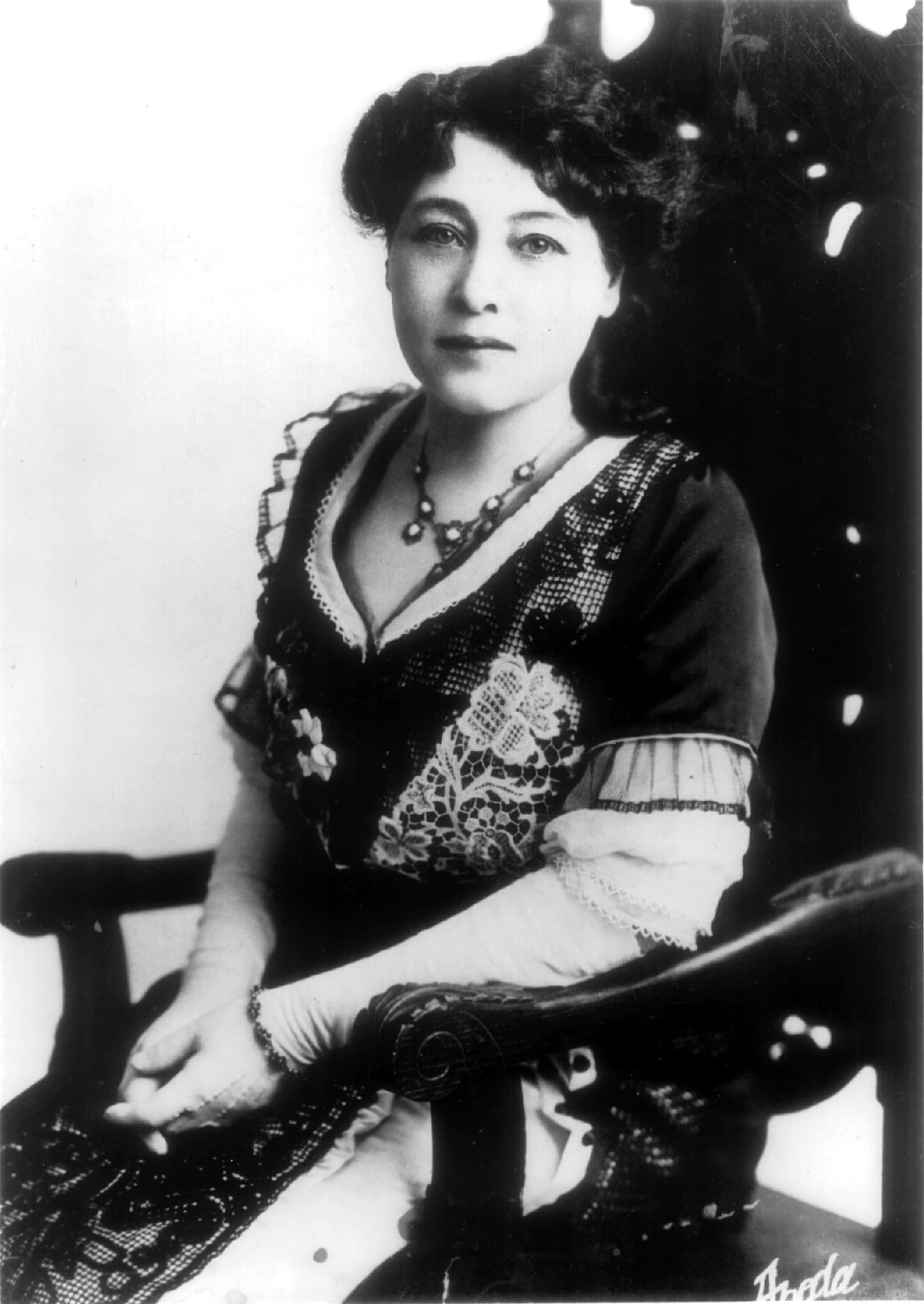
Alice Guy-Blaché is too often introduced with the language of correction: the first woman director, the forgotten pioneer, the missing name in the first chapter of film history. Those labels are necessary, because the erasure was real. But they can also make her sound like a recovered footnote rather than what she was: a working filmmaker, studio organizer, experimenter, and practical builder of cinematic behavior. Her career matters because it shows early cinema becoming a craft before the craft had settled into rules.[1][2][4]
The better question is not simply whether she came first. It is what kind of directing her firstness produced. Guy-Blaché moved from Léon Gaumont's office into production at the moment when the motion-picture camera was still often treated as a device for recording spectacle. She saw that it could stage behavior, rhythm, gender roles, comic reversal, religious pageantry, domestic suspense, and social instruction. Britannica's compact chronology is startling: she directed La Fée aux choux in 1896, became Gaumont's head of production, experimented with double exposure and running film backward, made Chronophone sound films in 1906-1907, then crossed to the United States and founded Solax in 1910.[1] That is not a curiosity cabinet. It is a career spent turning novelty into workflow.
Image context: the cover uses a real 1896 portrait from Wikimedia Commons, sourced to the Solax collection and Apeda Studio.[6] For a director profile, the portrait is more useful than a generic silent-cinema still because the article's argument follows Guy-Blaché as an author and organizer across Gaumont, Solax, and the later recovery of her credit.
Directing Before Directing Was Stable
Guy-Blaché began before the job title "director" had hardened into its later authority. AFI's account makes the point plainly: in early filmmaking, directing was still a little-known profession, but she performed it with unusual regularity.[2] That matters because her authorship was not built on the later myth of the director as solitary genius. It was built on daily production: arranging performers, choosing stories, managing trick effects, testing sound systems, supervising output, and deciding what a film scene should do.
The famous claim around La Fée aux choux can sometimes distract from this larger pattern. Yes, Britannica describes her as generally acknowledged as the first director to film a narrative story, while noting that historians have debated the exact dating of the surviving versions.[1] Smithsonian gives the story's practical shape: she asked Gaumont for permission, made the film during lunch breaks, and treated a one-minute fairy-tale premise as proof that cinema could tell stories rather than merely display motion.[4] Whether one emphasizes the 1896 claim or the later surviving variants, the key is the same: she understood narrative as a use case for a machine that many people still saw as a demonstration device.
Her early technique was not naive. Britannica notes masking, double exposures, reverse motion, and longer productions such as Esmeralda and La Vie du Christ.[1] AFI adds hand-drawn coloring and synchronized sound to the list.[2] These were not decorative gimmicks floating above content. They show a filmmaker testing what the medium could hold: duration, illusion, color, voice, bodies, crowd movement, and moral action.
"Be Natural" Was A Production Rule
The phrase that should stay attached to Guy-Blaché is not only "first." It is "Be Natural." AFI describes the sign at Solax as a studio mandate to actors at a time when exaggerated gesture was common in silent performance.[2] Smithsonian also treats the phrase as an acting maxim, one that still sounds current because it asks performers to connect stylized genres to recognizable behavior.[4]
That command is easy to sentimentalize, but it was a technical instruction. Silent cinema did not mean absence of acting detail. It required a different calibration between body and camera. "Be Natural" told performers not to shout with their limbs simply because the audience could not hear dialogue. It asked them to make the frame legible through behavior rather than pantomime. In a short comedy or melodrama, that could mean letting embarrassment, scheming, tenderness, or social pressure register through small adjustments instead of broad display.
This is where Guy-Blaché's directorial intelligence becomes visible even when many films are lost. BFI's guide to early women filmmakers recommends Falling Leaves as one of her most beautiful films and singles out its haunting central image: a young girl tying greenery back onto bare branches because she believes her sister will die when the last leaf falls.[3] That image works because it is simple without being crude. It turns childish misunderstanding, illness, time, and care into one physical action. The scene does not need grand machinery to move. It needs a director who knows how to make an idea behave in front of a camera.
Solax Made Authorship Industrial
The Solax years are the part of Guy-Blaché's career that most clearly overturns the footnote version of her story. After moving to the United States, she founded the Solax Company in 1910 and then built a larger Fort Lee, New Jersey, studio by 1912.[1][2][4] Britannica says she directed 40 to 50 films there and supervised nearly 300 other productions.[1] AFI adds the useful industrial detail that the Fort Lee facility cost $100,000 and made her the first woman to own her own film company.[2]
Those numbers matter because they shift the conversation from symbolic representation to production power. Guy-Blaché was not only allowed to direct a few exceptional films. She built a pipeline. Solax produced comedies, action adventures, melodramas, social dramas, and shorts with performers who had to work quickly inside a young industry's demand for volume.[2] The Kino Lorber restoration set makes that output tangible for modern viewers by placing Guy-Blaché inside a broader field of restored early women filmmakers rather than leaving her as an isolated exception.[5]
Industrial authorship is harder to romanticize than a single masterpiece, but it may be the most important part of her profile. She helped prove that a director could be a story worker, a production manager, a technical experimenter, and a company head at once. Later Hollywood would divide many of those functions into more rigid hierarchies. In Guy-Blaché's moment, the boundaries were still fluid, and she occupied that fluidity with unusual force.
Her Comedy Knew Gender Was A System
Guy-Blaché's films should not be preserved only because they are early. They are interesting because they often understand social roles as things that can be staged, reversed, and exposed. BFI's Pamela Hutchinson notes that when viewers dig into films such as Making an American Citizen, Algie, the Miner, and The Ocean Waif, they notice Guy-Blaché's attention to gender constructions and unequal relationships between men and women.[3] That is a precise way to frame her modernity.
Early cinema loved simple reversal: servants mock masters, machines misbehave, bodies fall, costumes betray people, courtship turns ridiculous. Guy-Blaché's best gender comedy uses that appetite for reversal to test social arrangements. A man is not just a comic type because he looks foolish; he looks foolish because his authority has been made visible as a performance. A woman is not interesting only because she escapes danger; she is interesting because the scene shows how danger was normalized in the first place.
This is also why A Fool and His Money has become such an important title in discussions of her Solax period. AFI describes the 1912 film as believed to be the first with an all-Black cast.[2] That fact should be handled carefully: the survival and historiography of early film are patchy, and one title cannot redeem the era's racial exclusions. But it shows that Guy-Blaché's studio practice sometimes opened spaces that dominant film histories later had trouble remembering. The erasure was not only of one woman. It was of a wider early-cinema field in which women, immigrant workers, performers of color, and regional studios helped build the medium before the canonical story narrowed.
Recovery Is Part Of The Film History
The last act of a Guy-Blaché profile has to include recovery, but recovery should not replace analysis. Britannica notes that only a handful of the hundreds of films she made survive and that some accomplishments were forgotten or credited to male colleagues.[1] Smithsonian traces the same damage: by 1922, after returning to France with her children, she found no place for herself in the film industry, and later historians ignored or reassigned her work.[4]
That history changes how we watch what remains. A surviving Guy-Blaché film is not simply a transparent sample of the past. It is evidence that passed through accident, neglect, institutional bias, storage failure, and restoration labor. Kino Lorber's Pioneers: First Women Filmmakers set matters for that reason: its 2K and 4K restorations, archival-source work, essays, and scores do not merely package old films for collectors. They make an argument about what film history becomes when recovery is treated as a serious editorial act.[5]
The same is true of broader public writing on early women filmmakers. BFI's guide opens by challenging the "scarcity myth," the idea that women directors were rare exceptions in silent cinema.[3] Guy-Blaché is central to that correction, but she should not be isolated from it. If she becomes only the exceptional first woman, the story remains too narrow. Her career points toward a larger ecology of women directors, writers, producers, performers, and restoration scholars whose work changes the shape of early cinema once it is allowed back into view.[3][5]
That is why Alice Guy-Blaché still feels like a director for the present. Not because she can be turned into a neat inspirational plaque, and not because every firstness claim is free from archival complexity. She matters because her surviving record shows cinema being made by decisions: stage this action, simplify that gesture, try sound here, color this frame, build the studio, train the actors, make the social role visible, keep the production moving.
The miracle of early cinema was never only that images moved. It was that someone had to decide what movement meant. Guy-Blaché's answer was practical, prolific, and still bracing: make the machine tell stories, make actors behave, make genre reveal social pressure, and make a studio where those choices could happen again tomorrow.[1][2][3][5]
Sources
- Encyclopaedia Britannica, "Alice Guy-Blaché," biography and career chronology.
- American Film Institute, "Alice Guy Blaché - AFI Catalog Spotlight," August 1, 2022.
- Pamela Hutchinson, "Where to begin with early women filmmakers," BFI, June 10, 2019.
- Jason Daley, "Documentary Explores Pioneering Woman Director Written Out of Film History," Smithsonian Magazine, August 22, 2019.
- Video Librarian, "Pioneers: First Women Filmmakers," review of the Kino Lorber restoration set.
- Wikimedia Commons, "File:Alice Guy.jpg," archival portrait file page.