King Hu's A Touch of Zen is often remembered through one spectacular phrase: the bamboo-forest fight. That memory is fair, but it can make the film sound as if it exists to deliver a single set piece. The stranger achievement is structural. Hu spends nearly an hour delaying combat, teaches the viewer to read a village, a ruined fort, robe color, bird calls, and suspicious entrances, and only then lets bodies rise, vanish, and fall through the trees.[2][4] Action arrives not as an interruption of atmosphere but as atmosphere becoming kinetic.
That is why a craft reading has to begin before the first famous leap. Criterion describes the film as a wuxia work, a spiritual quest, and a study in human nature, with widescreen landscapes and innovative editing central to its force.[1] Janus gives the plot's clean surface: Yang, a fugitive noblewoman, hides in a village and must escape with a scholar and aides when her identity is exposed.[6] Hu's technique makes that premise expand. A political chase becomes a haunted-house puzzle, then a military stratagem, then a metaphysical passage in which fighting and awakening begin to share the same visual language.
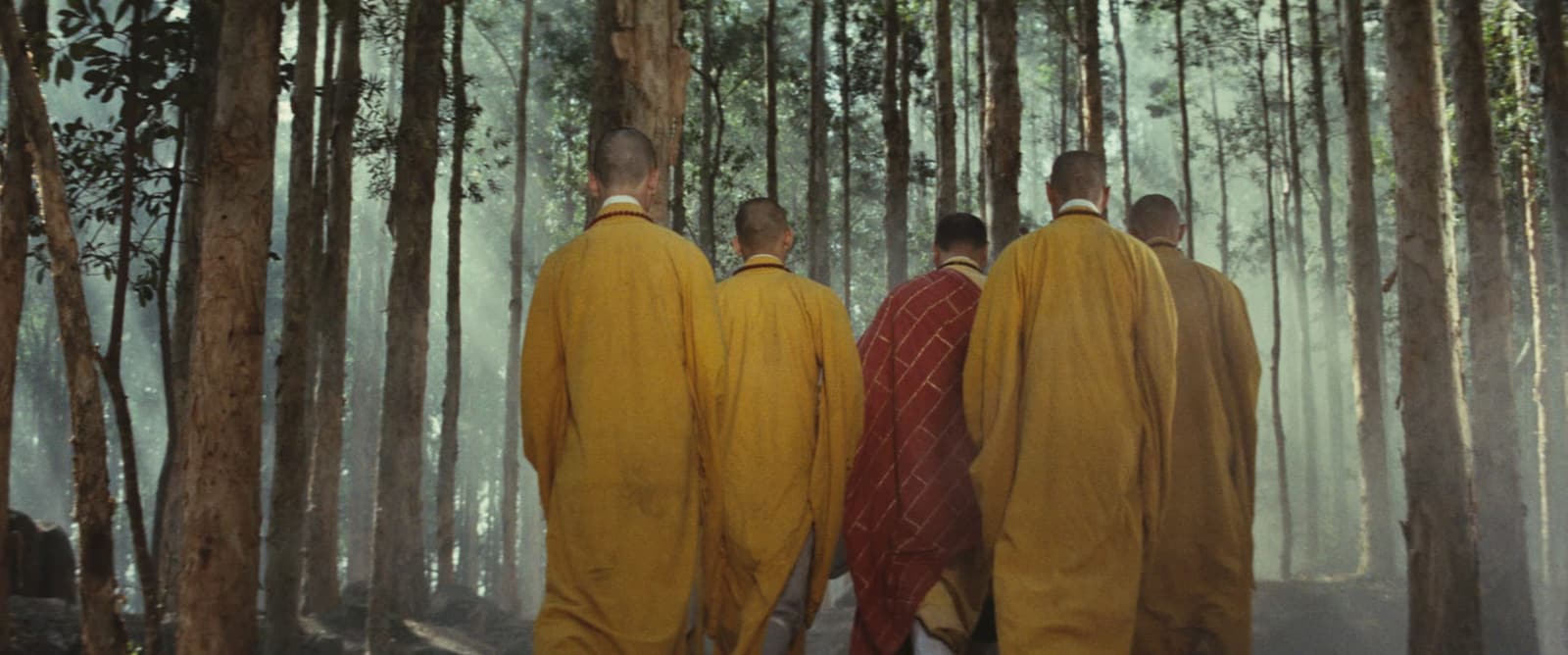
Image context: the cover still shows monks moving through a forest rather than swordsmen frozen mid-strike. That matters because Hu's film does not treat action as a detachable stunt unit. Trees, mist, color, and procession become part of the same system that later makes combat feel airborne and finally spiritual.[1][2][4]
Delay Is The First Technique
The most radical decision in A Touch of Zen is patience. Bordwell notes that Hu postpones the first combat for nearly an hour, using that opening stretch for Gu Sheng-zhai's daily routine, his mother's pressure, suspicious strangers, monks, a fortune-teller, unexplained noises, and the neighboring mansion inside the abandoned fortress.[2] That delay is not slack pacing. It is calibration.
In a more ordinary swordplay film, early fights would prove genre credentials and establish the heroine's skill. Hu withholds that proof so the viewer becomes alert to other kinds of movement. A figure dodges out of sight. A robe enters the edge of a pale street. A doctor seems to know too much. A scholar moves through social embarrassment before he understands political danger.[2] The audience learns to scan the frame before the combat begins, which means the later fights feel less like isolated excitement and more like the payoff to a trained way of looking.
Hu's own notes help explain why that opening is so carefully textured. He says he wanted the supernatural dimension, the "touch of Zen," to emerge through an experience rather than through explanation, and that costumes, sets, and props had to be authentic enough to carry that charge.[3] The haunted fort took nine months to construct, and Hu supervised details personally.[3] That labor shows. The setting does not behave like scenic background. It behaves like a pressure chamber in which ghost story, court intrigue, and religious possibility can coexist before the plot names them.
The Scholar Makes Action Indirect
Another craft choice is Hu's use of Gu as witness. Bordwell emphasizes that the film presents heroic swordplay through the eyes of a secondary character: Gu begins as an ineffectual scholar, becomes briefly useful through strategy, and then recedes while Yang and the other fighters occupy the center.[2] This is not a weakness in characterization. It is a way of making action feel discovered rather than possessed.
Because Gu is often catching up, the viewer catches up with him. He does not enter the film as a martial hero whose competence guarantees legibility. He misreads, suspects, invents explanations, and then watches the world enlarge beyond his capacity. The shift matters. When Yang's identity and backstory finally come into focus, the film has already made the viewer feel how partial civilian perception can be inside a political terror system.[2][3]
That indirectness keeps the film from becoming a simple prowess display. The Eastern Depot background in Hu's notes gives the danger institutional weight: a Ming-dynasty secret police force controlled by eunuchs, able to arrest and execute without normal administrative constraint.[3] The villains are not merely bad fighters waiting to be defeated. They represent a state apparatus moving through rumor, disguise, pursuit, and force. Hu's action grammar has to answer that apparatus, so it moves through concealment and ambush as much as direct duel.
Bamboo Turns Space Into A Vertical Instrument
The bamboo sequence is famous because it changes the body's contract with space. BFI's King Hu guide says the center battle took twenty-five days to shoot and is often cited as a forerunner of wire-fu, though the gravity-defying stunts used hidden trampolines.[4] Bordwell gives the formal version of the same point: Hu's fighters pop in and out from every side, with sudden long shots forcing the viewer to hunt through the frame after bursts of close cutting.[2]
The effect is not merely that people seem to fly. It is that the forest becomes an editing machine. The vertical trunks divide the widescreen frame into slats. Mist softens depth. Leaves and branches create hiding places. A body can disappear behind one line and reappear at another, and the cut can make that transition feel both impossible and spatially exact. Hu uses the forest as a natural grid for surprise.
This is where the film's craft differs from ordinary impact choreography. A punch or sword blow can be satisfying because it lands clearly. Hu often makes satisfaction depend on almost missing the action. Bordwell's phrase "the glimpse," discussed in the BFI guide, captures the logic: quick cuts convey movements the audience barely registers while preserving enough spatial continuity to keep the scene intelligible.[4] The viewer is not confused in the lazy sense. The viewer is made alert, as if the warriors are operating at the edge of human perception.
That edge is essential to the film's spiritual escalation. The same technique that makes fighters seem faster than the camera will later help make Buddhist intervention feel like a change in physical law. Hu is not abandoning realism scene by scene. He is gradually teaching the eye that the material world in this film is porous.
Color Marks The Passage From Intrigue To Revelation
Hu's color design works like a second structure. Bordwell points to saffron robes entering the street as an early subdued burst of color, then returning in the later image of golden blood.[2] The cover still makes that principle visible: yellow and red robes move through a blue-green forest, not as decoration but as an organizing force. Human figures become moving color fields inside landscape.
That matters because A Touch of Zen is a long film with several tonal lives. It begins as eerie village mystery, becomes political thriller, expands into military action, and then enters a realm where Buddhist imagery overtakes the revenge plot.[1][2][5] Color helps the viewer cross those thresholds. The saffron does not simply announce holiness. It prepares a register in which fighting can become ritualized and violence can be judged by a visual order larger than tactical victory.
Senses of Cinema is useful here because it stresses the film's hybrid style: zooms, eye close-ups, slow motion, Taiwanese rocky landscapes, bamboo forest swordfights, compositions tied to calligraphic interest, Beijing opera-style musical punctuation, and split-screen touches all coexist inside the film.[5] That mixture could have become incoherent. Hu holds it together by making each device serve passage. The film keeps asking how one mode of perception gives way to another: suspicion to recognition, strategy to combat, combat to awe.
Editing Makes The Body Larger Than The Body
The editing is the decisive craft. Bordwell describes Hu as a daring cutter whose fight scenes stretch and pinch time, with some shots lasting only six frames, making the warriors' prowess feel beyond the camera's ability to keep up.[2] That is a crucial distinction. Hu does not simply record athletic movement. He builds an idea of movement that no single body could fully contain.
The result is action as inference. A head snaps sideways; a cut answers from another direction. A long shot suddenly reveals where the fighters have moved. A leap begins as physical exertion and finishes as spatial apparition. The viewer constructs the impossible passage between shots, and that construction is part of the pleasure. Hu's cinema trusts the audience to feel the missing interval.
This also keeps violence from becoming only force. In many martial arts films, technique proves itself through bodily impact. In A Touch of Zen, technique often proves itself through disappearance, rhythm, and transformation. The best fighters do not merely strike. They alter the viewer's sense of where a body can be. That is why the bamboo sequence has been so influential: it offered later wuxia cinema a grammar for airborne motion that was not just stunt escalation but perceptual reorganization.[4]
The Finale Changes The Scale Of Victory
The film's final movement is not content to crown the best fighter. Bordwell describes the last section as moving toward a mystic transformation in which Xu Xian-chun is overwhelmed by visions and the appearance of the Buddha, while Gu, long forgotten by the action, is shown kneeling as if he too has witnessed the apparition.[2] The plot has not disappeared, but its scale has changed. Combat becomes the threshold through which the film asks what force can and cannot solve.
Hu's own stated caution matters here. He said he was not trying to be didactic or evangelical, only to present the flavor of a particular experience.[3] That protects the finale from simple message-making. The golden light, the monks, the rocky ground, the red-robed antagonist, and the altered bodies do not translate neatly into a doctrine. They create a sensory condition in which revenge, survival, and spiritual shock are all present at once.
This is why A Touch of Zen remains a craft landmark rather than only a genre milestone. Its action is not bigger because the fights are longer. It is bigger because every formal choice has been prepared to change what action means. Delay makes combat consequential. Gu's witness position makes heroism indirect. The fort makes politics feel haunted. The bamboo forest turns vertical space into an instrument. Color carries spiritual pressure. Editing lets the body exceed itself.
The movie's greatness lives in that chain. Hu does not decorate wuxia with philosophy after the fact. He makes technique philosophical: a cut, a robe, a leap, a misty tree line, a delayed entrance, a flash of gold. By the end, action has become weather, and the viewer has been taught to feel a sword film opening into revelation without ever ceasing to be cinema.[1][2][3][4]
Sources
- The Criterion Collection, "A Touch of Zen" film page, including credits, restoration notes, stills, format, and synopsis.
- David Bordwell, "A Touch of Zen: Prowling, Scheming, Flying," The Criterion Collection, July 20, 2016.
- King Hu, "Notes on A Touch of Zen," The Criterion Collection, edited from the 1975 Cannes Film Festival press kit.
- John Berra, "Where to begin with King Hu," BFI, March 9, 2020.
- Tony Williams, "A Touch of Zen," Senses of Cinema, July 2013.
- Janus Films, "A Touch of Zen" film page, including synopsis, format, runtime, and theatrical booking details.
Editor’s Pick Review
Selected for the 24-hour editor-pick slot because it combines a strong critical thesis with unusually tight form-to-meaning analysis. The piece does not merely praise A Touch of Zen as a wuxia landmark; it shows how delay, witness position, bamboo geometry, color, and six-frame cutting work together until action becomes atmosphere. The image choice also passes the stricter visual policy: it is an immersive, film-specific still rather than an analytical diagram, and it directly supports the article's argument about landscape, robe color, mist, and spiritual procession. The Chinese edition carries the same chain of reasoning in natural literary-critical Chinese, with clean terminology and controlled rhythm, so the article holds up in both language lanes.