Spoiler note: this article discusses the film's ending.
Jean-Pierre Melville's Le Samouraï is one of the foundational hitman movies, yet it still feels stranger than most of the films that borrowed from it.[1][2][3] Plenty of later thrillers copied the fedora, the trench coat, the impassive face, and the idea of the killer as a near-abstract professional. What they often missed is that Melville's coolness is not a layer laid over the material. It is the material. Gray-blue rooms, thin sound, repeated gestures, and the exhausted labor of staying legible to police, witnesses, and employers turn professionalism into a kind of living tomb.[1][2][5]
That is why Alain Delon's Jef Costello never feels merely glamorous, even when the film grants him one of cinema's most durable silhouettes.[1][4] The look matters, but the look is only convincing because the movie keeps showing how much maintenance it requires. Melville does not romanticize criminal mastery by making work disappear. He makes work the whole point. Keys, hats, gloves, trains, receipts, timetables, glances, and rehearsed answers keep returning until the assassin's code starts to resemble a mechanical routine that has outlived any human warmth.[2][3][5]
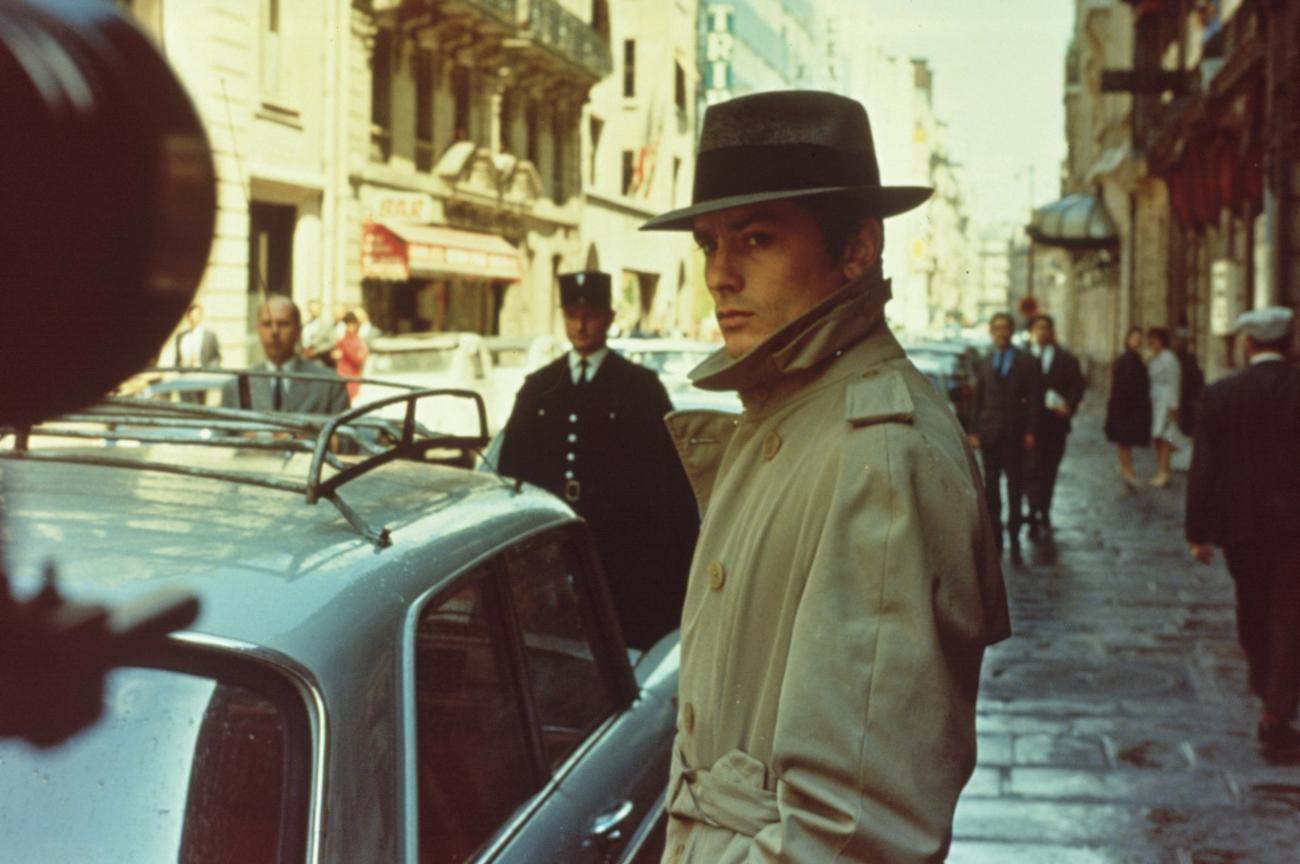
Image context: the cover uses BFI's street still of Alain Delon in fedora and trench coat from Le Samouraï. It fits this essay because the film's key visual idea is reduction. Melville strips Jef down to outline, gait, and costume until the man looks almost designed rather than born, as if he were trying to become anonymous by becoming unforgettable.[1][4]
The apartment teaches us that emptiness itself is part of the technique
The opening apartment is one of the great statements of method in postwar crime cinema.[1][2] Melville gives Jef a room so spare that it almost ceases to feel domestic: a bed, a few functional objects, a caged bird, a gray light that seems to flatten warmth before it can settle anywhere. BFI's introduction to Melville is useful here because it describes the director's cool-toned hues, exacting frames, and alienated male protagonists as part of a single world rather than separate stylistic signatures.[2] In Le Samouraï, that world arrives before the plot has properly begun. Jef does not live in a home that reveals character through clutter. He occupies a chamber that has already been cleared for ritual.
That bareness changes how every object behaves.[1][5] The hat is no longer just clothing. The key ring is no longer just a practical tool. The bird is no longer casual decoration. Each item sits in the frame with too much clarity, which makes Jef's life look less like ordinary living than like a sequence of necessary checks. The apartment becomes a calibration space. He dresses, verifies, leaves, returns, and repeats. Melville is telling us, without speech, that this man survives by reducing the world to a small number of controllable variables.
The cold palette sharpens the effect.[1][2] Later neo-noir would often use darkness to create mystery. Melville does something harsher. He creates a climate of near-colorlessness, a drained atmosphere in which feeling seems to have been bleached into procedure. The result is not lush fatalism. It is professional fatigue photographed with severe elegance.
The alibi circuit is the movie's real action system
One reason Le Samouraï still feels modern is that it understands criminal expertise as logistics.[1][3][5] The murder itself matters, but the film keeps redirecting attention toward everything around it: the stolen car, the route, the false certainties, the timing of trains, the narrow margin between recognition and deniability, the friends and acquaintances who can be turned into parts of an alibi whether they want to be or not. Brogan Morris's BFI survey of hitman films describes the screen assassin as a cool, calculating figure who seems to operate outside normal rules.[3] Melville's harder insight is that such coolness has to be manufactured minute by minute.
That is why the middle stretches of the film feel both procedural and ghostly.[1][5] Jef moves through Paris as if he were executing a routine perfected long ago, yet each repetition shows strain rather than confidence. He is always answering for his own outline. A witness has seen him. Police questions keep narrowing. Employers mistrust loose ends. Even before the final movement, the film understands that an underworld built on professional codes is also a world of endless verification. Everyone wants proof from everyone else, and proof corrodes the very invisibility Jef depends on.
Melville films this bureaucracy with extraordinary patience.[1][2] Police work in Le Samouraï is not exciting because it produces flamboyant deduction. It is exciting because it turns time itself into pressure. Men sit, wait, line up, watch, repeat, and compare stories. The procedural texture keeps pushing against the myth of the free assassin. Jef is not free. He is trapped inside a system that demands he appear frictionless while constantly generating new friction.
The film's silence is really a discipline of selective sound
People often remember Le Samouraï as silent, which is true only in the way a stripped room can be called empty.[1][2][5] The film is full of sound, but Melville thins it out so aggressively that each noise lands like a measurement. Shoes on pavement, a car door, keys, the flutter or warning chatter of the bird, police voices in controlled interiors, the nightclub's music cues, and François de Roubaix's score all arrive in a field that has been cleared of unnecessary emotional padding.[1][5]
That selectivity is central to the movie's chill.[1][2] In many crime films, music tells the viewer when danger has arrived. Here, danger often announces itself through the absence of expressive emphasis. Melville withholds sonic reassurance so that small sounds grow disproportionately large. A room tone can feel accusatory. A pause can feel like surveillance. The nightclub sequences work especially well because performance space should overflow with atmosphere, yet Melville keeps reducing everything to watchfulness: who sees whom, who looks away, who can still pretend not to know.
This is where Delon's performance becomes inseparable from the soundtrack.[1][5] He does very little in any ordinary psychological sense. The face stays controlled, the voice stays measured, the body rarely spends energy. Because the film offers so little excess sound or gesture, that restraint becomes thunderously visible. Jef does not read as depth hidden beneath surface. He reads as a surface under permanent test.
Costume and gesture turn cool into a professional uniform
If the apartment gives Jef a chamber and the alibi circuit gives him a schedule, the costume gives him a creed.[2][3][4] Christina Newland's BFI piece on Melville is especially sharp about the director's totemic objects: guns, hats, leather-gloved hands, steering wheels, all treated less as props than as ritual instruments.[2] Le Samouraï may be the cleanest version of that logic. Jef's fedora, trench coat, and white gloves do not individualize him. They standardize him. The clothes make him look finished, but they also make him look trapped inside a role that has already been decided.
That is one reason the film's style keeps reproducing itself across later decades.[3][4] Jonathan Heaf's GQ essay on Delon's trench coat treats the outfit as a menswear landmark, which is fair enough, but the film itself is more severe than fashion homage can capture.[4] The coat is memorable because it belongs to a total system of reduction: neutral color, hard brim, controlled posture, minimal speech, no wasted flourish. Jef looks perfect because perfection is part of the disguise. The uniform promises mastery, while the story keeps exposing how fragile that mastery is.
Melville also uses gesture with almost punishing economy.[1][2] Hat adjustments, key turns, cigarette handling, gloved hands, the simple act of standing still in a doorway: all of it is filmed as if action had been boiled down to bare necessity. The movie's coolness comes from that refusal to spend movement freely. Every gesture looks accounted for, which makes every deviation feel fatal.
The ending works because the code has already hollowed the man out
By the time Jef returns to the nightclub in the final stretch, Le Samouraï has stopped being a fantasy of professional control and become a study of control after its purpose has drained away.[1][5] The film's brilliance is that it does not need melodramatic confession to make this transition. It keeps faith with the same reduced method to the end. Jef's last movements still look calm, still look coded, still belong to the same man who seemed at first to have mastered his world. What changes is the meaning of the code. Routine no longer protects him. Routine reveals that he has almost nothing outside it.
That final return is devastating because Melville stages it as both action and surrender.[1][2][5] The nightclub, which earlier functioned as a site of witness, profession, and suspended noise, becomes the place where Jef's cultivated coolness can no longer pass as neutrality. He has spent the whole film turning himself into an instrument. At the end, the instrument has no remaining use except to complete the logic already set in motion.
This is why Le Samouraï remains more than a style bible for hitman cinema.[2][3][4] It does not merely teach later filmmakers how to photograph a killer attractively. It shows that attraction curdles when a life is reduced too completely to procedure, silhouette, and code. Melville takes the most imitated ingredients in the genre and arranges them so that coolness itself starts to feel terminal. The movie does not ask whether Jef Costello has a soul somewhere under the coat. It asks what is left of a person after the coat, the room, the route, and the alibi have done all the living for him.[1][2][5]
Sources
- BFI, "Le Samouraï (1967)" film page with credits, running time, hero still, and related context.
- Christina Newland, "Where to begin with Jean-Pierre Melville," BFI.
- Brogan Morris, "10 great hitman films," BFI.
- Jonathan Heaf, "The Way They Wore: Alain Delon's trench coat from Le Samouraï," British GQ.
- Wikipedia, "Le Samouraï," for release, score, plot, and reception overview.