A home video appears to defeat forgetting. It has a date, a viewpoint, a voice behind the camera. Press play and the past moves again.
Charlotte Wells's Aftersun distrusts that promise without dismissing its power. The MiniDV tape at its center does not contain a hidden explanation for Calum, the young father whose sadness his eleven-year-old daughter, Sophie, can sense but cannot yet name. It preserves something more difficult: the visible surface of a loving holiday before Sophie has the adult experience to read it. A grin held too long, a body edging out of frame, a breath close to the microphone—each waits years for a second meaning.
The camcorder therefore remembers before Sophie can. Not because a machine understands Calum better than she does, but because it can hold gestures beyond the moment in which a child had any use for them. When the adult Sophie returns to the footage, she is not recovering an intact father. She is meeting the limits of the girl who filmed him and of the man who kept filming her.
Released in 2022, Wells's debut places Sophie and Calum at a fading Turkish resort in the late 1990s, then lets the adult Sophie revisit that last holiday two decades later. A24's own synopsis draws the essential line between the father she knew and the man she did not.[1] The movie lives in the gap between those two people—and makes a cheap family camera the object that cannot close it.
Spoiler note: this essay discusses the full film, including its final airport and rave images.
The tape keeps a point of view, not the truth
The MiniDV image looks like evidence. Its color is thin, its highlights harsh, its zoom clumsy. Buttons click; the autofocus searches; the built-in microphone exaggerates whoever is breathing nearest to it. Compared with the film's composed 35 mm images, the tape seems unpolished enough to be honest.
But every home video has an author. On the plane, Sophie points the camera at Calum as he hides behind a guidebook, challenges him to smile properly, and catches the awkward grin he produces while trying to escape the lens. She is not conducting an investigation. She is playing with her dad. In Wells's formulation, the camera turns their looking into a game and gives Calum access to Sophie's viewpoint when he later watches what she shot.[2]
That game establishes the tape's boundary. It records what Sophie finds interesting, what Calum permits, what either of them notices in time, and what a small lens can reach. Dead batteries, accidental framing, overextended zooms, and sudden cuts are not period decoration. They make authorship visible. This record has blind spots because a person held it.
The screenplay describes the film's first recorded images as an unstable assortment—an airport corridor, faces, sea, sky—seen during rewind before the tape begins again.[6] That reversal gives the holiday a destination before it has a story. Adult Sophie already knows where the images lead. Young Sophie is still making them. The same frame can therefore carry two times at once: a child's present-tense pleasure and an adult's knowledge that the pleasure will end.
Calum leaves his fingerprints on images he does not occupy
The home video repeatedly fails to give adult Sophie the portrait she wants. Wells has said that Calum's relative absence from the recordings was intentional. During the birthday filming, Paul Mescal was directed to move from side to side and avoid being caught cleanly. Much of the tape belongs to Calum's gaze at Sophie; he is present as the hands operating the camera even when his body is missing.[3]
This reverses the usual value of family footage. The treasured subject is not always the person visible on-screen. When Calum films Sophie sleeping or walking away at the airport, the image preserves his attention. Its slight adjustments—holding, tracking, zooming to keep her from disappearing—are traces of a father behind the device. Adult Sophie inherits not just pictures of herself but a record of how he looked at her.
The hotel-room television scene makes that split literal. The camera feeds an image to the television while Sophie moves between the tiny screen and the room around it. She sees herself and announces, “I'm on TV.” She straightens her clothes, checks the image, then turns the lens toward a father who keeps himself at the edge. The frame is playful and architectural at once: Sophie is simultaneously a girl performing, a picture being made, and a future adult who will watch that performance.
Then she asks Calum about being eleven. He resists while the camera is on. Only after Sophie says she has stopped recording does he describe a childhood birthday that his family forgot.[6] The disclosure arrives precisely where the official record ends.
That is not a trick proving that cameras make people lie. It is a sharper observation about intimacy. Some truths require the protection of not being preserved. The tape can keep Calum's evasion, the static, the edge of his body, and the silence before his answer. It cannot keep the answer itself. Years later, Sophie must work with both kinds of absence: what she was too young to understand and what the machine was never allowed to hear.
The 35 mm image remembers differently
Aftersun does not oppose false video to true cinema. Its main images are also reconstructed, selected, and incomplete. Cinematographer Gregory Oke has explained that he and Wells chose 35 mm for a film about memory, then divided perspective through framing: Sophie is often held in conventional close and medium views, while Calum appears from behind, in reflections, or at disjointed angles.[4]
The distinction matters. MiniDV is a surviving artifact inside the story. The 35 mm world is the film's larger act of remembrance, where observation, inference, and imagination can share a cut. Its richer color does not make it more factual. It makes room for sensations that a family tape cannot certify: the weight of afternoon heat, a father's isolation on a balcony, the strange duration of a bus ride, the loneliness of a body entering the sea at night.
Wells, Oke, and editor Blair McClendon built that memory through form rather than explanation. Wells has described her attraction to holding on actors long enough to watch thought appear and has traced the feature's visual language back through her earlier shorts and collaborations.[5] Duration lets Calum remain unreadable without becoming empty. The audience sees fatigue, effort, tenderness, embarrassment, and self-disgust accumulate, but no single look becomes a diagnosis.
Reflections keep enforcing that limit. Calum doubles in bathroom mirrors, appears as a partial body at the edge of the television composition, and is often caught through surfaces that both reveal and withhold him. These are not clues in a mystery whose solution waits at the end. They are the adult Sophie's problem made visual: she can revisit her father from more angles than she possessed as a child, yet every new angle is still an angle.
Love is not disproved by later knowledge
The most reductive reading of Aftersun would treat the holiday as a false happy memory exposed by adult insight. The film refuses that correction. Calum's distress is real, but so is his care. He applies sunscreen, shares jokes, listens, apologizes, buys the carpet he cannot comfortably afford, and tries to give Sophie a freedom that his own childhood denied him.
Wells deliberately removed more overt conflict from earlier drafts because she wanted the week together to be positive, with the deeper strain arising inside the characters and from their time apart.[3] That choice protects Calum from becoming a retrospective warning sign. He is not meaningful only because adult Sophie can now detect his suffering. He mattered to the child because he was funny, attentive, young, imperfect, and hers.
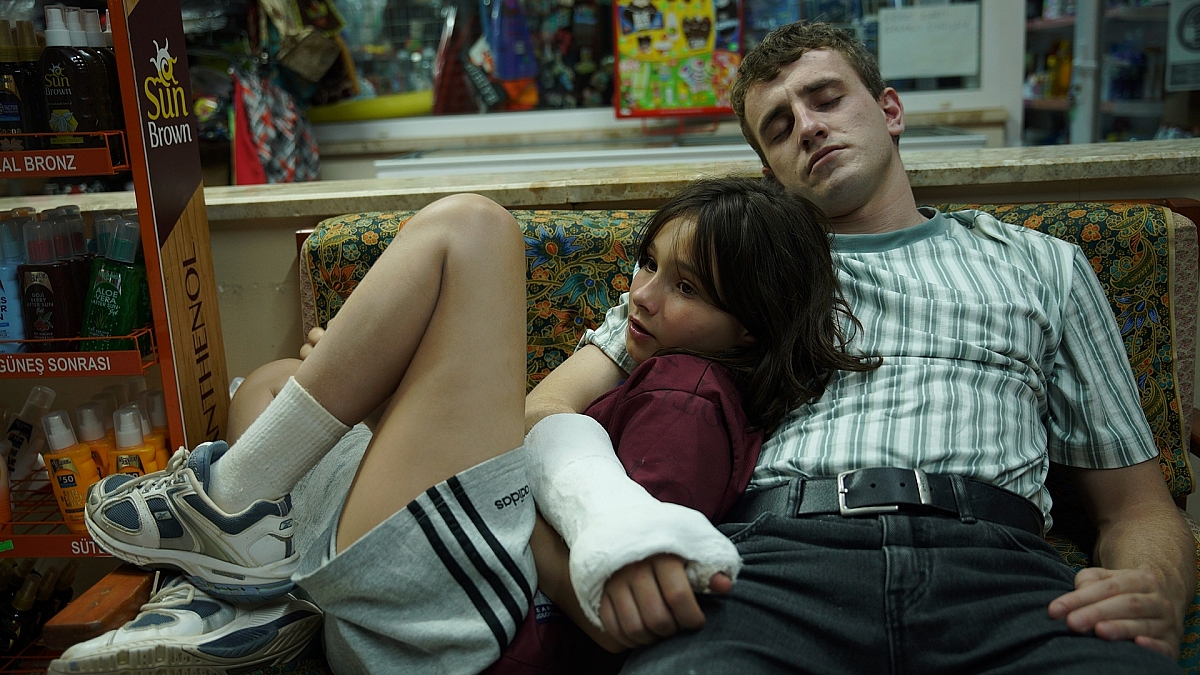
The official still above catches the balance without decoding it. Sophie folds herself against Calum in a shop while he sleeps, his cast lying across them. They are unmistakably close. They are also in different states: she remains alert to the room while he has withdrawn into exhaustion. The image's force comes from refusing to make one fact cancel the other.[4]
That same refusal shapes the painful playback after karaoke night. Calum watches footage in which Sophie presents him as her marvellous father. Her praise is sincere; his inability to receive it is equally sincere. The machine lets the words return after the mood that produced them has changed. Home video becomes emotionally asynchronous: one person speaks from afternoon play, another listens in nighttime despair, and a third—the adult Sophie—will eventually inherit both.
The tape is cruel only because the love on it is not fake. If the holiday were merely a performance, adult Sophie could discard the record as deception. Instead she has to accept that joy can be complete in its moment and still fail to save the people inside it.
The rave begins where the archive ends
The strobe-lit rave is not on the MiniDV cassette. It belongs to adult Sophie's imaginative labor: a dark, crowded space where she repeatedly tries to reach Calum as light breaks their bodies into glimpses. Wells has described the tapes as anchors from which remembered and invented images can grow, and editing as a search for meaning that resembles memory while remaining more fixed than memory ever is.[3]
This is why the rave must look radically unlike the home video. The tape offers duration, sequence, and the stubborn fact of a recorded gaze. The rave offers desire. Adult Sophie can grab for her father there, resist him, embrace him, lose him, and repeat the encounter. It is not evidence about what happened after the holiday. It is the form grief takes when evidence has run out.
The climactic use of “Under Pressure” was itself discovered in the edit rather than built into the original plan; Wells recognized that its emotional directness required an unusually earnest commitment.[5] The sequence makes that commitment through collision. Calum's goofy resort dance and the adult Sophie's desperate reach occupy the same movement. What embarrassed a child becomes the gesture an adult would give anything to enter again.
At the airport, Calum records Sophie walking toward security. She repeatedly turns back, playing for him until she finally disappears. The microphone keeps his breathing close even as his body remains outside the image. When adult Sophie watches, the film reveals that the departing child has been looking into her father's lens and, across the years, into her own eyes.
The recorded footage can take her only that far. After Sophie leaves, the movie imagines Calum lowering the camera, turning away, and walking through doors that open onto the rave. The device that authenticated the holiday is packed away; cinema continues beyond it. That threshold is Aftersun's cleanest statement about memory. An artifact can give imagination somewhere responsible to begin. It cannot tell imagination where to end.
Playback cannot turn a child into a witness
Adult Sophie sees more than she did at eleven, but the film never grants her total hindsight. She can identify patterns, place moments beside one another, and understand that her father's composure cost him effort. She cannot return to the resort as the adult she is now, ask the right question, or make her childhood attention retroactively responsible for his survival.
That boundary is the movie's mercy. Children often perceive distress without possessing its causes or remedies; Wells explicitly distinguishes their sensitivity from an adult capacity to interpret what they notice.[2] Aftersun will not convert Sophie's loving ignorance into guilt. Nor will it turn Calum into a case assembled from symptoms.
The camcorder matters because it preserves the distance between them as faithfully as their closeness. It keeps the face that dodges, the girl who performs, the father who breathes behind the lens, and the moment when a wall finally takes the child out of frame. Playback lets Sophie see those gestures again with a changed mind. It does not let her change the gestures.
The machine remembered first. Sophie gives the memory meaning later. The ache of Aftersun lies in everything that can happen between those two acts.
Sources
- A24, “Aftersun” — official film page with release year, writer-director, principal cast, and synopsis framing adult Sophie's attempt to reconcile the father she knew with the man she did not.
- Adam Nayman, “Postcard from the edge: Charlotte Wells on Aftersun,” Sight and Sound, January 5, 2023 — Wells on the camcorder as a game and literal point of view, children's perception, Calum's concealed distress, performance, and adult hindsight.
- Sogo Hiraiwa, “A Dialogue Between a Father and Daughter Via a Videotape,” TOKION, June 6, 2023 — Wells on Calum avoiding the lens, the camera operator's invisible presence, tape as a memory anchor, editing, fatherhood, and the rave.
- Kodak, “DP Gregory Oke captured the color of memory on 35mm for Charlotte Wells' award-winning Aftersun,” April 4, 2023 — cinematography interview covering 35 mm, MiniDV, point-of-view framing, reflections, production context, and the official A24 still used above.
- Vadim Rizov, “Within Memory: Writer/Director Charlotte Wells on Aftersun,” Filmmaker Magazine, October 20, 2022 — Wells on her shorts, duration, visual collaboration, adult Sophie's framing perspective, editing, and the discovery of “Under Pressure.”
- Charlotte Wells, Aftersun screenplay — primary text for the MiniDV mechanics, hotel television composition, off-camera birthday disclosure, and airport footage.