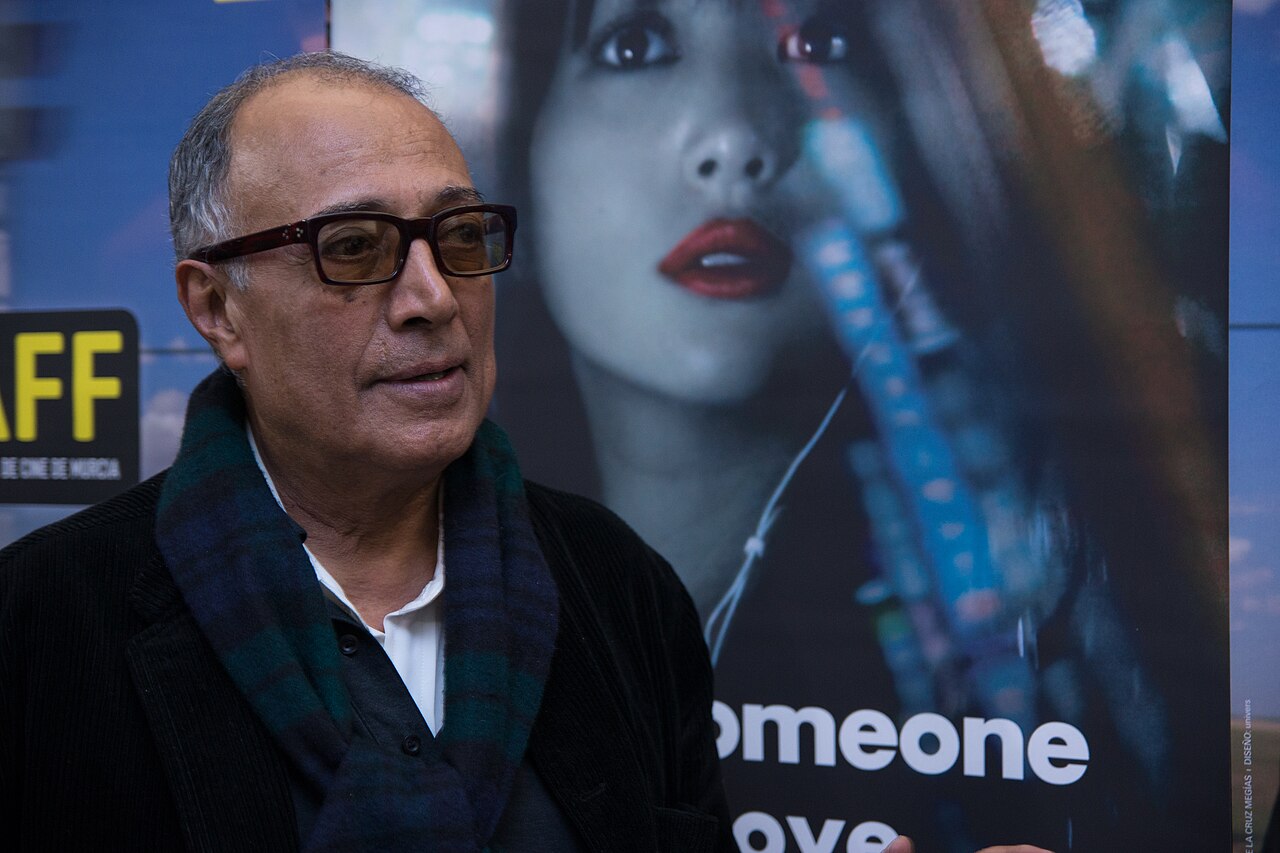
Abbas Kiarostami's films often begin with an action so plain that it can look almost too slight to carry a feature: a child must return a notebook, a man drives through the outskirts of Tehran looking for someone to hear him, a court case becomes a film, a village route becomes a question about what can be known. The modesty is deceptive. Kiarostami's cinema does not shrink drama. It relocates drama into the pressure of attention.
That is why he remains a useful corrective to the idea that film language must announce seriousness through scale. Kiarostami's greatness lies in how little he needs before the world becomes unstable: a road, a face, an unanswered question, a nonprofessional performer, a camera that refuses to fill every gap. His films often feel gentle while they are happening. Afterward they become demanding, because they have quietly handed part of the work to the viewer.
He learned from small moral tasks
The Criterion Channel's Kiarostami program frames his early career through the Institute for the Intellectual Development of Children and Young Adults in Tehran, where small struggles involving children became ways to think about society and ethics.[2] That origin matters because it explains why his later simplicity never feels naive. A child's errand is not a cute premise in Kiarostami. It is a test of social space: which adults listen, which paths are legible, which rules are humane, and where duty becomes heavier than a child can explain.
In Where Is the Friend's House?, the problem is almost laughably concrete: a boy has taken home the wrong notebook and tries to return it before his classmate is punished. The film's power comes from refusing to inflate that premise into melodrama. Instead, the route itself becomes the argument. The child moves through village paths, thresholds, adult interruptions, and repeated misunderstandings. What should be simple keeps becoming socially complicated.
That pattern carries into the director's mature work. Kiarostami does not need a villain to make a world feel difficult. He needs ordinary systems that do not quite hear the person moving through them. The notebook, the road, the court file, the hillside, and the car interior all become ethical instruments. They measure whether attention can survive habit.
The road is never just a road
Kiarostami's cinema is full of movement, but it is rarely the movement of conquest or chase. Roads in his films are thinking machines. They give the camera a reason to travel while refusing the clean arrival that conventional narrative promises. A car conversation can be intimate and evasive at the same time. A winding hillside route can feel documentary in its patience and metaphysical in its repetition.
That is clearest in Taste of Cherry, whose 1997 Palme d'Or at Cannes marked a major moment in the international reception of Iranian cinema.[5] The film follows Mr. Badii as he drives around Tehran's outskirts seeking someone who will help with the aftermath of his planned suicide. The premise could have produced psychological disclosure. Kiarostami does almost the opposite. He keeps the man's interior life partial, lets conversation replace confession, and makes the landscape around the car feel like a moral field.
The restraint is not emptiness. It is structure. By withholding the biographical explanation that another film might treat as mandatory, Kiarostami shifts attention from cause to encounter. What matters is not only why Badii wants to die, but how each passenger receives the request, what kind of speech becomes possible inside the car, and whether the camera can honor suffering without pretending to solve it.
Cinema Iranica's account of Iranian New Wave minimalism helps place this method in a wider tradition: the movement repeatedly used ordinary settings, naturalistic performance, allegory, silence, and moral ambiguity to reach beyond surface realism.[3] Kiarostami is not reducible to that movement, but he gives one of its clearest lessons. Minimalism is not a lack of content. It is a way of making every gesture, pause, and omission carry more weight.
Close-Up turns sympathy into a formal problem
If one film explains why Kiarostami cannot be summarized as simply humane, it is Close-Up. BFI's film page identifies it as a turning point in his career and emphasizes how it blurs documentary and fiction while centering the real case of Hossein Sabzian, who impersonated filmmaker Mohsen Makhmalbaf in his dealings with the Ahankhah family.[1] Kiarostami filmed trial material and had the people involved reenact parts of the story. The result is not a puzzle box designed to trick the viewer. It is a film about why the truth of an event can exceed evidence.
The radical move in Close-Up is that compassion does not arrive after formal experiment. Compassion depends on the experiment. If Kiarostami had made a clean courtroom record, Sabzian might remain a defendant explained by a case file. If he had made a purely fictional drama, the social embarrassment and documentary discomfort might soften into performance. By keeping both modes in contact, the film asks a harder question: what does cinema owe to someone whose deception was itself a desperate attempt to enter cinema?
That question is still sharp because Close-Up refuses easy innocence. Sabzian hurts people. He also reveals a hunger for art, recognition, and dignity that the film treats with unusual seriousness. The Ahankhah family is not reduced to a symbol of class privilege, and Sabzian is not reduced to a lovable dreamer. Kiarostami's gift is to keep them all inside the frame of attention long enough for judgment to become inadequate by itself.
BFI's 2022 poll page for Close-Up also records its high placement among critics and directors, which is not just canon trivia.[1] The ranking suggests that the film's odd hybrid structure has become central to how many viewers now understand modern cinema. It showed that a movie could be fact-based without surrendering to reportage, staged without becoming false, and compassionate without becoming sentimental.
The image remains unfinished on purpose
MoMA's Abbas Kiarostami: Image Maker exhibition is useful because it places him beyond the narrow category of feature filmmaker.[4] The title fits: Kiarostami's films, photographs, and installation work all return to a similar discipline of looking. He does not treat the image as a container that delivers meaning intact. He treats it as an invitation with an ethical cost.
That cost is visible in his endings. Kiarostami often refuses the viewer the satisfaction of final certainty, but his ambiguity is not a fashionable fog. It has a moral function. A sealed ending can let the viewer exit with mastery. An unfinished ending keeps the viewer responsible. Did the person change? Did the gesture matter? Was the story completed, interrupted, or exposed as a story? Kiarostami's best films do not answer by withholding information for its own sake. They answer by making the missing information part of the experience.
This is also why his use of nonprofessional performers and real locations does not feel like a simple authenticity claim. The point is not that reality automatically purifies cinema. Close-Up proves the opposite: reality becomes more complicated once cinema touches it.[1] Kiarostami's realism is porous. It lets fiction enter, lets performance reveal truth, and lets the viewer feel how much any image depends on position, distance, and patience.
Why he still feels contemporary
Kiarostami's influence persists because his cinema anticipated a modern problem without becoming trapped in modern noise. We live among images that claim immediacy, evidence, intimacy, confession, and truth. Kiarostami teaches skepticism without cynicism. He asks the viewer to look longer, to distrust total explanation, and to notice when a frame has made a person too easy to classify.
That lesson is practical for watching films far beyond his own. When a movie explains a character too quickly, Kiarostami reminds us that mystery can be a form of respect. When a documentary treats access as truth, Close-Up reminds us that filming changes the event it records.[1] When minimalism is mistaken for thinness, Taste of Cherry reminds us that a car, a road, a face, and a difficult request can hold enough pressure for an entire philosophy of living.[3][5]
His cinema is not quiet because it has little to say. It is quiet because it understands that some questions become smaller when shouted. Kiarostami made films in which ordinary roads carry impossible questions, and he trusted the viewer enough not to pave those roads all the way to certainty.
Sources
- BFI, "Close-up (1989)" - film page and Geoff Andrew note on Kiarostami's documentary-fiction method, themes, credits, and 2022 poll placement.
- The Criterion Channel, "Directed by Abbas Kiarostami" - program note on Kiarostami's Kanoon beginnings, child-centered ethical stories, and the Koker trilogy context.
- Cinema Iranica, "Poetic Minimalism of Iranian Cinema: Pre-Revolution to New Wave" - context on Iranian New Wave minimalism, allegory, naturalistic performance, and Taste of Cherry.
- The Museum of Modern Art, "Abbas Kiarostami: Image Maker" - exhibition page situating Kiarostami across film, photography, and image practice.
- Festival de Cannes, "Abbas Kiarostami" - official profile noting the 1997 Palme d'Or for Taste of Cherry and other festival honors.
- Wikimedia Commons, "File:Abbas Kiarostami-Murcia.jpg" - 2013 photograph by Pedro J Pacheco used as the article image source.