Chris Marker's Sans Soleil is often introduced by category because it refuses the usual shelter of plot: documentary, essay film, travelogue, cine-letter, memory machine. Criterion Channel calls it a free-form travelogue moving from Africa to Japan, while Harvard Film Archive describes it as a meditation on memory, place, and image built through a lonely traveling cameraman's letters from Africa and Japan.[1][2] Both descriptions are useful. Neither quite catches the film's sharper trick. Sans Soleil does not merely remember places. It makes remembering feel like an itinerary whose stops can be revisited but not recovered.
That is why the film still feels contemporary without depending on topical novelty. Its materials are recognizably late twentieth-century: ferry passengers in Hokkaido, Tokyo commuters, cat shrines, Guinea-Bissau, Cape Verde, Iceland, San Francisco, images from television, and electronic transformations inside the Zone.[1][2][4] But the structure feels uncannily close to how image memory works now. A place appears. A voice attaches thought to it. The image is filed beside other images that do not belong to the same trip, decade, politics, or emotional register. Meaning arrives through contact, not through a clean argument.
The Letter Form Keeps The Film Intimate And Uncatchable
The film's most important formal decision is that the images are not presented as direct authorial testimony. A woman reads letters from the fictional cameraman Sandor Krasna, a mask that lets Marker approach confession without surrendering to autobiography.[1][2][3] The BFI programme note catches the effect well when it emphasizes the film's sly tone and its collapse of distance between screen image, soundtrack thought, and viewer.[4]
That indirection changes the ethics of the travel film. A conventional travelogue often asks the viewer to trust that the camera has gone somewhere and brought back knowledge. Sans Soleil asks something more difficult: what if travel produces images before it produces knowledge? What if the person who was there still has to invent a form for what the images mean later? The narrator is not simply explaining the footage. She is staging the interval between event and recollection.
The opening Iceland memory sets the rule. The film begins with an image of children on a road, then admits that the image could not be joined easily to other images.[5] In ordinary editing, a shot proves its worth by fitting into sequence. Marker makes a shot important because it resists sequence. Happiness appears not as a story beat but as a fragment that refuses to become available on command.
Tokyo Is Not Exotic Background
The Tokyo passages are sometimes remembered as the film's most seductive surface: trains, television, shrines, department stores, people sleeping in transit, and rituals of ordinary attention. The danger is to treat them as stylish estrangement, as if Japan were mainly a theater of visual difference. Harvard's program note is more precise when it says the film transforms modern Japan into a metaphor for a mediated image world.[2] The point is not that Tokyo is unreal. The point is that Tokyo gives Marker a place where images, public rituals, private fatigue, and electronic culture are already visibly entangled.
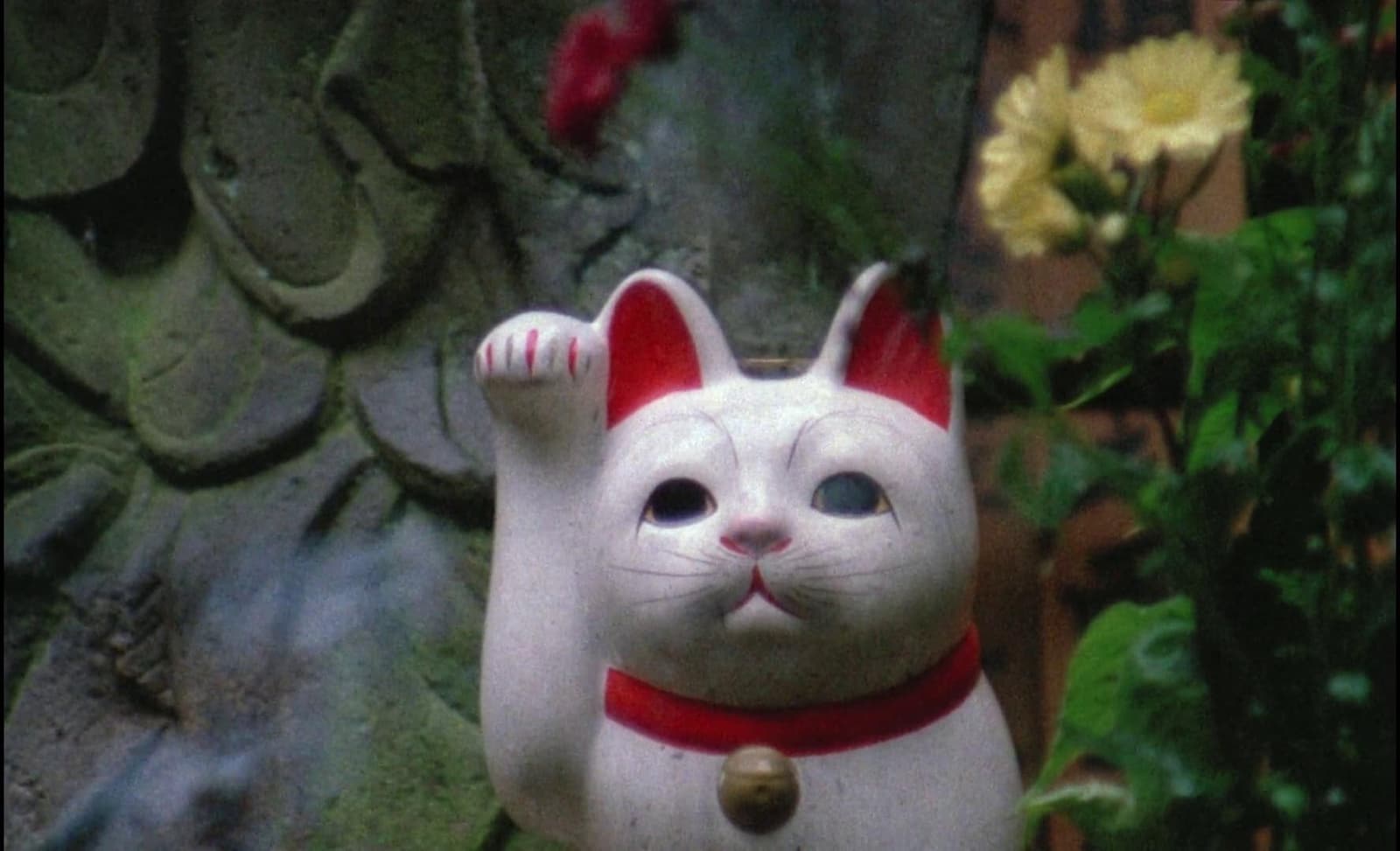
The cat material is a good example. Marker does not turn the cat shrine into a simple cultural explanation. The transcripted narration lingers on the couple placing an inscribed wooden slat for a lost cat, a ritual act that joins affection, death, naming, and future uncertainty.[5] The white cat figurine in the cover image belongs to that wider field. It is not a mascot. It is a small object through which the film asks how feeling becomes externalized: written down, offered, photographed, and then carried into another viewer's memory.
The same logic governs the sleeping commuters. They are not illustrations of modern alienation in the lazy sense. They are bodies suspended between schedules. Marker is fascinated by travel states because they loosen identity: ferry, train, airport, street, shrine, bar, television screen. People become briefly available to the camera, but not possessed by it. The film's grace lies in knowing the difference.
Africa Is History, Not Counterpoint
The film's movement through Guinea-Bissau and Cape Verde can be misread if it is treated only as a contrast with Japan. Walker Art Center's note is useful because it describes the film as an experimental travelogue that interweaves documentary footage, stock images, and fictional film excerpts across Guinea-Bissau, Iceland, and Japan while probing memory's complexity.[3] That framing matters. These images are not decorative evidence from elsewhere. They carry the afterlife of anti-colonial struggle, incomplete revolution, and the problem of who gets to preserve political memory.
This is where the film's method becomes more than lyrical wandering. Marker places personal memory beside historical memory and refuses to let either one become stable. The narrator can return to an image, but the return does not repair history. The film can remember liberation movements, but remembering does not guarantee political victory. It can place Africa and Japan in one essay, but the connection is not a thesis that erases their differences.
That refusal is one reason the film's montage still has force. It does not flatter the viewer with mastery. Instead, it teaches a rhythm of partial relation. A Tokyo ritual may sit near an African political memory; a ferry image may suggest war; a San Francisco street may reopen Hitchcock's Vertigo; a television image may become more intimate than a diary.[2][3][5] The film's intelligence lies in making those relations felt without pretending they settle into a map.
The Vertigo Pilgrimage Shows Memory As Reenactment
The San Francisco passages are among the film's clearest statements about cinephilia. Marker returns to the city through Vertigo, a film he had repeatedly watched and mentally inhabited.[5] This is not fan tourism in the modern checklist sense. He is not hunting locations to prove that cinema touched the real city. He is asking what happens when the remembered film becomes part of the real city's surface.
That question sharpens the whole essay. Memory is never pure recollection in Sans Soleil. It is reenactment, overlay, substitution, displacement. San Francisco is San Francisco, but it is also Hitchcock's San Francisco, Marker's remembered San Francisco, and the viewer's newly edited San Francisco. The city becomes legible through repetitions that are emotionally true and factually unstable at the same time.
This is why Sans Soleil belongs with cinema rather than illustrated philosophy. The film thinks in shots. It understands that an image can be documentary evidence, fantasy trigger, political trace, and private souvenir at once. It also understands that editing does not simply organize these functions. Editing reveals that they were never separate.
The Zone Makes Image Damage Visible
The film's electronic image-processing sequences, associated with the Zone, can look quaint if treated only as early video manipulation. They are more than a period effect. Harvard calls Sans soleil a bridge between Marker's earlier travel films and his growing interest in media and technology.[2] The Zone is where that bridge becomes visible. Images are altered until their documentary surface is wounded, recolored, or made spectral.
The key is that the Zone does not destroy memory. It exposes memory's condition. A remembered image is already processed by desire, loss, repetition, and later knowledge. The electronic image merely makes that processing visible. Where ordinary documentary may hide its transformations under continuity, Sans Soleil lets transformation become the subject.
That is why the film's reputation as one of the central documentaries remains deserved but slightly misleading. BFI's 2014 Sight and Sound poll ranked Sans soleil third among the greatest documentaries, which confirms its canonical weight.[6] Yet the film's greatness partly comes from pressuring the documentary category until it admits what it cannot guarantee: stable voice, stable evidence, stable witness, stable memory.
A Film About Keeping What Cannot Be Kept
The most moving thing about Sans Soleil is that it does not solve the sadness it keeps circling. It knows that images preserve and betray at the same time. They keep the children on the Icelandic road visible, but not recoverable. They bring Tokyo rituals close, but not fully translatable. They hold fragments of Guinea-Bissau's political history, but not the total experience of struggle. They let Marker revisit Vertigo, but only as another layer of loss.[3][5]
That is the film's quiet discipline. It does not ask the viewer to choose between memory and history, travel and politics, intimacy and distance, image and text. It asks the viewer to notice how each term changes the others. A letter makes an image personal. A cut makes a place comparative. A processed frame makes documentary unstable. A remembered film makes a city haunted by another film.
In a simpler movie, the scattered route would be a weakness. In Sans Soleil, the route is the argument. Memory does not live in a vault. It moves by ferry, shrine, archive, screen, voice, quotation, and return. Marker edits that movement without pretending to own it. The film's gift is not that it captures the world. It shows how the world survives in fragments after capture has failed.
Sources
- The Criterion Channel, "Sans Soleil" - film page with director, year, country, travelogue framing, and available supplements.
- Harvard Film Archive, "Sans soleil" (2013 programme note) - screening details, 16mm print context, and essay-film description.
- Walker Art Center, "Sans Soleil by Chris Marker" - programme note on the experimental travelogue, documentary and fictional materials, locations, and anonymous narrator.
- BFI Southbank Programme Notes, "Sans soleil" - programme note on the film's time-and-space-hopping travelogue structure, tone, and relation between images and soundtrack.
- Chris Marker, "Sans Soleil / Sunless" transcript at markertext.com - reference text for the film's letter narration, Iceland opening, Tokyo passages, and San Francisco memory.
- BFI, "Critics' 50 Greatest Documentaries of All Time," Sight and Sound - 2014 poll listing Sans soleil at number 3.
- FilmGrab, "Sans Soleil" - source page for the downloaded photographic film still used as the article image.